Leeds Institute of Rheumatic and Musculoskeletal Disease, University of Leeds, Leeds, UK.
NIHR Leeds Biomedical Research Centre, Leeds Teaching Hospitals NHS Trust, Leeds, UK.
RMD Open. 2024 Apr 10;10(2):e003927. doi: 10.1136/rmdopen-2023-003927.
To investigate the role of third-generation anticyclic citrullinated peptide (anti-CCP3) antibodies in predicting progression to inflammatory arthritis (IA) in individuals with new musculoskeletal (MSK) symptoms and a negative second-generation anti-CCP antibody test (anti-CCP2-).
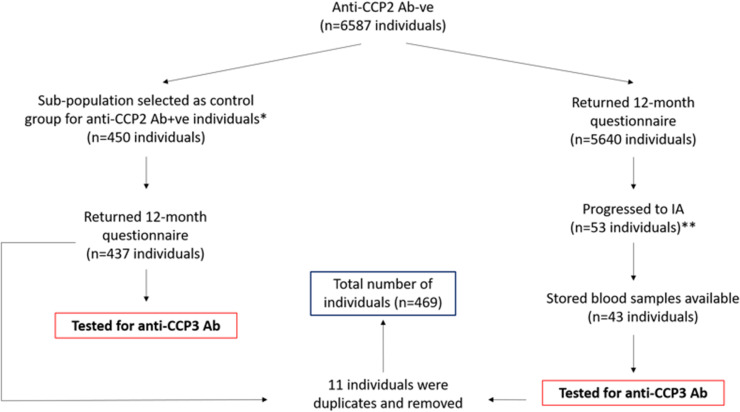
469 anti-CCP2- individuals underwent baseline anti-CCP3 testing (QUANTA Lite CCP3; Inova Diagnostics) and received a post enrolment 12-month questionnaire. A rheumatologist confirmed or excluded diagnosis of IA. Univariable/multivariable analyses were performed to assess the value of anti-CCP3 in predicting IA development in these anti-CCP2- individuals.
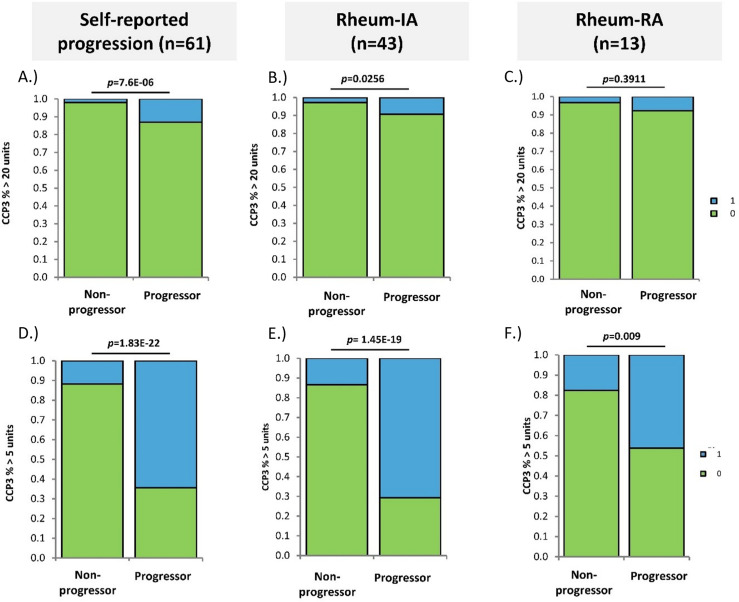
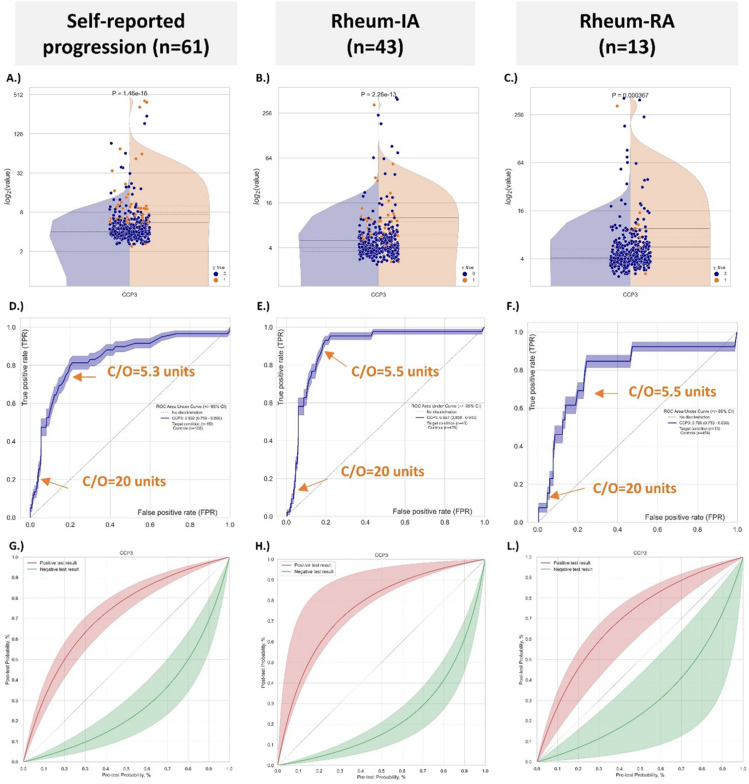
Only 16/469 (3.4%) anti-CCP2- individuals had a positive anti-CCP3 test. Of these 16 individuals, 4 developed IA. In addition, 61/469 (13.0%) anti-CCP2- individuals self-reported, to have developed, IA. Progression was confirmed in 43/61 of them (70.5%); of whom 30/43 (69.8%) and 13/43 (30.2%) were given a diagnosis of IA and rheumatoid arthritis (RA), respectively. In qualitative univariable analysis, anti-CCP3 positivity was associated with self-reported progression (p<0.01) and IA (p=0.03), but not with RA. Anti-CCP3 levels differed significantly between progressors and non-progressors (p<0.01) for all three categories. At the manufacturer's cut-off, OR for progression ranged from 2.4 (95% CI 0.5 to 18.6; RA) to 7.5 (95% CI 2.3 to 24.0; self-reported progression). Interestingly, when cut-offs for anti-CCP3 were optimised, lower values (≥5 units) significantly increased the OR for progression in all three categories. In multivariable analysis, anti-CCP3 positivity at the manufacturer's cut-off did not remain associated with IA progression, while this lower cut-off value (≥5 units) was associated with diagnosis of RA (p=0.02).
Anti-CCP3 testing could improve the prediction of IA development in anti-CCP2- individuals with new MSK symptoms.
研究第三代环瓜氨酸肽(抗-CCP3)抗体在预测新出现的肌肉骨骼(MSK)症状且第二代抗 CCP 抗体检测(抗-CCP2-)阴性的个体中发展为炎症性关节炎(IA)中的作用。
469 名抗-CCP2-个体进行了基线抗-CCP3 检测(QUANTA Lite CCP3;Inova Diagnostics),并在入组后 12 个月接受了问卷调查。一名风湿病学家确认或排除了 IA 的诊断。对单变量/多变量分析进行了评估,以评估抗-CCP3 在预测这些抗-CCP2-个体中 IA 发展方面的价值。
在 469 名抗-CCP2-个体中,仅有 16 名(3.4%)的抗-CCP3 检测呈阳性。这 16 名个体中,有 4 名发展为 IA。此外,61 名抗-CCP2-个体自述出现了 IA。在他们中,43 名(70.5%)被确诊为 IA,其中 30 名(69.8%)和 13 名(30.2%)分别被诊断为 IA 和类风湿关节炎(RA)。在定性单变量分析中,抗-CCP3 阳性与自述进展(p<0.01)和 IA(p=0.03)相关,但与 RA 不相关。在所有三个类别中,进展者和非进展者的抗-CCP3 水平差异显著(p<0.01)。在制造商的截止值处,进展的 OR 范围为 2.4(95%CI 0.5 至 18.6;RA)至 7.5(95%CI 2.3 至 24.0;自述进展)。有趣的是,当优化抗-CCP3 的截止值时,所有三个类别的较低值(≥5 单位)显著增加了进展的 OR。在多变量分析中,制造商截止值处的抗-CCP3 阳性与 IA 进展不再相关,而较低的截止值(≥5 单位)与 RA 诊断相关(p=0.02)。
抗-CCP3 检测可提高对新出现的 MSK 症状且抗-CCP2-个体中 IA 发展的预测。