
重复脉冲波超声刺激通过影响星形胶质细胞来调节周围γ-氨基丁酸(GABA)水平,从而抑制神经活动。
Repetitive pulsed-wave ultrasound stimulation suppresses neural activity by modulating ambient GABA levels via effects on astrocytes.
作者信息
Mishima Tatsuya, Komano Kenta, Tabaru Marie, Kofuji Takefumi, Saito Ayako, Ugawa Yoshikazu, Terao Yasuo
机构信息
Department of Medical Physiology, Kyorin University School of Medicine, Mitaka, Japan.
Institute of Innovative Research, Tokyo Institute of Technology, Yokohama, Japan.
出版信息
Front Cell Neurosci. 2024 Mar 27;18:1361242. doi: 10.3389/fncel.2024.1361242. eCollection 2024.
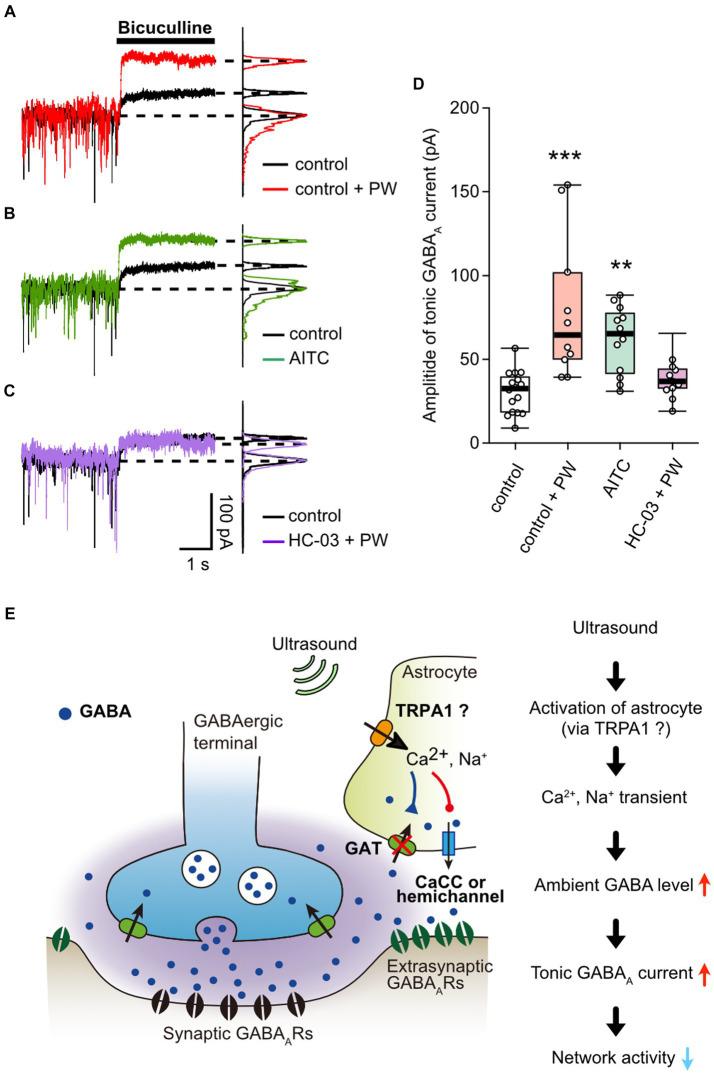
Ultrasound is highly biopermeable and can non-invasively penetrate deep into the brain. Stimulation with patterned low-intensity ultrasound can induce sustained inhibition of neural activity in humans and animals, with potential implications for research and therapeutics. Although mechanosensitive channels are involved, the cellular and molecular mechanisms underlying neuromodulation by ultrasound remain unknown. To investigate the mechanism of action of ultrasound stimulation, we studied the effects of two types of patterned ultrasound on synaptic transmission and neural network activity using whole-cell recordings in primary cultured hippocampal cells. Single-shot pulsed-wave (PW) or continuous-wave (CW) ultrasound had no effect on neural activity. By contrast, although repetitive CW stimulation also had no effect, repetitive PW stimulation persistently reduced spontaneous recurrent burst firing. This inhibitory effect was dependent on extrasynaptic-but not synaptic-GABA receptors, and the effect was abolished under astrocyte-free conditions. Pharmacological activation of astrocytic TRPA1 channels mimicked the effects of ultrasound by increasing the tonic GABA current induced by ambient GABA. Pharmacological blockade of TRPA1 channels abolished the inhibitory effect of ultrasound. These findings suggest that the repetitive PW low-intensity ultrasound used in our study does not have a direct effect on neural function but instead exerts its sustained neuromodulatory effect through modulation of ambient GABA levels via channels with characteristics of TRPA1, which is expressed in astrocytes.
超声具有高度的生物渗透性,能够无创地深入穿透大脑。用模式化低强度超声进行刺激可在人类和动物中诱导神经活动的持续抑制,这对研究和治疗具有潜在意义。尽管机械敏感通道参与其中,但超声神经调节的细胞和分子机制仍不清楚。为了研究超声刺激的作用机制,我们在原代培养的海马细胞中使用全细胞膜片钳记录技术,研究了两种模式化超声对突触传递和神经网络活动的影响。单次脉冲波(PW)或连续波(CW)超声对神经活动没有影响。相比之下,尽管重复的连续波刺激也没有影响,但重复的脉冲波刺激持续减少了自发的爆发式放电。这种抑制作用依赖于突触外而非突触的GABA受体,并且在无星形胶质细胞的条件下这种作用消失。星形胶质细胞TRPA1通道的药理学激活通过增加环境GABA诱导的强直GABA电流模拟了超声的作用。TRPA1通道的药理学阻断消除了超声的抑制作用。这些发现表明,我们研究中使用的重复脉冲波低强度超声对神经功能没有直接影响,而是通过具有TRPA1特征的通道调节环境GABA水平,从而发挥其持续的神经调节作用,TRPA1在星形胶质细胞中表达。


 Zotero 插件