Department of Medicine, Division of General Internal Medicine, University of Pittsburgh, Pittsburgh, Pennsylvania.
Division of General Medicine, Beth Israel Deaconess Medical Center, Boston, Massachusetts.
JAMA Health Forum. 2024 Apr 5;5(4):e240417. doi: 10.1001/jamahealthforum.2024.0417.
In 2013, Medicare implemented payments for transitional care management (TCM) services, which provide increased reimbursement to clinicians providing ambulatory care to patients after discharge from medical facilities to the community.
To determine whether the introduction of TCM payments was associated with an increase in timely postdischarge follow-up.
DESIGN, SETTING, AND PARTICIPANTS: This cross-sectional interrupted time-series study assessed quarterly postdischarge visit rates before (2010-2012) and after (2013-2019) TCM implementation 100% sample of Medicare fee-for-service beneficiaries discharged to the community after a hospital or skilled nursing facility stay. Data analyses were performed February 1 to December 15, 2023.
Implementation of payments for TCM.
Timely postdischarge primary care follow-up, defined as receipt of a primary care ambulatory visit within 14 days of discharge. Secondary outcomes included receipt of a TCM visit and specialty care follow-up.
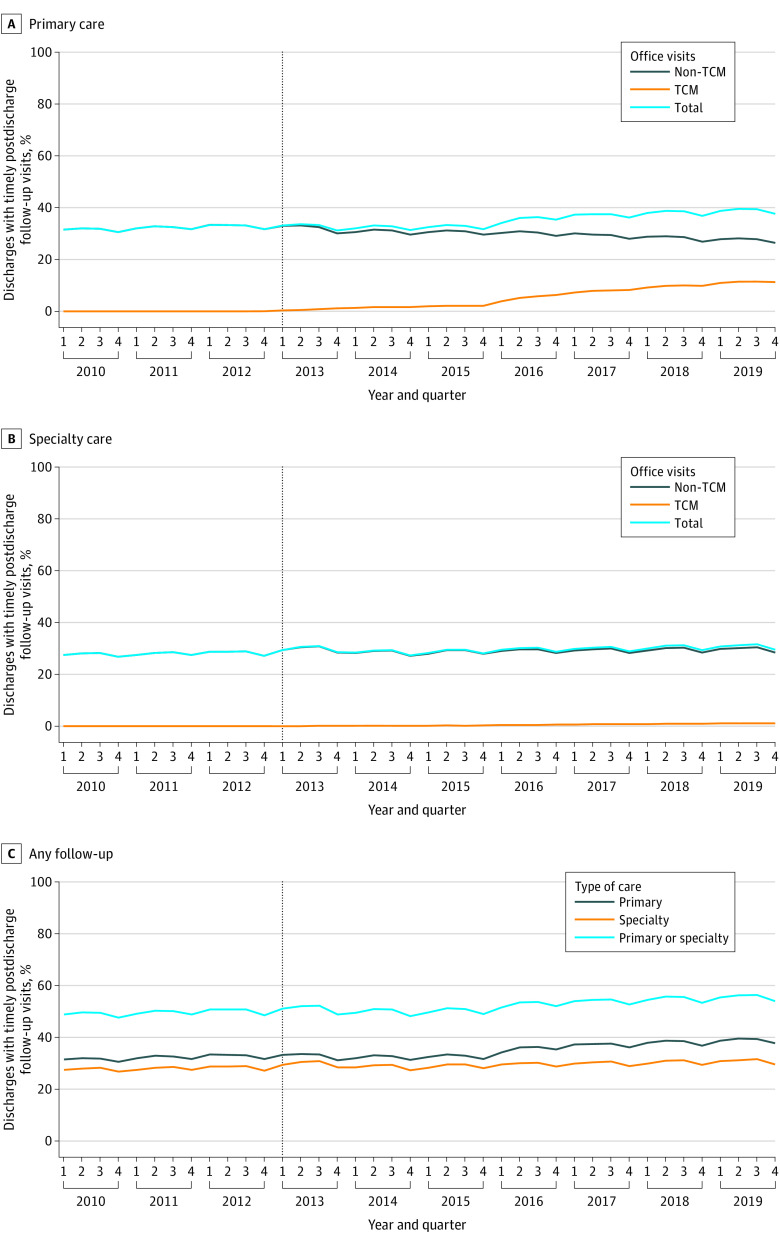
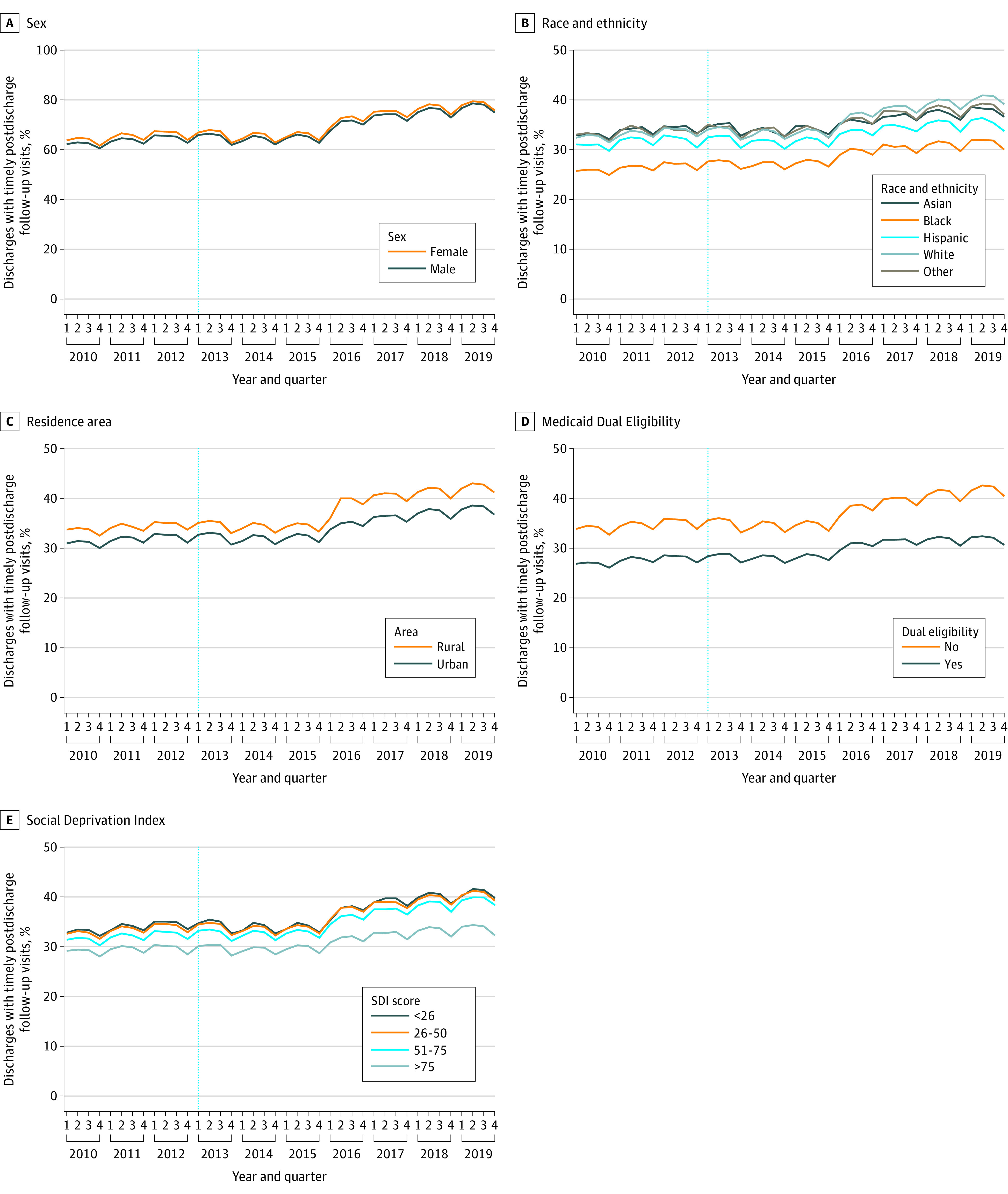
The study sample comprised 79 125 965 eligible discharges. Of these, 55.4% were female; 1.5% were Asian, 12.1% Black, 5.6% Hispanic, and 79.0% were White individuals; and 79.6% were beneficiaries aged 65 years and older. Timely primary care follow-up increased from 31.5% in 2010 to 38.8% in 2019 (absolute increase 7.3%), whereas specialist follow-up increased from 27.6% to 30.8% (absolute increase 3.2%). By 2019, 11.3% of eligible patients received TCM services. Interrupted time-series analyses demonstrated an increased slope of timely primary care follow-up after the introduction of TCM services (pre-TCM slope, 0.12% per quarter vs post-TCM slope, 0.29% per quarter; difference, 0.13%; 95% CI, 0.02% to 0.22%). Receipt of timely follow-up increased for all demographic groups; however, Black, Hispanic, and Medicaid dual-eligible patients and patients residing in urban areas and counties with high-level social deprivation were less likely to receive follow-up during the study period. These disparities widened for Black patients (difference-in-differences in pre-TCM vs post-TCM slope, -0.14%; 95% CI, -0.25% to -0.2%) and patients who were Medicaid dual-eligible (difference-in-differences pre-TCM vs post-TCM slope, -0.21%; 95% CI, -0.35% to -0.07%).
These findings indicate that Medicare's introduction of payments for TCM services was associated with a persistent increase in the rate of timely postdischarge primary care but did not narrow demographic or socioeconomic disparities. Most beneficiaries did not receive timely primary care follow-up.
重要性:2013 年,医疗保险开始支付过渡性护理管理(TCM)服务费用,这为向从医疗机构出院到社区的患者提供门诊护理的临床医生增加了报销。
目的:确定 TCM 支付的引入是否与出院后及时随访的增加有关。
设计、设置和参与者:这项横断面中断时间序列研究评估了医疗保险按服务收费受益人的出院后季度随访率,这些患者在出院前(2010-2012 年)和之后(2013-2019 年)接受了 TCM 服务。该研究的样本包括 100%接受过住院或熟练护理机构治疗后出院到社区的医疗保险按服务收费受益人群。数据分析于 2023 年 2 月 1 日至 12 月 15 日进行。
暴露:TCM 服务支付的实施。
主要结果和测量:及时进行出院后的初级保健随访,定义为在出院后 14 天内接受初级保健门诊就诊。次要结果包括接受 TCM 就诊和专科护理随访。
结果:研究样本包括 79125965 名符合条件的出院患者。其中,55.4%为女性;1.5%为亚洲人,12.1%为黑人,5.6%为西班牙裔,79.0%为白人;79.6%为 65 岁及以上的受益人。及时进行初级保健随访的比例从 2010 年的 31.5%增加到 2019 年的 38.8%(绝对增加 7.3%),而专科随访的比例从 27.6%增加到 30.8%(绝对增加 3.2%)。到 2019 年,11.3%的符合条件的患者接受了 TCM 服务。中断时间序列分析显示,在引入 TCM 服务后,及时进行初级保健随访的斜率增加(TCM 服务前斜率为每季度 0.12%,TCM 服务后斜率为每季度 0.29%;差异为 0.13%;95%置信区间为 0.02%至 0.22%)。所有人群的及时随访率都有所增加;然而,黑人、西班牙裔和医疗补助双重合格患者以及居住在城市地区和社会剥夺程度较高的县的患者在研究期间不太可能接受随访。对于黑人患者(TCM 服务前与后斜率的差异,-0.14%;95%置信区间,-0.25%至-0.2%)和医疗补助双重合格患者(TCM 服务前与后斜率的差异,-0.21%;95%置信区间,-0.35%至-0.07%),这些差异有所扩大。
结论:这些发现表明,医疗保险引入 TCM 服务支付与及时出院后初级保健率的持续增加有关,但并未缩小人口统计学或社会经济差距。大多数受益人没有得到及时的初级保健随访。