Bey Romain, Cohen Ariel, Trebossen Vincent, Dura Basile, Geoffroy Pierre-Alexis, Jean Charline, Landman Benjamin, Petit-Jean Thomas, Chatellier Gilles, Sallah Kankoe, Tannier Xavier, Bourmaud Aurelie, Delorme Richard
Innovation and Data unit, IT Department, Assistance Publique-Hôpitaux de Paris, Paris, France.
Child and Adolescent Psychiatry Department, Robert Debré University Hospital, Assistance Publique-Hôpitaux de Paris, Paris, France.
Npj Ment Health Res. 2024 Feb 14;3(1):6. doi: 10.1038/s44184-023-00046-7.
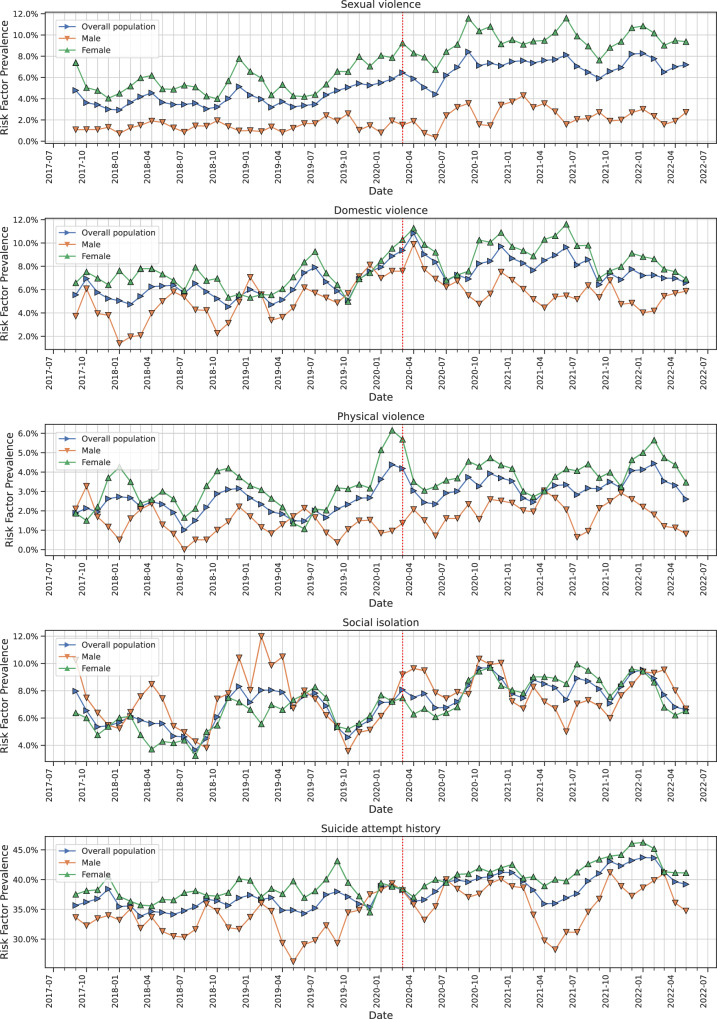
There is an urgent need to monitor the mental health of large populations, especially during crises such as the COVID-19 pandemic, to timely identify the most at-risk subgroups and to design targeted prevention campaigns. We therefore developed and validated surveillance indicators related to suicidality: the monthly number of hospitalisations caused by suicide attempts and the prevalence among them of five known risks factors. They were automatically computed analysing the electronic health records of fifteen university hospitals of the Paris area, France, using natural language processing algorithms based on artificial intelligence. We evaluated the relevance of these indicators conducting a retrospective cohort study. Considering 2,911,920 records contained in a common data warehouse, we tested for changes after the pandemic outbreak in the slope of the monthly number of suicide attempts by conducting an interrupted time-series analysis. We segmented the assessment time in two sub-periods: before (August 1, 2017, to February 29, 2020) and during (March 1, 2020, to June 31, 2022) the COVID-19 pandemic. We detected 14,023 hospitalisations caused by suicide attempts. Their monthly number accelerated after the COVID-19 outbreak with an estimated trend variation reaching 3.7 (95%CI 2.1-5.3), mainly driven by an increase among girls aged 8-17 (trend variation 1.8, 95%CI 1.2-2.5). After the pandemic outbreak, acts of domestic, physical and sexual violence were more often reported (prevalence ratios: 1.3, 95%CI 1.16-1.48; 1.3, 95%CI 1.10-1.64 and 1.7, 95%CI 1.48-1.98), fewer patients died (p = 0.007) and stays were shorter (p < 0.001). Our study demonstrates that textual clinical data collected in multiple hospitals can be jointly analysed to compute timely indicators describing mental health conditions of populations. Our findings also highlight the need to better take into account the violence imposed on women, especially at early ages and in the aftermath of the COVID-19 pandemic.
迫切需要对大量人群的心理健康进行监测,尤其是在诸如新冠疫情等危机期间,以便及时识别出风险最高的亚群体,并设计针对性的预防活动。因此,我们开发并验证了与自杀倾向相关的监测指标:自杀未遂导致的每月住院人数以及其中五种已知风险因素的患病率。这些指标是通过基于人工智能的自然语言处理算法,对法国巴黎地区15家大学医院的电子健康记录进行分析自动计算得出的。我们通过开展一项回顾性队列研究来评估这些指标的相关性。考虑到一个通用数据仓库中包含的2911920条记录,我们通过进行中断时间序列分析,测试了疫情爆发后自杀未遂每月数量的斜率变化。我们将评估时间分为两个子时期:新冠疫情之前(2017年8月1日至2020年2月29日)和期间(2020年3月1日至2022年6月31日)。我们检测到14023例因自杀未遂导致的住院病例。新冠疫情爆发后,其每月数量加速上升,估计趋势变化达到3.7(95%置信区间2.1 - 5.3),主要由8 - 17岁女孩数量增加所驱动(趋势变化1.8,95%置信区间1.2 - 2.5)。疫情爆发后,家庭、身体和性暴力行为的报告更为频繁(患病率比值:1.3,95%置信区间1.16 - 1.48;1.3,95%置信区间1.10 - 1.64和1.7,95%置信区间1.48 - 1.98),死亡患者减少(p = 0.007)且住院时间缩短(p < 0.001)。我们的研究表明,可以对多家医院收集的文本临床数据进行联合分析,以及时计算出描述人群心理健康状况的指标。我们的研究结果还凸显了更好地考虑对女性施加的暴力行为的必要性,尤其是在幼年时期以及新冠疫情之后。