Naka Sadahiro, Ooe Kazuhiro, Shirakami Yoshifumi, Kurimoto Kenta, Sakai Toshihiro, Takahashi Kazuhiro, Toyoshima Atsushi, Wang Yang, Haba Hiromitsu, Kato Hiroki, Tomiyama Noriyuki, Watabe Tadashi
Department of Nuclear Medicine and Tracer Kinetics, Osaka University Graduate School of Medicine, 2-2 Yamadaoka, Suita, Osaka, 565-0871, Japan.
Department of Pharmacy, Osaka University Hospital, 2-15 Yamadaoka, Suita, Osaka, 565-0871, Japan.
EJNMMI Radiopharm Chem. 2024 Apr 15;9(1):29. doi: 10.1186/s41181-024-00257-z.
The alpha emitter astatine-211 (At) is garnering attention as a novel targeted alpha therapy for patients with refractory thyroid cancer resistant to conventional therapy using beta emitter radioiodine (I). Herein, we aimed to establish a robust method for the manufacturing and quality control of [At]NaAt solution for intravenous administration under the good manufacturing practice guidelines for investigational products to conduct an investigator-initiated clinical trial.
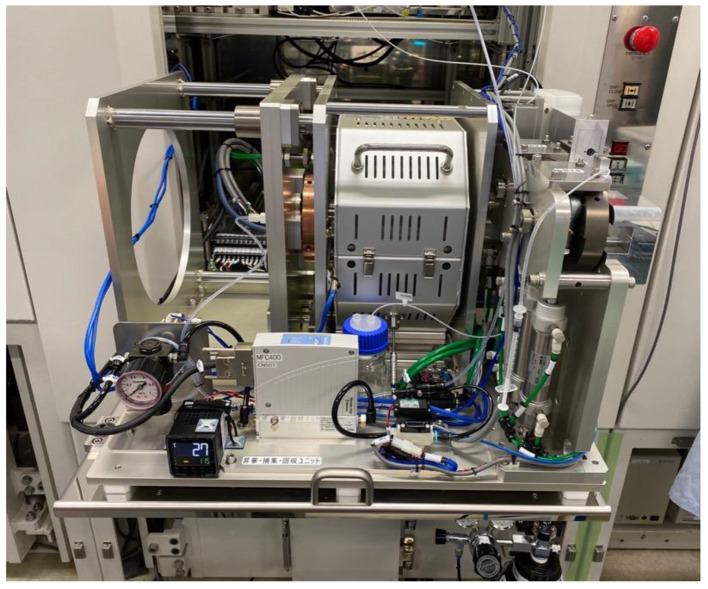
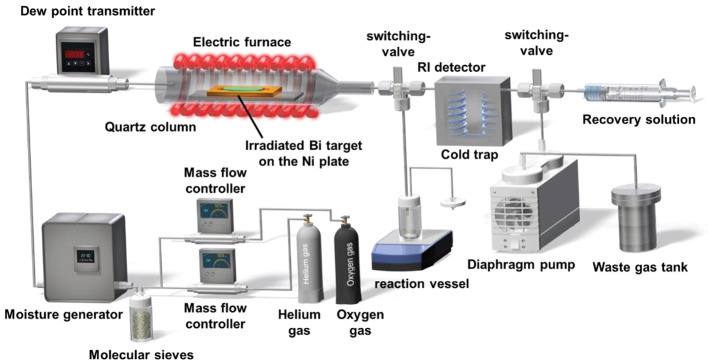
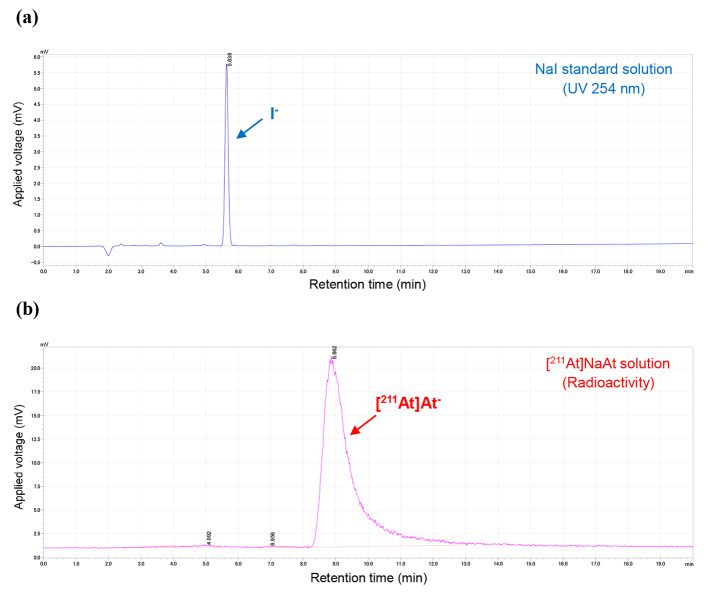
At was separated and purified via dry distillation using irradiated Bi plates containing At obtained by the nuclear reaction of Bi(He, 2n)At. After purification, the At trapped in the cold trap was collected in a reaction vessel using 15 mL recovery solution (1% ascorbic acid and 2.3% sodium hydrogen carbonate). After stirring the At solution for 1 h inside a closed system, the reaction solution was passed through a sterile 0.22 μm filter placed in a Grade A controlled area and collected in a product vial to prepare the [At]NaAt solution. According to the 3-lot tests, decay collected radioactivity and radiochemical yield of [At]NaAt were 78.8 ± 6.0 MBq and 40 ± 3%, respectively. The radiochemical purity of [At]At obtained via ion-pair chromatography at the end of synthesis (EOS) was 97 ± 1%, and remained > 96% 6 h after EOS; it was detected at a retention time (RT) 3.2-3.3 min + RT of I. LC-MS analysis indicated that this principal peak corresponded with an astatide ion (m/z = 210.988046). In gamma-ray spectrometry, the At-related peaks were identified (X-ray: 76.9, 79.3, 89.3, 89.8, and 92.3 keV; γ-ray: 569.7 and 687.0 keV), whereas the peak at 245.31 keV derived from At was not detected during the 22 h continuous measurement. The target material, Bi, was below the 9 ng/mL detection limit in all lots of the finished product. The pH of the [At]NaAt solution was 7.9-8.6; the concentration of ascorbic acid was 9-10 mg/mL. Other quality control tests, including endotoxin and sterility tests, confirmed that the [At]NaAt solution met all quality standards.
We successfully established a stable method of [At]NaAt solution that can be administered to humans intravenously as an investigational product.
α发射体砹-211(At)作为一种新型的靶向α疗法,正受到关注,用于治疗对使用β发射体放射性碘(I)的传统疗法耐药的难治性甲状腺癌患者。在此,我们旨在根据研究产品的良好生产规范指南,建立一种稳健的方法,用于制备静脉注射用[At]NaAt溶液的生产和质量控制,以开展一项研究者发起的临床试验。
通过对含铋(Bi)板进行干馏来分离和纯化At,该含铋板通过Bi(He,2n)At核反应获得,其中含有At。纯化后,捕获在冷阱中的At使用15 mL回收溶液(1%抗坏血酸和2.3%碳酸氢钠)收集到反应容器中。在封闭系统中将At溶液搅拌1小时后,反应溶液通过置于A级控制区域的无菌0.22μm过滤器,并收集到产品小瓶中,以制备[At]NaAt溶液。根据三批次测试,[At]NaAt的衰变收集放射性和放射化学产率分别为78.8±6.0 MBq和40±3%。合成结束时(EOS)通过离子对色谱法获得的[At]At的放射化学纯度为97±1%,EOS后6小时仍>96%;在保留时间(RT)3.2 - 3.3分钟 + I的RT处检测到。液相色谱 - 质谱分析表明,该主峰对应于砹化物离子(m/z = 210.988046)。在γ射线能谱分析中,鉴定出了与At相关的峰(X射线:76.9、79.3、89.3、89.8和92.3 keV;γ射线:569.7和687.0 keV),而在22小时连续测量期间未检测到源自At的245.31 keV处的峰。目标物质Bi在所有成品批次中的含量均低于9 ng/mL的检测限。[At]NaAt溶液的pH为7.9 - 8.6;抗坏血酸浓度为9 - 10 mg/mL。其他质量控制测试,包括内毒素和无菌测试,证实[At]NaAt溶液符合所有质量标准。
我们成功建立了一种稳定的[At]NaAt溶液制备方法,该溶液可作为研究产品静脉注射给人类。