Department of Chemistry and the Henry Eyring Center for Cell and Genome Science, University of Utah, Salt Lake City, UT 84112, United States.
ISME J. 2024 Jan 8;18(1). doi: 10.1093/ismejo/wrae060.
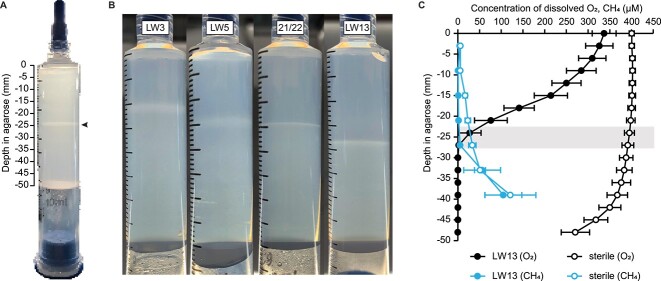
Connecting genes to phenotypic traits in bacteria is often challenging because of a lack of environmental context in laboratory settings. Laboratory-based model ecosystems offer a means to better account for environmental conditions compared with standard planktonic cultures and can help link genotypes and phenotypes. Here, we present a simple, cost-effective, laboratory-based model ecosystem to study aerobic methane-oxidizing bacteria (methanotrophs) within the methane-oxygen counter gradient typically found in the natural environment of these organisms. Culturing the methanotroph Methylomonas sp. strain LW13 in this system resulted in the formation of a distinct horizontal band at the intersection of the counter gradient, which we discovered was not due to increased numbers of bacteria at this location but instead to an increased amount of polysaccharides. We also discovered that different methanotrophic taxa form polysaccharide bands with distinct locations and morphologies when grown in the methane-oxygen counter gradient. By comparing transcriptomic data from LW13 growing within and surrounding this band, we identified genes upregulated within the band and validated their involvement in growth and band formation within the model ecosystem using knockout strains. Notably, deletion of these genes did not negatively affect growth using standard planktonic culturing methods. This work highlights the use of a laboratory-based model ecosystem that more closely mimics the natural environment to uncover bacterial phenotypes missing from standard laboratory conditions, and to link these phenotypes with their genetic determinants.
将基因与细菌的表型特征联系起来通常具有挑战性,因为在实验室环境中缺乏环境背景。基于实验室的模型生态系统提供了一种与标准浮游培养物相比更好地考虑环境条件的方法,并有助于将基因型与表型联系起来。在这里,我们提出了一种简单、经济高效的基于实验室的模型生态系统,用于研究有氧甲烷氧化细菌(甲烷营养菌),该系统位于这些生物的自然环境中通常存在的甲烷-氧气逆梯度内。在该系统中培养甲烷营养菌 Methylomonas sp. strain LW13 会导致在逆梯度的交汇处形成一个独特的水平带,我们发现这不是由于该位置的细菌数量增加,而是由于多糖的含量增加。我们还发现,当在甲烷-氧气逆梯度中生长时,不同的甲烷营养菌形成具有不同位置和形态的多糖带。通过比较 LW13 在该带内和周围生长的转录组数据,我们确定了在带内上调的基因,并使用敲除菌株验证了它们在模型生态系统中生长和带形成的参与。值得注意的是,删除这些基因不会在使用标准浮游培养方法时对生长产生负面影响。这项工作强调了使用基于实验室的模型生态系统,该系统更能模拟自然环境,以揭示标准实验室条件下缺失的细菌表型,并将这些表型与其遗传决定因素联系起来。