Esteve-Pérez Jerónimo, Gutiérrez-Romero José Enrique
Department of Applied Physics and Naval Technology, Universidad Politécnica de Cartagena, Paseo Alfonso XIII, 52, 30203 Cartagena, Spain.
Eur Transp Res Rev. 2022;14(1):11. doi: 10.1186/s12544-022-00532-7. Epub 2022 Apr 1.
This study aims to investigate the degree of concentration and the competitive positions of the Baltic cruise port network.
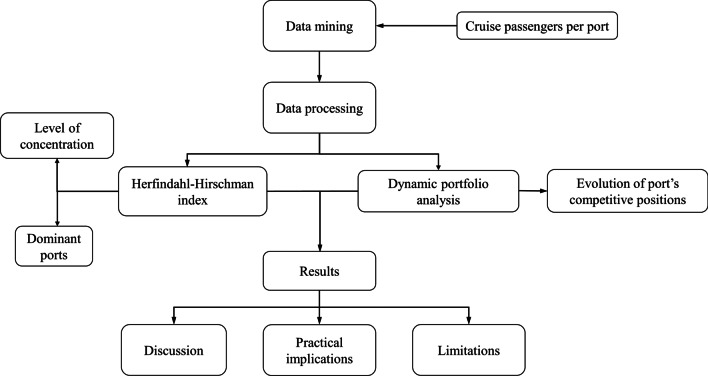
A set of 29 Baltic ports are analysed, market concentration is evaluated using the analytical technique of the Herfindahl-Hirschman index, and competitive positions are determined through portfolio analysis based on the Boston Consulting Group matrix from 2000 to 2019.
The Herfindahl-Hirschman index indicates that the Baltic cruise port system is unconcentrated with an average score of 0.11 for the analysed period, suggesting that eight of the twenty-nine ports are the dominant ports in the Baltic. Portfolio analysis results suggest that the hierarchy picture of competitive positions is dynamic and has changed over time. The Baltic cruise port system has a wide range of competitive positions. Kiel and Rostock becoming mature leaders is one of the most relevant changes in competitive positions.
This study contributes to the literature not only by investigating the competitive positions of the second most important European operational area for cruise ships but also by filling the gap in research on the concentration and competitive strategic positions of Baltic cruise ports. This research allows seaport operators to visualise the position and progress of selected ports and predict the possible future seaport developments.
本研究旨在调查波罗的海邮轮港口网络的集中程度和竞争地位。
分析了29个波罗的海港口,使用赫芬达尔-赫希曼指数分析技术评估市场集中度,并基于2000年至2019年的波士顿咨询集团矩阵通过组合分析确定竞争地位。
赫芬达尔-赫希曼指数表明,波罗的海邮轮港口系统集中度较低,分析期内平均得分为0.11,这表明29个港口中有8个是波罗的海的主要港口。组合分析结果表明,竞争地位的层次结构是动态的,并且随时间发生了变化。波罗的海邮轮港口系统具有广泛的竞争地位。基尔和罗斯托克成为成熟的领导者是竞争地位最显著的变化之一。
本研究不仅通过调查欧洲第二重要的邮轮运营区域的竞争地位,还通过填补波罗的海邮轮港口集中度和竞争战略地位研究的空白,为相关文献做出了贡献。这项研究使海港运营商能够直观了解选定港口的地位和发展,并预测未来海港可能的发展。