Anagnostopoulos Lemonia, Vasileiadis Sotirios, Kourentis Leonidas, Bogogiannidou Zacharoula, Voulgaridi Ioanna, Nichols Gordon, Kalala Fani, Speletas Matthaios, Hadjichristodoulou Christos, Mouchtouri Varvara A
Laboratory of Hygiene and Epidemiology, Faculty of Medicine, University of Thessaly, 22 Papakyriazi Street, 41222, Larissa, Thessaly, Greece.
HEALTHY SAILING Project, 22 Papakyriazi Street, 41222, Larissa, Thessaly, Greece.
Trop Med Health. 2025 Jan 9;53(1):3. doi: 10.1186/s41182-025-00681-0.
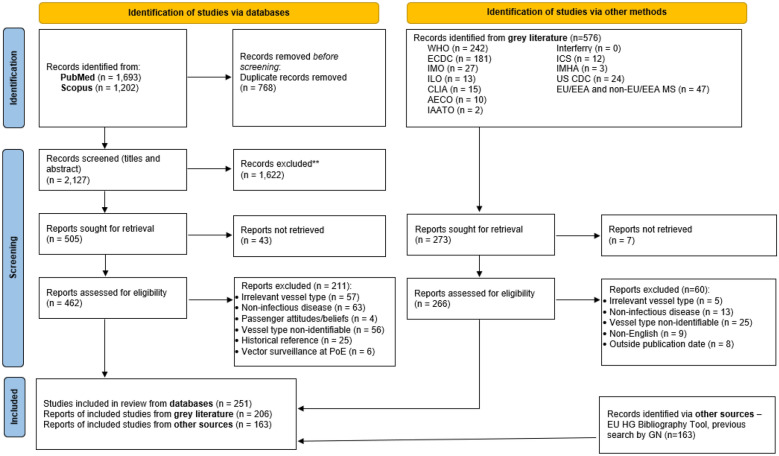
With various infectious disease risks to passenger ship travellers, guidance for infectious disease prevention, mitigation and management (PMM) exists. Emerging infections and emergencies necessitate updated, context-specific guidelines and practices. New evidence for infection PMM must be translated into guidance for governmental authorities and the passenger ship industry. Under the European HEALTHY SAILING project, we conducted a scoping review of publications in PubMed, Scopus and grey literature for scientific articles, regulations, guidelines and policies describing infectious disease PMM in seaports, cruise, ferry, expedition and river cruise ships between 1990 and 2023.
Of 620 publications most were peer-reviewed articles (57.7%) and technical guidance (27.9%), followed by reports/other documents (9.1%), industry guidance (3.4%) and legislation (1.9%). Half (50.5%) of all publications addressed respiratory illnesses, fewer addressed gastroenteritis (11.5%), Legionnaire's (6.1%), other vaccine-preventable (3.2%), vector-borne (1.6%) and sexually transmitted (1.0%) diseases. Most publications focus on infectious disease in seagoing cruise ships (75.7%) compared to ferries, expedition and river cruise ships (26.6%, 16.9%, 16.3%, respectively). Fewer publications addressed seaports (39.0%), shore-side personnel (19.7%) and port communities (2.4%). Most literature was published between 2020 and 2023 (50.2%) with a peak addressing respiratory illnesses (264 publications) during this period. A trend in volume and type was observed based on public health emergencies associated with the publication year.
Peer-reviewed articles and guidance primarily address respiratory and gastrointestinal illnesses, seagoing cruise ships and onboard populations. Gaps on the following topics exist: other infectious disease types; other passenger ship types; land-based personnel and port communities. Future research could assess risk factors and PMM measure effectiveness considering vaccine-preventable, vector-borne and sexually transmitted diseases. The evidence-base should be strengthened to produce guidelines targeting specificities of seaports, ferries, expedition and river cruise ships. Developing guidelines to standardise passenger ship outbreak investigation reporting could help evaluate PMM measure effectiveness, the impact of passenger ship travel on port communities and vice versa. Modern passenger ship experiences-from educational to elderly focused cruising-present diverse public health risks, requiring continuous efforts by public health authorities and the shipping industry. While outside the review's scope, measures may impact travellers' mental health, necessitating strategies when designing and implementing PMM measures.
鉴于客船乘客面临各种传染病风险,已有传染病预防、缓解和管理(PMM)指南。新出现的感染和紧急情况需要更新的、因地制宜的指南和做法。感染预防、缓解和管理方面的新证据必须转化为针对政府当局和客船行业的指南。在欧洲“健康航行”项目下,我们对1990年至2023年间发表在PubMed、Scopus和灰色文献中的科学文章、法规、指南和政策进行了范围审查,这些文献描述了海港、邮轮、渡轮、探险船和内河游轮中的传染病预防、缓解和管理情况。
在620篇出版物中,大部分是同行评审文章(57.7%)和技术指南(27.9%),其次是报告/其他文件(9.1%)、行业指南(3.4%)和法规(1.9%)。所有出版物中有一半(50.5%)涉及呼吸道疾病,较少涉及肠胃炎(11.5%)、军团病(6.1%)、其他可通过疫苗预防的疾病(3.2%)、媒介传播疾病(1.6%)和性传播疾病(1.0%)。与渡轮、探险船和内河游轮(分别为26.6%、16.9%、16.3%)相比,大多数出版物关注远洋游轮中的传染病(75.7%)。涉及海港(39.0%)、岸上人员(19.7%)和港口社区(2.4%)的出版物较少。大多数文献发表于2020年至2023年之间(50.2%),在此期间,关于呼吸道疾病的文献达到峰值(264篇)。根据与出版年份相关的突发公共卫生事件,观察到了数量和类型上的趋势。
同行评审文章和指南主要涉及呼吸道和胃肠道疾病、远洋游轮及船上人员。在以下主题方面存在差距:其他传染病类型;其他客船类型;陆上人员和港口社区。未来的研究可以评估考虑可通过疫苗预防的疾病、媒介传播疾病和性传播疾病的风险因素及预防、缓解和管理措施的有效性。应加强证据基础,以制定针对海港、渡轮、探险船和内河游轮特点的指南。制定标准化的客船疫情调查报告指南有助于评估预防、缓解和管理措施的有效性、客船旅行对港口社区的影响以及反之亦然的影响。现代客船体验——从教育型游轮到老年人游轮——呈现出多样的公共卫生风险,需要公共卫生当局和航运业持续努力。虽然不在本次审查范围内,但这些措施可能会影响旅行者的心理健康,因此在设计和实施预防、缓解和管理措施时需要制定相应策略。