Evers Stefan, Dell'Agnello Grazia, Novick Diego, Gonderten H Saygin, Panni Tommaso, Pascual Julio
University of Münster, Münster, Germany.
Lindenbrunn Hospital, Coppenbrügge, Germany.
Pain Ther. 2024 Jun;13(3):589-607. doi: 10.1007/s40122-024-00589-3. Epub 2024 Apr 16.
The ObserVational survey of the Epidemiology, tReatment and Care Of MigrainE (OVERCOME) European Union (EU) is part of an overarching population-based study program that also includes the United States and Japan. Here, we report data on the migraine/severe headache burden and the use of acute medication and healthcare resources in Spain and Germany.
OVERCOME (EU) was an online, non-interventional, cross-sectional survey conducted in adults in Spain and Germany between October 2020 and February 2021. A total migraine cohort was established based on health survey participants who reported headache/migraine in the last 12 months AND identified as having migraine based on modified International Classification of Headache Disorders, third edition criteria OR self-reported physician diagnosis. Data were analyzed for the total migraine cohort and the subcohort with moderate to severe headache attacks, with average pain severity ≥ 5 points, pain duration ≥ 4 h, and at least moderate disability due to migraine [Migraine Disability Assessment (MIDAS) score ≥ 11] over the past 3 months.
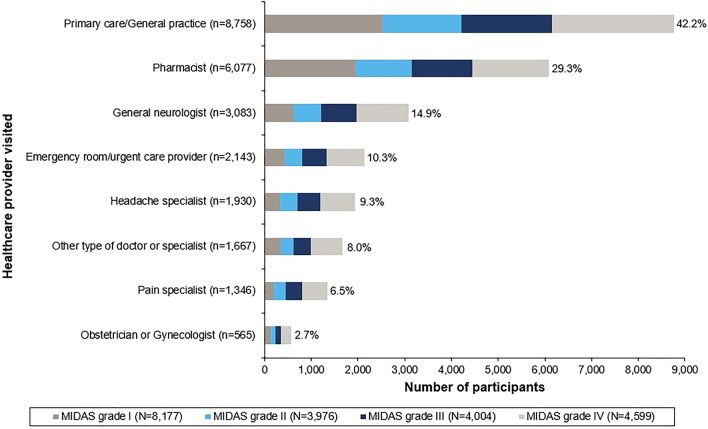
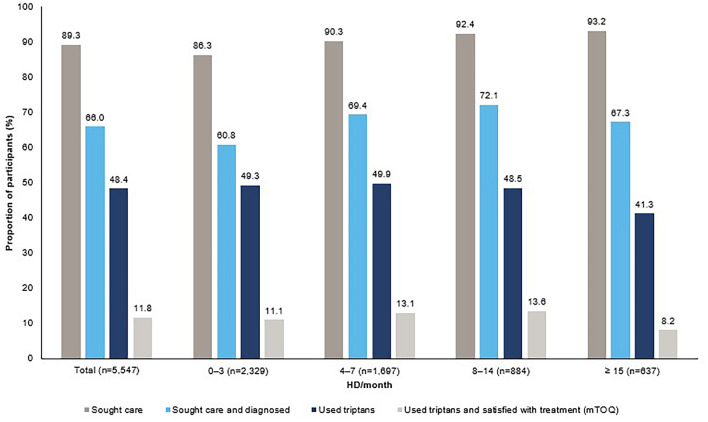
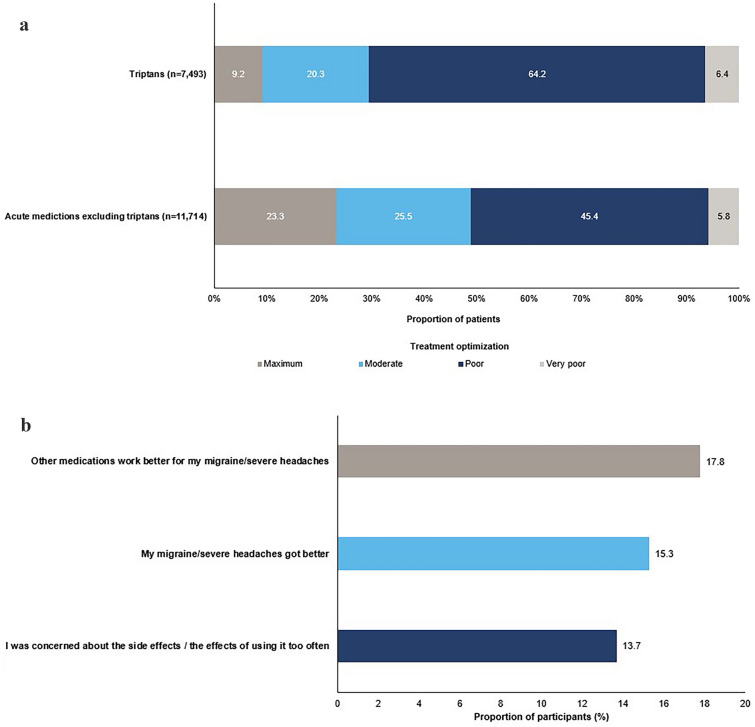
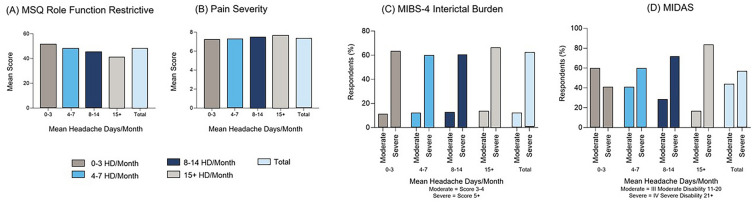
Pain of moderate or severe intensity was the most frequent symptom in the total migraine cohort (n = 19,103/20,756; 92.0%). Proportions of participants reporting severe disability (MIDAS Grade IV), poorer quality of life (QoL; Migraine-Specific QoL Questionnaire), and higher interictal burden (Migraine Interictal Burden Scale-4), generally increased with number of headache days (HDs)/month. Most participants (92.5%) reported current acute migraine/severe headache medication use, although only 39.0% were using triptans. In the moderate to severe attacks subcohort (n = 5547), 48.4% were using triptans, with nonsteroidal anti-inflammatory drugs the most common acute medication. The moderate to severe attacks subcohort also reported poorer QoL and greater pain and disability with increasing HDs/month, although severe interictal burden was reported for ~ 60% of participants regardless of HDs/month. Treatment satisfaction (six-item migraine Treatment Optimization Questionnaire) in those using triptans was generally poor in both total and subcohorts.
High migraine-related burden levels were reported, despite use of acute medication. Although triptans are recommended for moderate to severe migraine attacks in Spanish and German guidelines, less than half of participants were using triptans; treatment satisfaction in those using triptans was generally poor. New tailored treatment options may help address unmet needs in current acute treatment.
偏头痛的流行病学、治疗与护理观察性调查(OVERCOME)欧盟研究是一项基于总体人群的研究项目的一部分,该项目还包括美国和日本。在此,我们报告西班牙和德国偏头痛/重度头痛负担以及急性药物使用和医疗资源利用的数据。
OVERCOME(欧盟)是一项于2020年10月至2021年2月在西班牙和德国成年人中开展的在线、非干预性横断面调查。基于在过去12个月内报告有头痛/偏头痛且根据《国际头痛疾病分类》第三版修订标准或自我报告的医生诊断被确定为患有偏头痛的健康调查参与者,建立了一个偏头痛总队列。对偏头痛总队列以及在过去3个月中平均疼痛严重程度≥5分、疼痛持续时间≥4小时且因偏头痛导致至少中度残疾[偏头痛残疾评估(MIDAS)评分≥11]的中度至重度头痛发作亚队列的数据进行了分析。
在偏头痛总队列中(n = 19,103/20,756;92.0%),中度或重度疼痛是最常见的症状。报告严重残疾(MIDAS IV级)、生活质量较差(QoL;偏头痛特异性生活质量问卷)以及发作间期负担较高(偏头痛发作间期负担量表-4)的参与者比例,通常随着每月头痛天数(HDs)的增加而升高。大多数参与者(92.5%)报告目前正在使用急性偏头痛/重度头痛药物,尽管只有39.0%的人使用曲坦类药物。在中度至重度发作亚队列中(n = 5547),48.4%的人使用曲坦类药物,非甾体类抗炎药是最常见的急性药物。随着每月HDs的增加,中度至重度发作亚队列也报告了较差的QoL以及更严重的疼痛和残疾,尽管无论每月HDs如何,约60%的参与者报告有严重的发作间期负担。在总队列和亚队列中,使用曲坦类药物的患者的治疗满意度(六项偏头痛治疗优化问卷)普遍较差。
尽管使用了急性药物,但仍报告了与偏头痛相关的高负担水平。尽管西班牙和德国的指南推荐曲坦类药物用于中度至重度偏头痛发作,但使用曲坦类药物的参与者不到一半;使用曲坦类药物的患者的治疗满意度普遍较差。新的定制治疗方案可能有助于满足当前急性治疗中未满足的需求。