Edwards Sarah, Luzzara Marco, Dell'Acqua Veronica, Christodouleas John
Medical Affairs and Clinical Research, Elekta AB, Stockholm, Sweden.
Front Oncol. 2024 Apr 2;14:1351610. doi: 10.3389/fonc.2024.1351610. eCollection 2024.
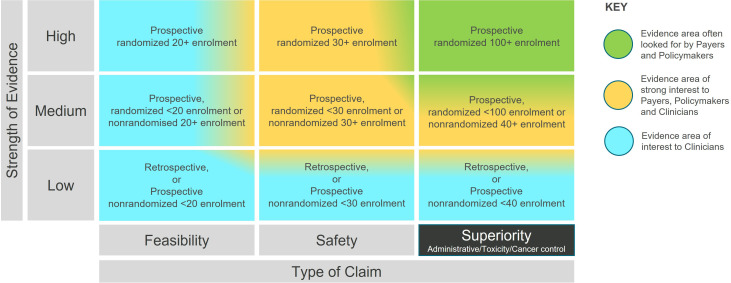
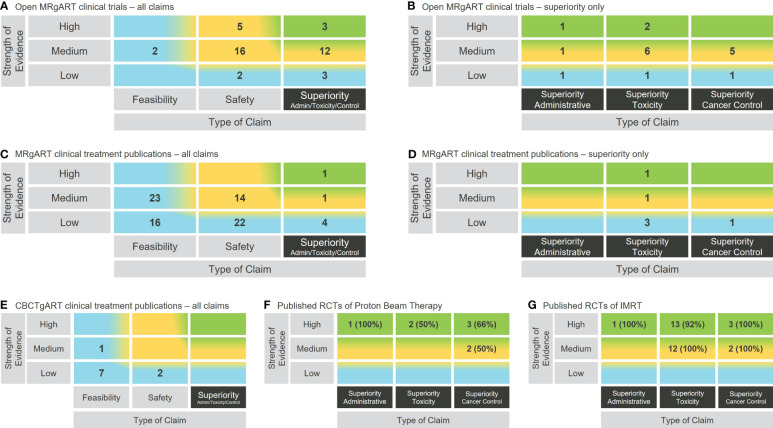
Clinical evidence is crucial in enabling the judicious adoption of technological innovations in radiation therapy (RT). Pharmaceutical evidence development frameworks are not useful for understanding how technical advances are maturing. In this paper, we introduce a new framework, the Radiation Therapy Technology Evidence Matrix (rtTEM), that helps visualize how the clinical evidence supporting new technologies is developing. The matrix is a unique 2D model based on the R-IDEAL clinical evaluation framework. It can be applied to clinical hypothesis testing trials, as well as publications reporting clinical treatment. We present the rtTEM and illustrate its application, using emerging and mature RT technologies as examples. The model breaks down the type of claim along the vertical axis and the strength of the evidence for that claim on the horizontal axis, both of which are inherent in clinical hypothesis testing. This simplified view allows for stakeholders to understand where the evidence is and where it is heading. Ultimately, the value of an innovation is typically demonstrated through superiority studies, which we have divided into three key categories - administrative, toxicity and control, to enable more detailed visibility of evidence development in that claim area. We propose the rtTEM can be used to track evidence development for new interventions in RT. We believe it will enable researchers and sponsors to identify gaps in evidence and to further direct evidence development. Thus, by highlighting evidence looked for by key policy decision makers, the rtTEM will support wider, timely patient access to high value technological advances.
临床证据对于明智地采用放射治疗(RT)技术创新至关重要。药物证据开发框架对于理解技术进步如何成熟并无帮助。在本文中,我们引入了一个新的框架,即放射治疗技术证据矩阵(rtTEM),它有助于直观呈现支持新技术的临床证据是如何发展的。该矩阵是基于R-IDEAL临床评估框架的独特二维模型。它可应用于临床假设检验试验以及报告临床治疗的出版物。我们以新兴和成熟的RT技术为例,展示rtTEM并说明其应用。该模型在纵轴上划分声明类型,在横轴上划分该声明的证据强度,这两者都是临床假设检验所固有的。这种简化的视图使利益相关者能够了解证据所在之处以及发展方向。最终,创新的价值通常通过优效性研究来证明,我们将其分为三个关键类别——管理、毒性和对照,以便在该声明领域更详细地了解证据发展情况。我们提出rtTEM可用于跟踪RT新干预措施的证据发展。我们相信它将使研究人员和资助者能够识别证据差距,并进一步指导证据发展。因此,通过突出关键政策决策者所寻求的证据,rtTEM将支持更广泛、及时地让患者获得高价值的技术进步。