Division of Bioinformatics, International Institute for Zoonosis Control, Hokkaido University, Sapporo, Hokkaido, Japan.
Infectious Disease Epidemiology Group, Weill Cornell Medicine-Qatar, Cornell University, Doha, Qatar.
Front Public Health. 2024 Apr 2;12:1335693. doi: 10.3389/fpubh.2024.1335693. eCollection 2024.
We aimed to investigate the overlapping epidemiologies of human immunodeficiency virus (HIV), herpes simplex virus type 2 (HSV-2), chlamydia, gonorrhea, and syphilis in sexual networks of men who have sex with men (MSM), and to explore to what extent the epidemiology of one sexually transmitted infection (STI) relates to or differs from that of another STI.
An individual-based Monte Carlo simulation model was employed to simulate the concurrent transmission of STIs within diverse sexual networks of MSM. The model simulated sexual partnering, birth, death, and STI transmission within each specific sexual network. The model parameters were chosen based on the current knowledge and understanding of the natural history, transmission, and epidemiology of each considered STI. Associations were measured using the Spearman's rank correlation coefficient (SRCC) and maximal information coefficient (MIC).
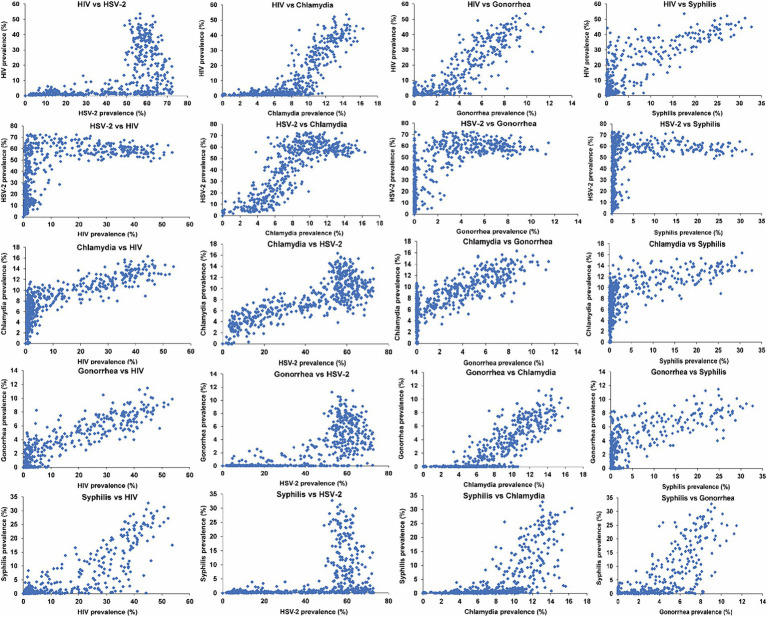
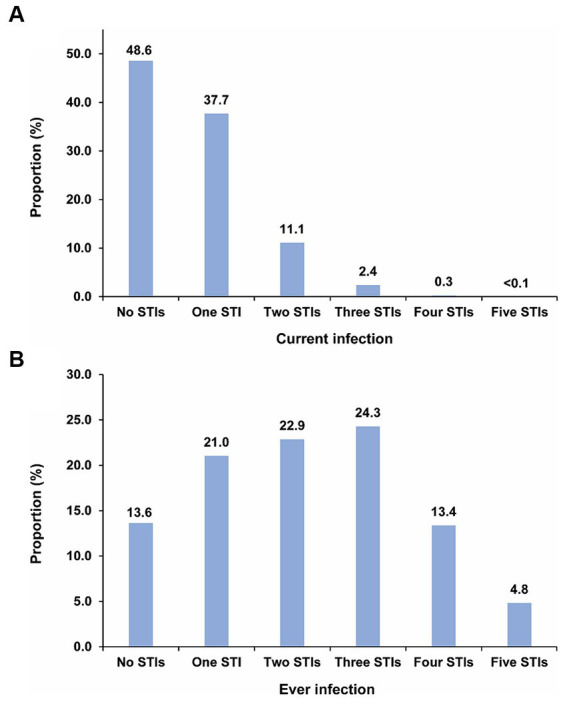
A total of 500 sexual networks were simulated by varying the mean and variance of the number of partners for both short-term and all partnerships, degree correlation, and clustering coefficient. HSV-2 had the highest current infection prevalence across the simulations, followed by HIV, chlamydia, syphilis, and gonorrhea. Threshold and saturation effects emerged in the relationship between STIs across the simulated networks, and all STIs demonstrated moderate to strong associations. The strongest current infection prevalence association was between HIV and gonorrhea, with an SRCC of 0.84 (95% CI: 0.80-0.87) and an MIC of 0.81 (95% CI: 0.74-0.88). The weakest association was between HSV-2 and syphilis, with an SRCC of 0.54 (95% CI: 0.48-0.59) and an MIC of 0.57 (95% CI, 0.49-0.65). Gonorrhea exhibited the strongest associations with the other STIs while syphilis had the weakest associations. Across the simulated networks, proportions of the population with zero, one, two, three, four, and five concurrent STI infections were 48.6, 37.7, 11.1, 2.4, 0.3, and < 0.1%, respectively. For lifetime exposure to these infections, these proportions were 13.6, 21.0, 22.9, 24.3, 13.4, and 4.8%, respectively.
STI epidemiologies demonstrate substantial overlap and associations, alongside nuanced differences that shape a unique pattern for each STI. Gonorrhea exhibits an "intermediate STI epidemiology," reflected by the highest average correlation coefficient with other STIs.
本研究旨在探究人类免疫缺陷病毒(HIV)、单纯疱疹病毒 2 型(HSV-2)、衣原体、淋病和梅毒在男男性行为者(MSM)性网络中的重叠流行病学,并探讨一种性传播感染(STI)的流行病学与另一种 STI 的关系或差异程度。
采用基于个体的蒙特卡罗模拟模型,模拟 MSM 不同性网络中 STI 的并发传播。该模型模拟了特定性网络内的性伴侣关系、出生、死亡和 STI 传播。模型参数是根据对每种考虑的 STI 的自然史、传播和流行病学的现有知识和理解来选择的。使用 Spearman 秩相关系数(SRCC)和最大信息系数(MIC)来测量关联。
通过改变短期和所有伴侣关系中伴侣数量的均值和方差、度数相关性和聚类系数,共模拟了 500 个性网络。在模拟网络中,HSV-2 的当前感染率最高,其次是 HIV、衣原体、梅毒和淋病。在网络中的 STI 之间出现了阈值和饱和效应,所有 STI 均显示出中度至高度关联。当前感染率最强的关联是 HIV 和淋病之间的关联,SRCC 为 0.84(95%CI:0.80-0.87),MIC 为 0.81(95%CI:0.74-0.88)。最弱的关联是 HSV-2 和梅毒之间的关联,SRCC 为 0.54(95%CI:0.48-0.59),MIC 为 0.57(95%CI:0.49-0.65)。淋病与其他 STI 的关联最强,而梅毒的关联最弱。在模拟网络中,人群中没有、有一个、两个、三个、四个和五个同时存在的 STI 感染的比例分别为 48.6%、37.7%、11.1%、2.4%、0.3%和<0.1%。对于这些感染的终生暴露,这些比例分别为 13.6%、21.0%、22.9%、24.3%、13.4%和 4.8%。
STI 的流行病学表现出显著的重叠和关联,同时存在细微的差异,为每种 STI 形成独特的模式。淋病表现出“中等 STI 流行病学”,其与其他 STI 的平均相关系数最高。