Peng Xiaolong, Connolly Dillon J, Sutton Falon, Robinson John, Baker-Vogel Brenna, Short Edward B, Badran Bashar W
Department of Psychiatry and Behavioral Sciences, Neuro-X Lab, Medical University of South Carolina, Charleston, SC, United States.
Front Hum Neurosci. 2024 Apr 2;18:1359396. doi: 10.3389/fnhum.2024.1359396. eCollection 2024.
The nucleus accumbens (NAc) is a key node of the brain reward circuit driving reward-related behavior. Dysregulation of NAc has been demonstrated to contribute to pathological markers of addiction in substance use disorder (SUD) making it a potential therapeutic target for brain stimulation. Transcranial focused ultrasound (tFUS) is an emerging non-invasive brain stimulation approach that can modulate deep brain regions with a high spatial resolution. However, there is currently no evidence showing how the brain activity of NAc and brain functional connectivity within the reward network neuromodulated by tFUS on the NAc.
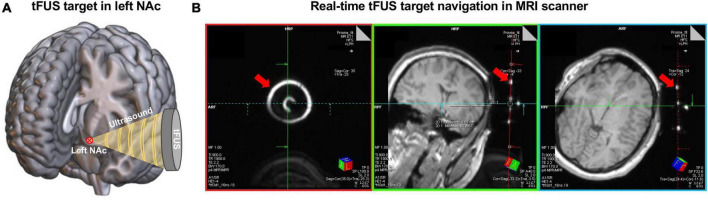
In this pilot study, we carried out a single-blind, sham-controlled clinical trial using functional magnetic resonance imaging (fMRI) to investigate the underlying mechanism of tFUS neuromodulating the reward network through NAc in ten healthy adults. Specifically, the experiment consists of a 20-min concurrent tFUS/fMRI scan and two 24-min resting-state fMRI before and after the tFUS session.
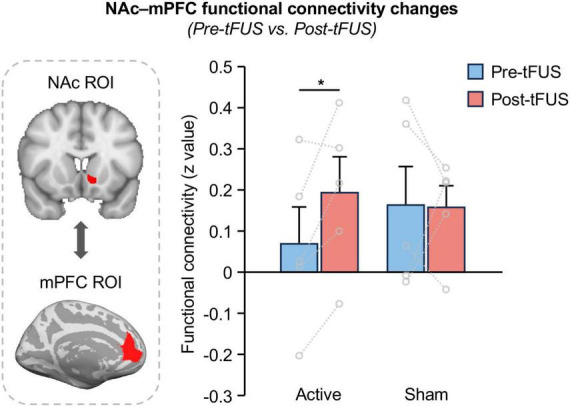
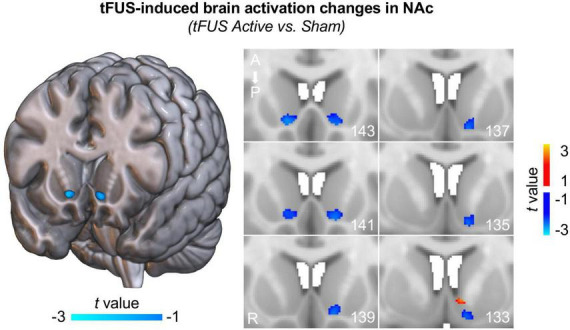
Firstly, our results demonstrated the feasibility and safety of 20-min tFUS on NAc. Additionally, our findings demonstrated that bilateral NAc was inhibited during tFUS on the left NAc compared to sham. Lastly, increased functional connectivity between the NAc and medial prefrontal cortex (mPFC) was observed after tFUS on the left NAc, but no changes for the sham group.
Delivering tFUS to the NAc can modulate brain activations and functional connectivity within the reward network. These preliminary findings suggest that tFUS could be potentially a promising neuromodulation tool for the direct and non-invasive management of the NAc and shed new light on the treatment for SUD and other brain diseases that involve reward processing.
伏隔核(NAc)是驱动奖赏相关行为的脑奖赏回路的关键节点。已证明NAc功能失调会导致物质使用障碍(SUD)成瘾的病理标志物,使其成为脑刺激的潜在治疗靶点。经颅聚焦超声(tFUS)是一种新兴的非侵入性脑刺激方法,能够以高空间分辨率调节深部脑区。然而,目前尚无证据表明tFUS对NAc进行神经调节时,NAc的脑活动以及奖赏网络内的脑功能连接情况如何。
在这项前瞻性研究中,我们对10名健康成年人进行了一项单盲、假对照临床试验,使用功能磁共振成像(fMRI)来研究tFUS通过NAc对奖赏网络进行神经调节的潜在机制。具体而言,实验包括一次20分钟的tFUS/fMRI同步扫描,以及在tFUS疗程前后各进行一次24分钟的静息态fMRI扫描。
首先,我们的结果证明了对NAc进行20分钟tFUS的可行性和安全性。此外,我们的研究结果表明,与假刺激相比,在对左侧NAc进行tFUS时,双侧NAc受到抑制。最后,在对左侧NAc进行tFUS后,观察到NAc与内侧前额叶皮质(mPFC)之间的功能连接增加,但假刺激组没有变化。
将tFUS应用于NAc可以调节奖赏网络内的脑激活和功能连接。这些初步研究结果表明,tFUS可能是一种有前景的神经调节工具,可用于直接、非侵入性地调控NAc,为SUD和其他涉及奖赏处理的脑部疾病的治疗提供了新线索。