Institute of Plant Breeding, Genetics, and Genomics, and Department of Crop and Soil Sciences, University of Georgia, Athens, GA, USA.
Soybean Genomics and Improvement Laboratory, USDA-ARS, Beltsville, MD, USA.
Theor Appl Genet. 2024 Apr 17;137(5):107. doi: 10.1007/s00122-024-04609-w.
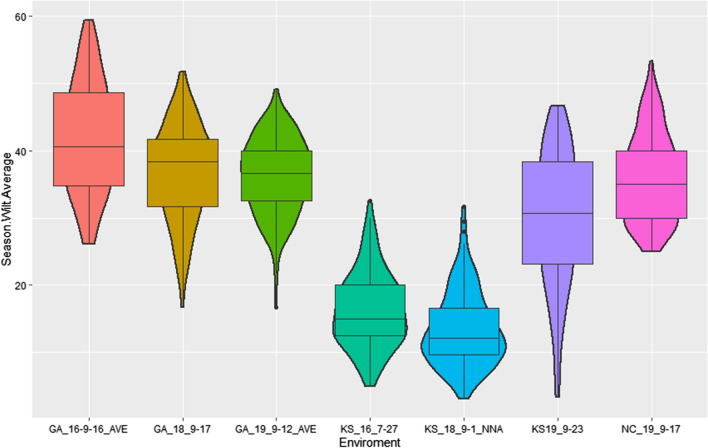
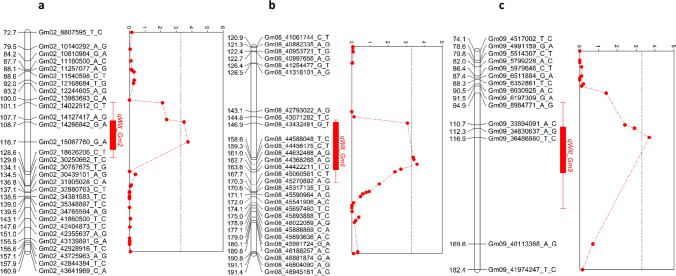
In soybean [Glycine max (L.) Merr.], drought stress is the leading cause of yield loss from abiotic stress in rain-fed US growing areas. Only 10% of the US soybean production is irrigated; therefore, plants must possess physiological mechanisms to tolerate drought stress. Slow canopy wilting is a physiological trait that is observed in a few exotic plant introductions (PIs) and may lead to yield improvement under drought stress. Canopy wilting of 130 recombinant inbred lines (RILs) derived from Hutcheson × PI 471938 grown under drought stress was visually evaluated and genotyped with the SoySNP6K BeadChip. Over four years, field evaluations of canopy wilting were conducted under rainfed conditions at three locations across the US (Georgia, Kansas, and North Carolina). Due to the variation in weather among locations and years, the phenotypic data were collected from seven environments. Substantial variation in canopy wilting was observed among the genotypes in the RIL population across environments. Three QTLs were identified for canopy wilting from the RIL population using composite interval mapping on chromosomes (Chrs) 2, 8, and 9 based on combined environmental analyses. These QTLs inherited the favorable alleles from PI 471938 and accounted for 11, 10, and 14% of phenotypic variation, respectively. A list of 106 candidate genes were narrowed down for these three QTLs based on the published information. The QTLs identified through this research can be used as targets for further investigation to understand the mechanisms of slow canopy wilting. These QTLs could be deployed to improve drought tolerance through a targeted selection of the genomic regions from PI 471938.
在大豆[ Glycine max (L.) Merr.]中,干旱胁迫是美国雨养种植区导致非生物胁迫减产的主要原因。美国只有 10%的大豆生产是灌溉的;因此,植物必须具有耐受干旱胁迫的生理机制。冠层缓慢萎蔫是少数外来植物引种(PIs)中观察到的一种生理特性,可能导致干旱胁迫下产量提高。在干旱胁迫下,对源自 Hutcheson × PI 471938 的 130 个重组自交系(RIL)的冠层萎蔫进行了视觉评估,并利用 SoySNP6K BeadChip 进行了基因型分析。在四年的时间里,在美国三个地点(乔治亚州、堪萨斯州和北卡罗来纳州)的雨养条件下对冠层萎蔫进行了田间评估。由于地点和年份之间天气的变化,表型数据是从七个环境中收集的。在 RIL 群体中,不同基因型的冠层萎蔫存在显著差异。利用复合区间作图法,在染色体(Chrs)2、8 和 9 上鉴定到 3 个与冠层萎蔫相关的 QTL,基于综合环境分析。这些 QTL 从 PI 471938 中继承了有利的等位基因,分别解释了 11%、10%和 14%的表型变异。根据已发表的信息,为这三个 QTL 缩小到 106 个候选基因列表。通过这项研究鉴定的 QTL 可作为进一步研究的目标,以了解冠层缓慢萎蔫的机制。这些 QTL 可以通过对 PI 471938 的基因组区域进行有针对性的选择来提高耐旱性。