Centre for Microbiology and Environmental Systems Science, Department of Microbiology and Ecosystem Science, University of Vienna, Vienna, Austria.
University of Vienna, Doctoral School in Microbiology and Environmental Science, Vienna, Austria.
Nat Commun. 2024 Apr 17;15(1):3056. doi: 10.1038/s41467-024-46920-6.
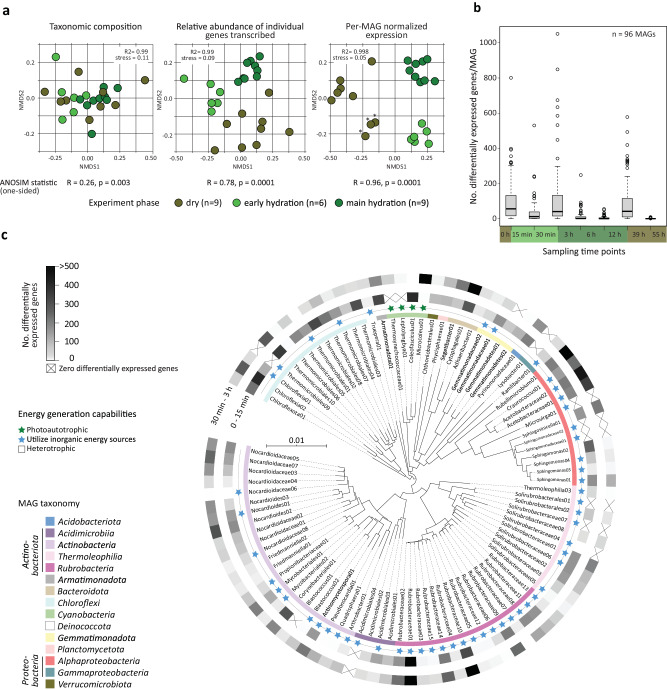
Microbial activity in drylands tends to be confined to rare and short periods of rain. Rapid growth should be key to the maintenance of ecosystem processes in such narrow activity windows, if desiccation and rehydration cause widespread cell death due to osmotic stress. Here, simulating rain with HO followed by single-cell NanoSIMS, we show that biocrust microbial communities in the Negev Desert are characterized by limited productivity, with median replication times of 6 to 19 days and restricted number of days allowing growth. Genome-resolved metatranscriptomics reveals that nearly all microbial populations resuscitate within minutes after simulated rain, independent of taxonomy, and invest their activity into repair and energy generation. Together, our data reveal a community that makes optimal use of short activity phases by fast and universal resuscitation enabling the maintenance of key ecosystem functions. We conclude that desert biocrust communities are highly adapted to surviving rapid changes in soil moisture and solute concentrations, resulting in high persistence that balances limited productivity.
干旱地区的微生物活动往往局限于罕见且短暂的降雨期。如果干燥和复水会因渗透胁迫而导致广泛的细胞死亡,那么在如此狭窄的活动窗口中,快速生长应该是维持生态系统过程的关键。在这里,我们通过 HO 模拟降雨,然后使用单细胞 NanoSIMS 进行研究,结果表明,内盖夫沙漠生物结皮微生物群落的生产力有限,中位数复制时间为 6 到 19 天,并且允许生长的天数有限。基于基因组的宏转录组学揭示,几乎所有微生物种群在模拟降雨后几分钟内都能复苏,与分类无关,并将其活性投入到修复和能量生成中。总之,我们的数据揭示了一个社区,通过快速而普遍的复苏,充分利用短暂的活动阶段,从而维持关键的生态系统功能。我们得出的结论是,沙漠生物结皮群落高度适应土壤水分和溶质浓度的快速变化,从而实现了高持久性和有限生产力之间的平衡。