Department of Sports Medicine, Beijing Key Laboratory of Sports Injuries, Peking University Third Hospital, Institute of Sports Medicine of Peking University, 49 North Garden Road, Haidian District, Beijing, 100191, People's Republic of China.
Engineering Research Center of Sports Trauma Treatment Technology and Devices, Ministry of Education, 49 North Garden Road, Haidian District, Beijing, 100191, People's Republic of China.
BMC Musculoskelet Disord. 2024 Apr 17;25(1):301. doi: 10.1186/s12891-024-07426-w.
From the perspective of graft protection and early rehabilitation during the maturation and remodeling phases of graft healing, suture augmentation (SA) for anterior cruciate ligament reconstruction (ACLR) has attracted more and more attention.
Retrospective study.
To determine whether the additional SA affects clinical results, graft maturation and graft-bone interface healing during two years follow-up after ACLR.
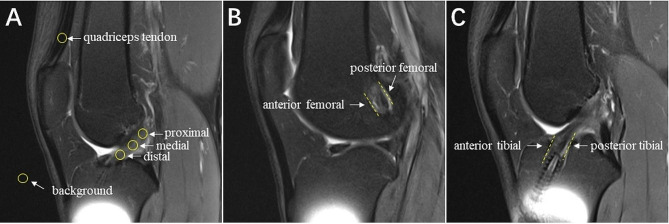
20 ACLRs with additional SA (ACLR-SA group) and 20 ACLRs without additional SA (ACLR group) were performed between January 2020 and December 2021 by the same surgeon and were retrospectively analyzed. Pre- and postoperative International Knee Documentation Committee (IKDC) scores, Lysholm scores, graft failure and reoperation were evaluated. The signal/noise quotient (SNQ) of autografts and the signal intensity of graft-bone interface were analyzed. All 40 patients in ACLR-SA group and ACLR group completed 2-years follow-up.
There was no patient in the two cohorts experienced graft failure and reoperation. The postoperative IKDC and Lysholm scores have been significantly improved compared with preoperative scored in both ACLR-SA group and ACLR group, however, there was no significant difference between two groups. The SNQ of proximal graft of ACLR-SA group (14.78 ± 8.62 vs. 8.1 ± 5.5, p = 0.041) was significantly greater while the grades of graft-bone interface healing of posterior tibial was significantly lower than that of ACLR group at 1-year postoperatively (p = 0.03), respectively. There were no significant differences between the two groups of the SNQ of proximal, distal medial graft segments, and the graft-bone interface healing grades of anterior femoral, posterior femoral, anterior tibial and posterior tibial at other time points (p>0.05).
The additional SA in ACLR had no effect on IKDC scores, Lysholm scores, graft maturation and graft-bone interface healing at 2-year postoperatively. Our research does not support the routine use of SA in ACLR.
从移植物保护和移植物愈合成熟及重塑阶段的早期康复角度来看,前交叉韧带重建(ACLR)中的缝线增强(SA)越来越受到关注。
回顾性研究。
确定 ACLR 后 2 年随访期间,SA 是否会影响临床结果、移植物成熟和移植物-骨界面愈合。
2020 年 1 月至 2021 年 12 月,由同一位外科医生对 20 例接受 ACLR 且附加 SA(ACLR-SA 组)和 20 例未附加 SA(ACLR 组)的患者进行回顾性分析。评估术前和术后国际膝关节文献委员会(IKDC)评分、Lysholm 评分、移植物失败和再次手术情况。分析自体移植物的信噪比(SNQ)和移植物-骨界面的信号强度。ACLR-SA 组和 ACLR 组的 40 例患者均完成了 2 年随访。
两组均无患者发生移植物失败和再次手术。与术前相比,两组患者术后的 IKDC 和 Lysholm 评分均有显著改善,但两组间无显著差异。术后 1 年,ACLR-SA 组的近端移植物 SNQ(14.78±8.62 比 8.1±5.5,p=0.041)显著升高,而胫骨后缘的移植物-骨界面愈合等级显著降低(p=0.03)。其他时间点,两组患者的股骨前、后段近端、远端内侧移植物 SNQ 及胫骨前、后缘移植物-骨界面愈合等级均无显著差异(p>0.05)。
ACL 重建中附加 SA 对术后 2 年的 IKDC 评分、Lysholm 评分、移植物成熟和移植物-骨界面愈合无影响。我们的研究不支持 ACLR 中常规使用 SA。