Department of Otolaryngology, Faculty of Medicine, Prince of Songkla University, 90110, Hatyai, Songkhla, Thailand.
Epidemiology Unit, Faculty of Medicine, Prince of Songkla University, Hatyai, Songkhla, Thailand.
BMC Res Notes. 2024 Apr 17;17(1):107. doi: 10.1186/s13104-024-06762-3.
Early detection and effective management of hearing loss constitute the key to improving the quality of life of individuals with hearing loss. However, in standardized pure tone audiometry, it is sometimes difficult for elderly patients to understand and follow all instructions. Audiologists also require time, expertise, and patience to ensure that an elderly can identify the faintest levels of stimuli during a hearing test. Therefore, this study aimed to devise and validate a formula to predict the pure tone threshold at each frequency across 0.5-4 kHz (PTTs) using speech reception threshold.
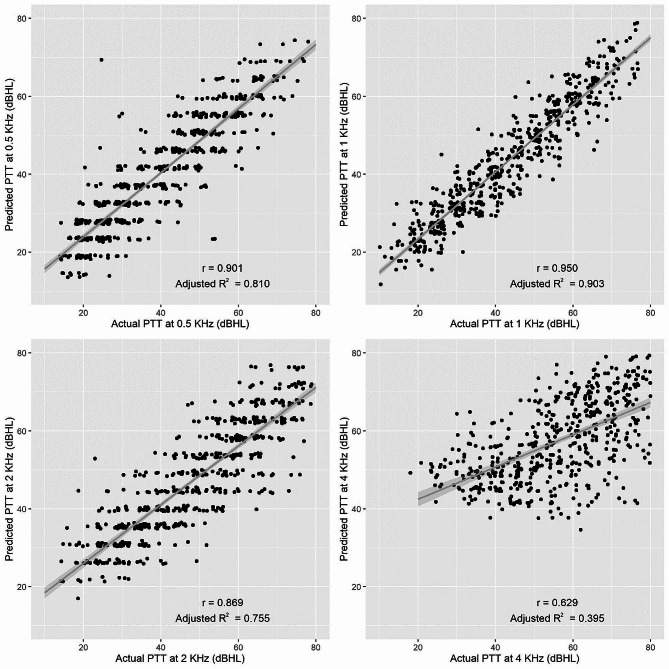
The 1226 audiograms of hearing-impaired individuals aged 60-90 years were reviewed. The random sample function randomly assigned 613 participants to the training and testing sets each. A linear model was created to predict the PTT value at each frequency based on variables significant at all frequencies across 0.5-4 kHz. The adjusted-R2 value was considered to indicate the performance of the predictive model. Pearson's correlation coefficient was used to describe the relationship between the actual and predicted PTT at 0.5, 1, 2, and 4 kHz among the testing set to measure the performance of the proposed model.
The predictive model was devised using variables based on the speech recognition threshold (SRT) after adjusting with age in the training set. The overall prediction accuracy demonstrated a higher adjusted-R ranging from 0.74 to 0.89 at frequencies of 0.5, 1, and 2 kHz, whereas a low percentage of explained variance was observed at 4 kHz (adjusted-R = 0.41). This predictive model can serve as an adjunctive clinical tool for guiding determination of the PTTs. Moreover, the predicted PTTs can be applied in the hearing aid programming software to set appropriate hearing aid gain using standard prescriptive formulas.
听力损失的早期发现和有效管理是提高听力损失患者生活质量的关键。然而,在标准化纯音测听中,老年患者有时难以理解和遵循所有的指令。听力学家也需要时间、专业知识和耐心,以确保老年患者在听力测试中能识别出最微弱的刺激水平。因此,本研究旨在设计和验证一种使用言语识别阈预测 0.5-4 kHz 各频率纯音听阈(PTTs)的公式。
回顾了 60-90 岁听力受损者的 1226 个听力图。随机样本函数将 613 名参与者随机分配到训练组和测试组。创建了一个线性模型,根据在 0.5-4 kHz 各频率上均有显著意义的变量,预测各频率的 PTT 值。调整后的 R2 值用于表示预测模型的性能。Pearson 相关系数用于描述测试组中 0.5、1、2 和 4 kHz 实际 PTT 与预测 PTT 之间的关系,以衡量所提出模型的性能。
在训练组中,使用基于言语识别阈(SRT)的变量并结合年龄进行调整后,构建了预测模型。在 0.5、1 和 2 kHz 频率下,总体预测准确率表现出较高的调整 R 值,范围从 0.74 到 0.89,而在 4 kHz 频率下,解释方差的比例较低(调整 R=0.41)。该预测模型可作为指导 PTT 测定的辅助临床工具。此外,预测的 PTT 可应用于助听器编程软件中,以使用标准处方公式设置适当的助听器增益。