Swetha Bollineni, Malini Duvvuri Lakshmi, Mohan T Murali, Priya B Devi, Reddy O Asha, Haripriya G
Department of Conservative Dentistry and Endodontics, Government Dental College and Hospital, Vijayawada, Andhra Pradesh, India.
Department of Conservative Dentistry and Endodontics, Balaji Dental College, Telangana, India.
J Conserv Dent Endod. 2024 Mar;27(3):337-341. doi: 10.4103/JCDE.JCDE_39_24. Epub 2024 Mar 6.
External inflammatory root resorption has rapid onset and progresses aggressively. It leads to cementum loss, which allows communication between the infected pulp and the periodontium through the denuded dentinal tubules. Primary management strategy includes adequate chemomechanical debridement and lesion arrest for which maintaining alkaline pH and aerobic conditions is essential for healing and repair of the resorption defect.
The aim of this study is to evaluate rise in pH and oxygen release at the site of simulated external root resorption cavities using different oxygen-releasing biomaterials.
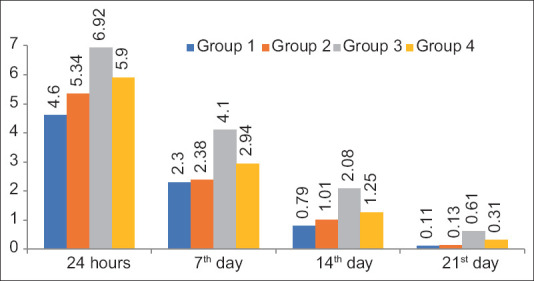
In 40 extracted single-rooted teeth access opening and chemomechanical debridement were done. Cavities simulating resorption defect are prepared on the roots. The samples are divided into four groups ( = 10) based on the biomaterial used. After placing the biomaterial, the root apices were sealed. Half of the samples from each group were tested for oxygen release using dissolved oxygen meter and the other half for rise in pH using pH meter at 7, 14, 21, and 28 days.
The pH values were analyzed using Friedman 2-way analysis of variance (ANOVA) and Kruskal-Wallis test. Oxygen release was measured using the two-way and repeated-measures ANOVA.
Calcium peroxide group showed the highest mean pH and oxygen release than other groups at any given point of time.
Incorporating oxygen-releasing biomaterials such as calcium peroxide and perfluorodecalin into intracanal medicaments, such as calcium hydroxide, creates an alkaline and oxygen-enriched milieu in the periapical tissues.
外部炎性牙根吸收发病迅速且进展迅猛。它会导致牙骨质丧失,使得感染的牙髓通过裸露的牙本质小管与牙周组织相通。主要治疗策略包括充分的化学机械清创和病变控制,为此保持碱性pH值和有氧环境对于吸收缺损的愈合和修复至关重要。
本研究旨在评估使用不同的释氧生物材料时,模拟外部牙根吸收腔部位的pH值升高情况和氧气释放情况。
对40颗拔除的单根牙进行开髓和化学机械清创。在牙根上制备模拟吸收缺损的洞。根据所使用的生物材料将样本分为四组(每组n = 10)。放置生物材料后,封闭牙根根尖。每组一半样本在第7、14、21和28天使用溶解氧仪检测氧气释放情况,另一半样本使用pH计检测pH值升高情况。
使用Friedman双向方差分析(ANOVA)和Kruskal-Wallis检验分析pH值。使用双向重复测量ANOVA测量氧气释放量。
在任何给定时间点,过氧化钙组的平均pH值和氧气释放量均高于其他组。
将过氧化钙和全氟萘烷等释氧生物材料加入到氢氧化钙等根管药物中,可在根尖周组织中营造一个碱性且富氧的环境。