Acosta-Vega Natalia L, Varela Rodolfo, Mesa Jorge Andrés, Garai Jone, Gómez-Gutiérrez Alberto, Serrano-Gómez Silvia J, Zabaleta Jovanny, Sanabria-Salas María Carolina, Combita Alba L
Grupo de Investigación en Biología del Cáncer, Instituto Nacional de Cancerología de Colombia, Bogotá D.C., Colombia.
Programa de doctorado en Ciencias Biológicas, Pontificia Universidad Javeriana, Bogotá D.C., Colombia.
Front Oncol. 2024 Apr 3;14:1338250. doi: 10.3389/fonc.2024.1338250. eCollection 2024.
African ancestry is a known factor associated with the presentation and aggressiveness of prostate cancer (PC). Hispanic/Latino populations exhibit varying degrees of genetic admixture across Latin American countries, leading to diverse levels of African ancestry. However, it remains unclear whether genetic ancestry plays a role in the aggressiveness of PC in Hispanic/Latino patients. We explored the associations between genetic ancestry and the clinicopathological data in Hispanic/Latino PC patients from Colombia.
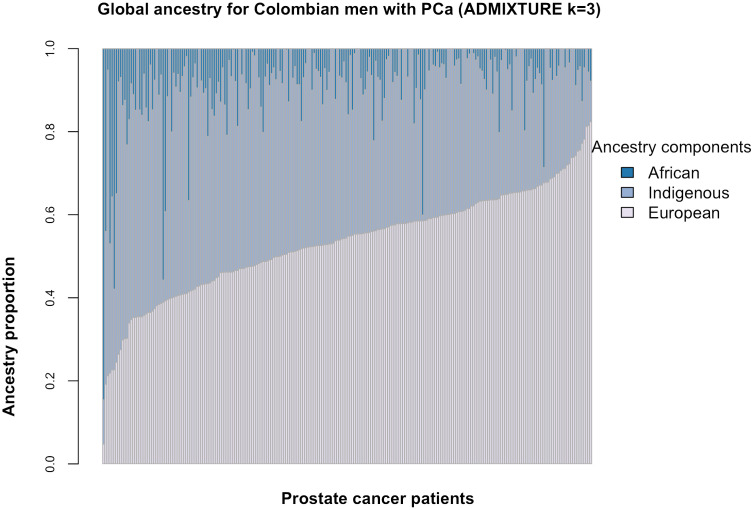
We estimated the European, Indigenous and African genetic ancestry, of 230 Colombian patients with localized/regionally advanced PC through a validated panel for genotypification of 106 Ancestry Informative Markers. We examined the associations of the genetic ancestry components with the Gleason Grade Groups (GG) and the clinicopathological characteristics.
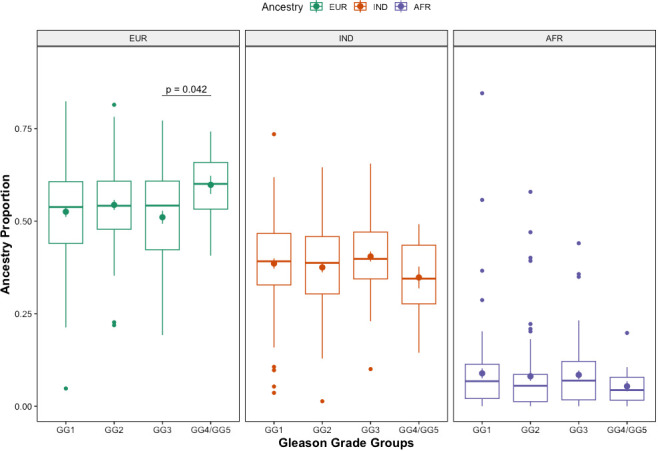
No association was observed between the genetic ancestry with the biochemical recurrence or Gleason GG; however, in a two groups comparison, there were statistically significant differences between GG3 and GG4/GG5 for European ancestry, with a higher mean ancestry proportion in GG4/GG5. A lower risk of being diagnosed at an advanced age was observed for patients with high African ancestry than those with low African ancestry patients (OR: 0.96, CI: 0.92-0.99, p=0.03).
Our findings revealed an increased risk of presentation of PC at an earlier age in patients with higher African ancestry compared to patients with lower African ancestry in our Hispanic/Latino patients.
非洲血统是与前列腺癌(PC)的表现和侵袭性相关的已知因素。西班牙裔/拉丁裔人群在拉丁美洲各国表现出不同程度的基因混合,导致非洲血统水平各异。然而,基因血统是否在西班牙裔/拉丁裔PC患者的侵袭性中起作用仍不清楚。我们探讨了哥伦比亚西班牙裔/拉丁裔PC患者的基因血统与临床病理数据之间的关联。
我们通过一个经过验证的用于106个祖先信息标记基因分型的面板,估计了230名哥伦比亚局限性/区域晚期PC患者的欧洲、本土和非洲基因血统。我们研究了基因血统成分与Gleason分级组(GG)和临床病理特征之间的关联。
未观察到基因血统与生化复发或Gleason GG之间存在关联;然而,在两组比较中,GG3与GG4/GG5在欧洲血统方面存在统计学显著差异,GG4/GG5的平均血统比例更高。非洲血统高的患者比非洲血统低的患者在高龄时被诊断的风险更低(OR:0.96,CI:0.92 - 0.99,p = 0.03)。
我们的研究结果显示,在我们的西班牙裔/拉丁裔患者中,与非洲血统较低的患者相比,非洲血统较高的患者在更早年龄患PC的风险增加。