Baio Raffaele, Napodano Giorgio, Caruana Christian, Molisso Giovanni, Di Mauro Umberto, Intilla Olivier, Pane Umberto, D'Angelo Costantino, Francavilla Antonella Bianca, Guarnaccia Claudio, Pentimalli Francesca, Sanseverino Roberto
Department of Medicine and Surgery 'Scuola Medica Salernitana', University of Salerno, Baronissi, I-84081 Salerno, Italy.
Department of Urology, Ospedale del Mare, I-80147 Naples, Italy.
Mol Clin Oncol. 2022 Jun 20;17(2):127. doi: 10.3892/mco.2022.2560. eCollection 2022 Aug.
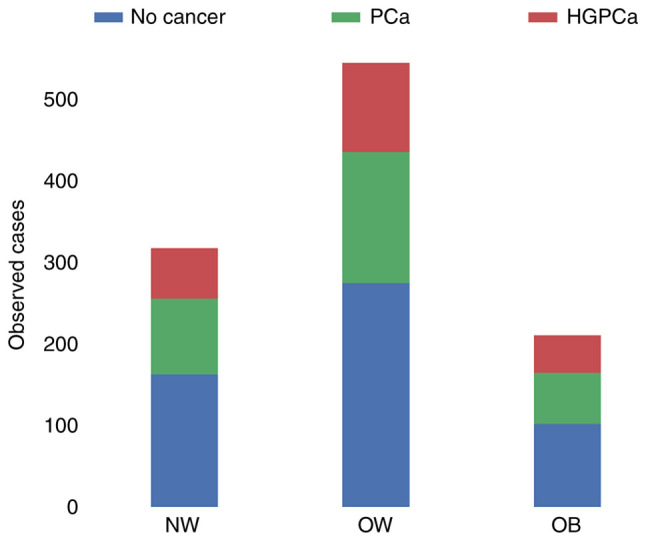
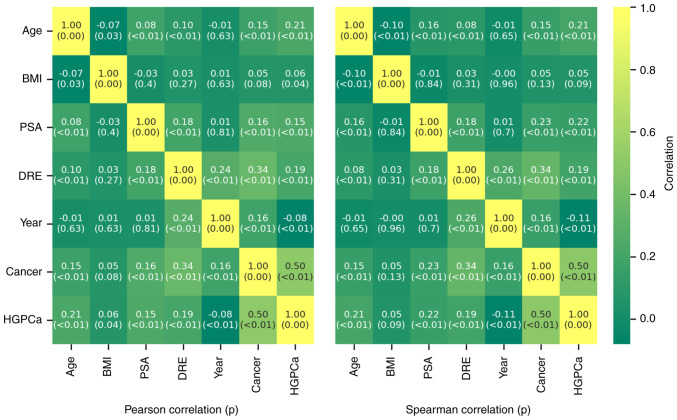
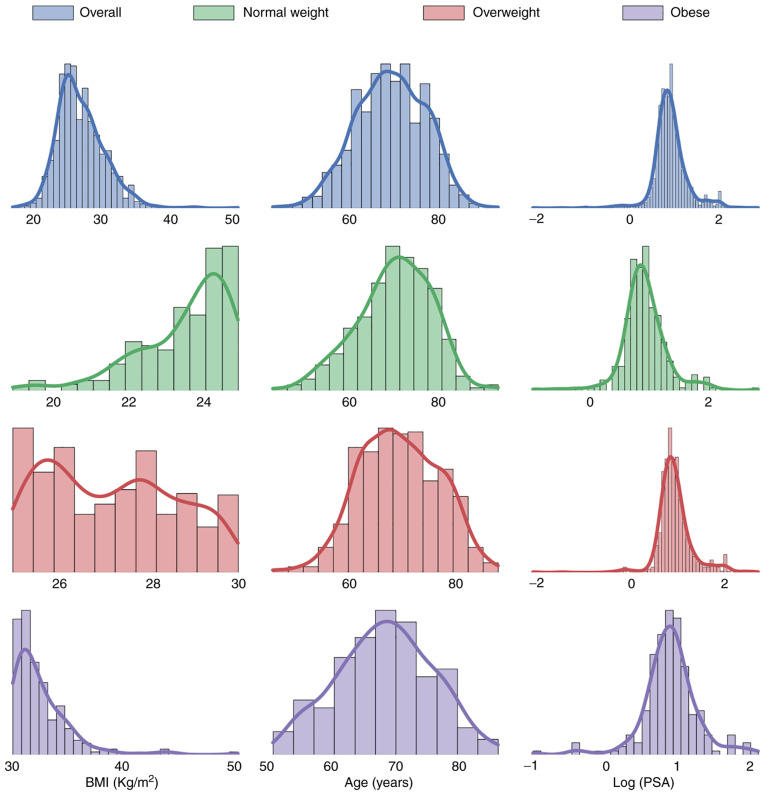
The present study aimed to investigate the relationship between BMI and the prostate cancer (PCa) risk at biopsy in Italian men. Retrospective analyses of the clinical data of 2,372 consecutive men undergoing ultrasound-guided multicore (≥10) prostate biopsy transrectally between May 2010 and December 2018 were performed. BMIs were categorized, according to Western countries' classification of obesity, as follows: <18.5 kg/m (underweight), 18.5-24.99 kg/m (normal weight), 25-30 kg/m (overweight) and >30 kg/m (obese). The distribution of patients undergoing biopsy was compared with a model population from the official survey data. Patient characteristics and the relationships between characteristics were investigated using correlation analysis, ANOVA, Kruskal-Wallis and Dunn's tests. The present study estimated the influence on cancer incidence not only of BMI but also of other patient characteristics using multi-variable logistic modelling and compared, using the models, the expected outcomes for patients who differed only in BMI. From a sample of 2,372 men, the present study enrolled 1,079 men due to a lack of clinical data [such as prostate specific antigen (PSA) and BMI data] in the other patients undergoing prostate biopsy. Their distribution was significantly different from the model distribution with the probability of undergoing biopsy increasing with increasing BMI. The median age was 69.4 years. The median BMI was 26.4 kg/m, while the median PSA level was 7.60 ng/ml. In total, the biopsies detected PCa in 320 men (29.7%) and high-grade PCa (HGPCa) in 218 men (20.2%). Upon applying the aforementioned Western countries' criteria for BMI categories, there were 4 (0.4%) underweight, 318 (29.5%) of normal weight, 546 (50.6%) overweight, and 211 (19.6%) obese patients. ANOVA/Kruskal-Wallis tests revealed that overweight and obese men were younger than the normal-weight men, while there was no statistical difference in their PSA values. Furthermore, 29.3% of normal-weight men, 29.5% of overweight men and 29.9% of obese men were diagnosed with PCa, while 19.5% of normal-weight men, 20.1% of overweight men and 21.8% of obese men were affected by severe cancer. BMI was found to be positively correlated with PCa risk and negatively correlated with both age and PSA level. Age and PSA level were both positively correlated with PCa risk, while digital rectal examination (DRE) outcome was strongly indicative of PCa discovery if the test outcome was positive. Logistics models attributed a positive coefficient to BMI when evaluated against both PCa risk and HGPCa risk. In patients having a negative DRE outcome who differed only in BMI, logistic regression showed a 60% increased risk of PCa diagnosis in obese patients compared with in normal-weight patients. This risk difference increased when other characteristics were less indicative of PCa (younger age/lower PSA), while it decreased when patient characteristics were more indicative (older age/higher PSA, positive DRE). In conclusion, the present study demonstrated that, in men with higher BMIs, the risk of PCa is higher. The relative difference in risk between low and high BMI is most pronounced in younger patients having a lower PSA level and a negative DRE outcome.
本研究旨在调查意大利男性活检时体重指数(BMI)与前列腺癌(PCa)风险之间的关系。对2010年5月至2018年12月期间连续2372名经直肠接受超声引导下多芯(≥10)前列腺活检的男性临床数据进行回顾性分析。根据西方国家的肥胖分类,将BMI分为以下几类:<18.5kg/m²(体重过轻)、18.5 - 24.99kg/m²(正常体重)、25 - 30kg/m²(超重)和>30kg/m²(肥胖)。将接受活检的患者分布与官方调查数据中的模型人群进行比较。使用相关分析、方差分析(ANOVA)、Kruskal - Wallis检验和Dunn检验研究患者特征及其之间的关系。本研究使用多变量逻辑模型估计BMI以及其他患者特征对癌症发病率的影响,并使用这些模型比较仅BMI不同的患者的预期结果。在2372名男性样本中,由于其他接受前列腺活检的患者缺乏临床数据(如前列腺特异性抗原(PSA)和BMI数据),本研究纳入了其中1079名男性。他们的分布与模型分布显著不同,接受活检的概率随BMI增加而增加。中位年龄为69.4岁。中位BMI为26.4kg/m²,而中位PSA水平为7.60ng/ml。活检共检测出320名男性患有PCa(29.7%),218名男性患有高级别PCa(HGPCa,20.2%)。按照上述西方国家的BMI分类标准,有4名(0.4%)体重过轻、318名(29.5%)正常体重、546名(50.6%)超重和211名(19.6%)肥胖患者。方差分析/Kruskal - Wallis检验显示,超重和肥胖男性比正常体重男性年轻,而他们的PSA值无统计学差异。此外,29.3%的正常体重男性、29.5%的超重男性和29.9%的肥胖男性被诊断患有PCa,而19.5%的正常体重男性、20.1%的超重男性和21.8%的肥胖男性患有严重癌症。发现BMI与PCa风险呈正相关,与年龄和PSA水平均呈负相关。年龄和PSA水平均与PCa风险呈正相关,而直肠指检(DRE)结果若为阳性则强烈提示发现PCa。在针对PCa风险和HGPCa风险评估时,逻辑模型赋予BMI一个正系数。在仅BMI不同且DRE结果为阴性的患者中,逻辑回归显示肥胖患者被诊断为PCa的风险比正常体重患者高60%。当其他特征对PCa的提示性较小时(年龄较小/PSA较低),这种风险差异会增加;而当患者特征对PCa的提示性较大时(年龄较大/PSA较高,DRE阳性),这种风险差异会减小。总之,本研究表明,BMI较高的男性患PCa的风险更高。低BMI和高BMI之间的风险相对差异在PSA水平较低且DRE结果为阴性的年轻患者中最为明显。