Department of Endocrine and Metabolic Diseases, Shanghai Institute of Endocrine and Metabolic Diseases, Ruijin Hospital, Shanghai Jiao Tong University School of Medicine, Shanghai, China.
Shanghai National Clinical Research Center for Metabolic Diseases, Key Laboratory for Endocrine and Metabolic Diseases of the National Health Commission of the People's Republic of China, Shanghai Key Laboratory for Endocrine Tumor, Shanghai National Center for Translational Medicine, Ruijin Hospital, Shanghai Jiao Tong University School of Medicine, Shanghai, China.
Diabetes Care. 2024 Jun 1;47(6):1074-1083. doi: 10.2337/dc24-0241.
We aimed to examine the effects of a 5:2 diet (2 days per week of energy restriction by formula diet) or an exercise (2 days per week of high-intensity interval training and resistance training) intervention compared with routine lifestyle education (control) on glycemic control and cardiometabolic health among adults with overweight/obesity and type 2 diabetes.
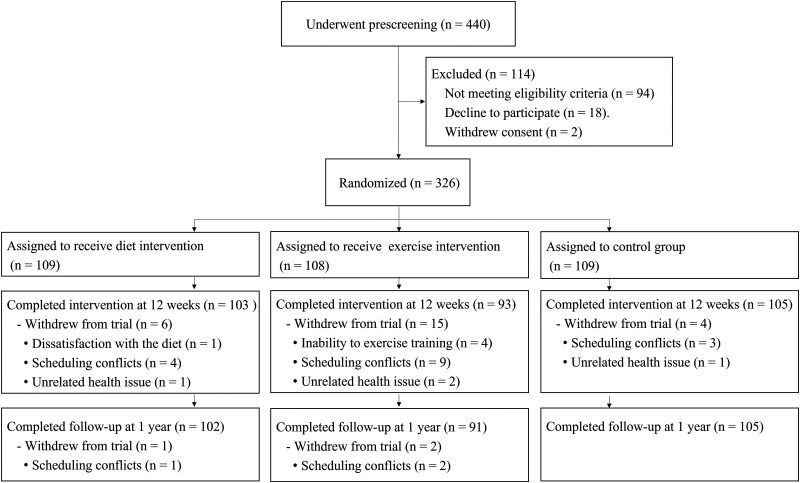
This two-center, open-label, three-arm, parallel-group, randomized controlled trial recruited 326 participants with overweight/obesity and type 2 diabetes and randomized them into 12 weeks of diet intervention (n = 109), exercise intervention (n = 108), or lifestyle education (control) (n = 109). The primary outcome was the change of glycemic control measured as glycated hemoglobin (HbA1c) between the diet or exercise intervention groups and the control group after the 12-week intervention.
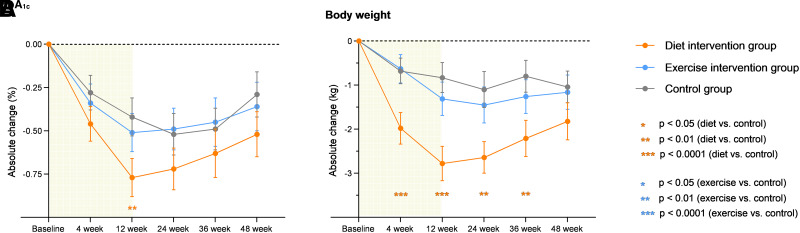
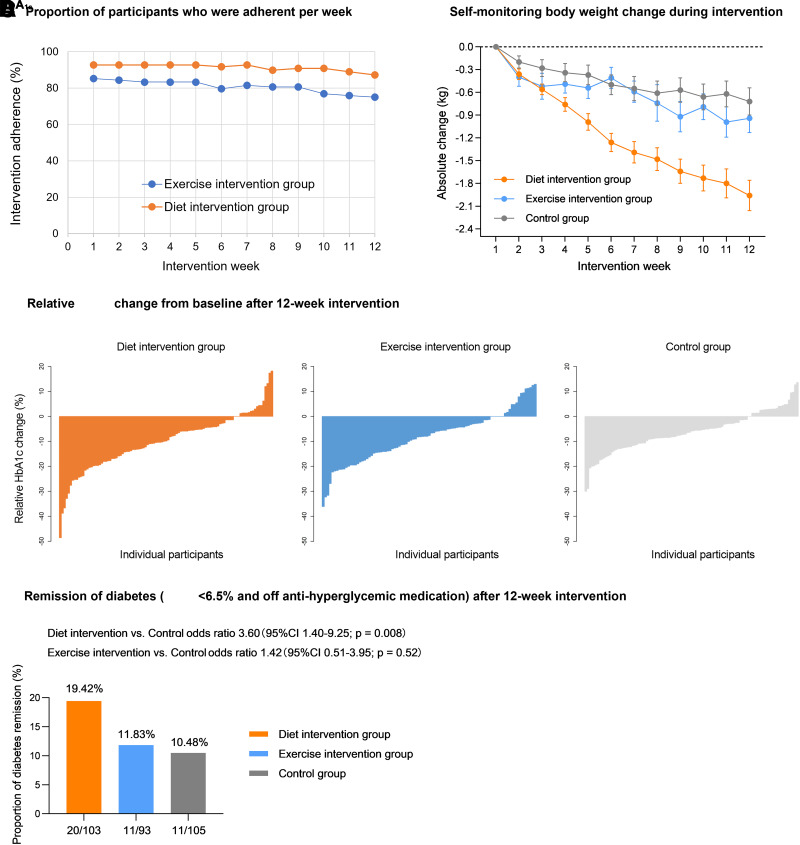
The diet intervention significantly reduced HbA1c level (%) after the 12-week intervention (-0.72, 95% CI -0.95 to -0.48) compared with the control group (-0.37, 95% CI -0.60 to -0.15) (diet vs. control -0.34, 95% CI -0.58 to -0.11, P = 0.007). The reduction in HbA1c level in the exercise intervention group (-0.46, 95% CI -0.70 to -0.23) did not significantly differ from the control group (exercise vs. control -0.09, 95% CI -0.32 to 0.15, P = 0.47). The exercise intervention group was superior in maintaining lean body mass. Both diet and exercise interventions induced improvements in adiposity and hepatic steatosis.
These findings suggest that the medically supervised 5:2 energy-restricted diet could provide an alternative strategy for improving glycemic control and that the exercise regimen could improve body composition, although it inadequately improved glycemic control.
我们旨在研究 5:2 饮食(每周 2 天通过配方饮食限制能量)或运动(每周 2 天进行高强度间歇训练和抗阻训练)干预与常规生活方式教育(对照组)相比,对超重/肥胖和 2 型糖尿病患者的血糖控制和心脏代谢健康的影响。
这项两中心、开放标签、三臂、平行组、随机对照试验纳入了 326 名超重/肥胖和 2 型糖尿病患者,并将他们随机分为 12 周饮食干预组(n = 109)、运动干预组(n = 108)或生活方式教育对照组(n = 109)。主要结局是通过糖化血红蛋白(HbA1c)衡量的血糖控制变化,比较饮食或运动干预组与对照组在 12 周干预后的变化。
饮食干预组在 12 周干预后 HbA1c 水平(%)显著降低(-0.72,95%CI -0.95 至 -0.48),与对照组(-0.37,95%CI -0.60 至 -0.15)相比(饮食 vs. 对照组 -0.34,95%CI -0.58 至 -0.11,P = 0.007)。运动干预组 HbA1c 水平降低(-0.46,95%CI -0.70 至 -0.23)与对照组相比无显著差异(运动 vs. 对照组 -0.09,95%CI -0.32 至 0.15,P = 0.47)。运动干预组在维持瘦体重方面更具优势。饮食和运动干预均能改善体脂和肝脂肪变性。
这些发现表明,医学监督的 5:2 能量限制饮食可能是改善血糖控制的一种替代策略,而运动方案可以改善身体成分,尽管它不能充分改善血糖控制。