Chavez Jennifer V, Ewart Leah Davis, Ilyas Ozair, Ghanooni Delaram, Diaz José E, Atkins Lindsay, Ramos Richard, Garayua Adriana Hernandez, Stewart Alex, Horvath Keith J, Hirshfield Sabina, Carrico Adam W
Florida International University.
University of Miami.
Res Sq. 2024 Apr 2:rs.3.rs-4132978. doi: 10.21203/rs.3.rs-4132978/v1.
Sexual minority men (SMM) with HIV who use stimulants may experience greater difficulties with antiretroviral therapy adherence which amplifies risk for unsuppressed HIV viral load (VL). Remote monitoring of VL could support efforts to rapidly respond to sub-optimal adherence.
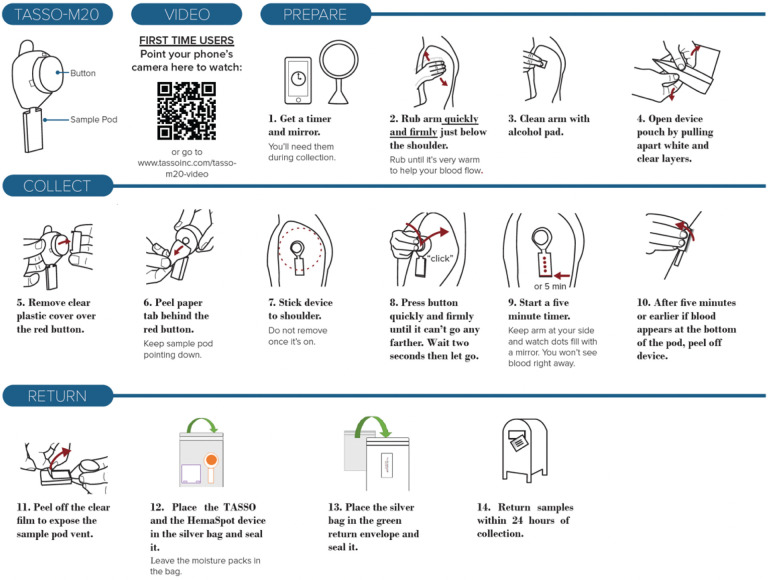
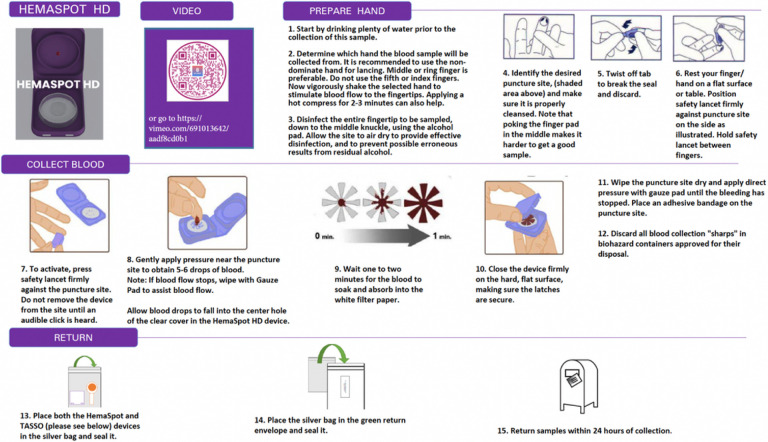
This qualitative study enrolled 24 SMM with HIV who use stimulants to examine experiences with two different dried blood spots (DBS) self-sampling devices (i.e., Tasso-M20 vs. HemaSpot HD) to measure VL. Participants were asked to complete self-sampling of DBS using both devices, and then participated in a 45-minute semi-structured interview. Interviews focused on ease of use, device preference, experiences with receiving and mailing kits, and barriers to participating in research. A thematic analysis was conducted to analyze interviews transcripts.
Twenty-two participants (92%) returned the Tasso-M20 and 21 (88%) returned the Hemaspot HD devices. Among the 22 participants that completed qualitative interviews, twenty-three codes were identified and collapsed within seven themes. Preferences for devices were based on convenience, pain and prior experiences with finger-pricking technology. Participants emphasized that clearer instructions with contingency plans for self-sampling of DBS would improve the user experience with self-sampling of DBS. Intersectional stigma (e.g., HIV, sexual minority status, and substance use) was noted as an important consideration in implementing self-sampling of DBS. Promoting decision making, or the option to choose sampling method based on personal preferences, may improve engagement and likelihood of DBS completion.
Findings will guide the broader implementation of self-sampling of DBS to optimize VL monitoring in SMM with HIV who use stimulants.
感染艾滋病毒且使用兴奋剂的性少数群体男性(SMM)在抗逆转录病毒治疗依从性方面可能会遇到更大困难,这会增加艾滋病毒病毒载量(VL)未得到抑制的风险。对病毒载量进行远程监测有助于迅速应对依从性欠佳的情况。
这项定性研究招募了24名感染艾滋病毒且使用兴奋剂的SMM,以考察他们使用两种不同的干血斑(DBS)自采样设备(即Tasso-M20与HemaSpot HD)测量病毒载量的体验。参与者被要求使用这两种设备完成DBS自采样,然后参加一次45分钟的半结构化访谈。访谈重点围绕易用性、设备偏好、接收和邮寄试剂盒的体验以及参与研究的障碍。对访谈记录进行了主题分析。
22名参与者(92%)归还了Tasso-M20设备,21名(88%)归还了HemaSpot HD设备。在完成定性访谈的22名参与者中,共识别出23个编码,并归纳为7个主题。对设备的偏好基于便利性、疼痛程度以及对手指采血技术的既往体验。参与者强调,更清晰的说明以及DBS自采样的应急计划将改善DBS自采样的用户体验。交叉污名(如艾滋病毒、性少数群体身份和物质使用)被视为实施DBS自采样时的一个重要考量因素。促进决策制定,或者提供根据个人偏好选择采样方法的选项,可能会提高参与度以及完成DBS采样的可能性。
研究结果将指导更广泛地实施DBS自采样,以优化对感染艾滋病毒且使用兴奋剂的SMM的病毒载量监测。