Hassaan Said, Mohamed Abdulaziz, Ibrahim Ahmed Farid, Elkatatny Salaheldin
Department of Petroleum Engineering, Cairo University, Giza 12613, Egypt.
Department of Petroleum Engineering and Geosciences, King Fahd University of Petroleum & Minerals, Dhahran 31261, Saudi Arabia.
ACS Omega. 2024 Apr 8;9(15):17066-17075. doi: 10.1021/acsomega.3c08795. eCollection 2024 Apr 16.
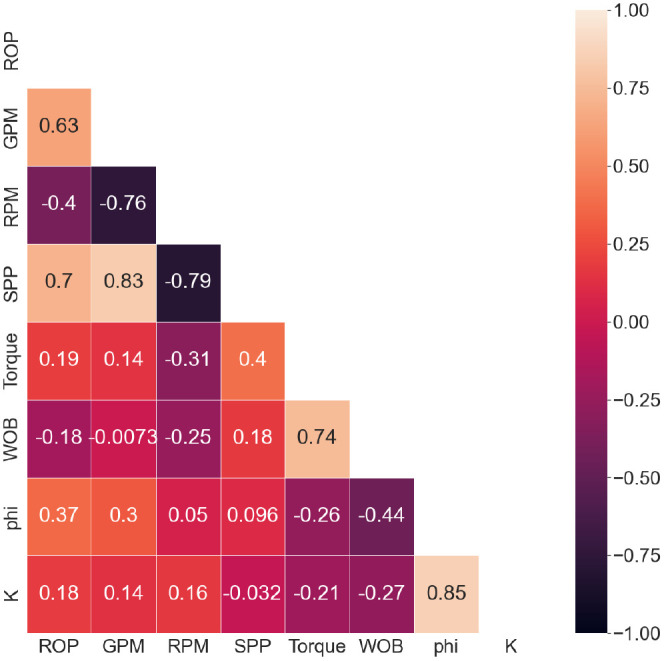
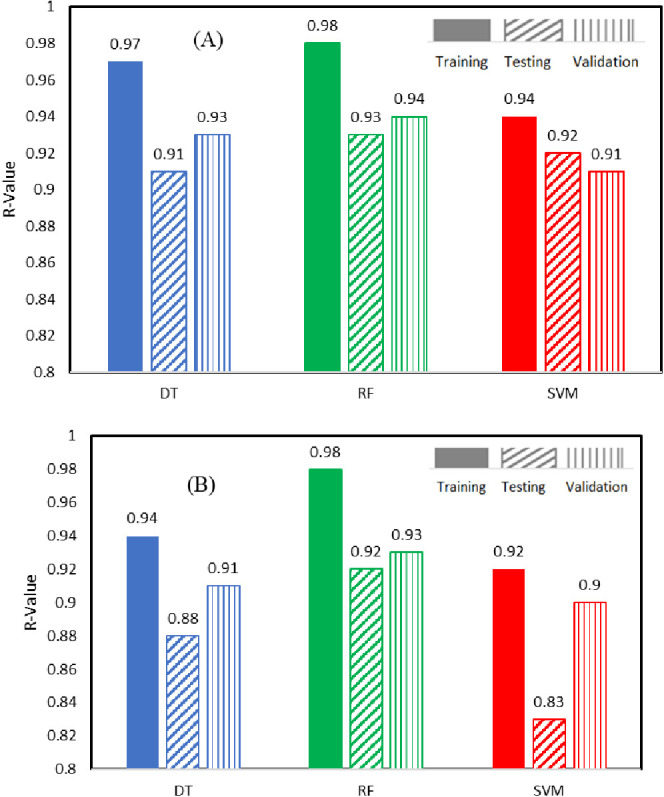
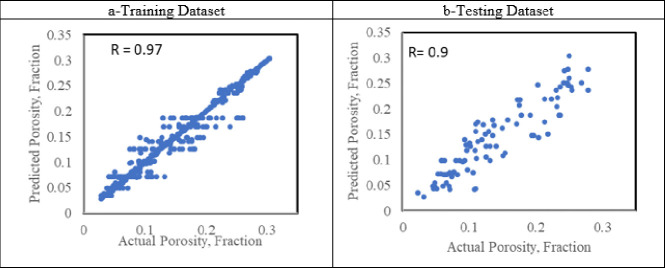
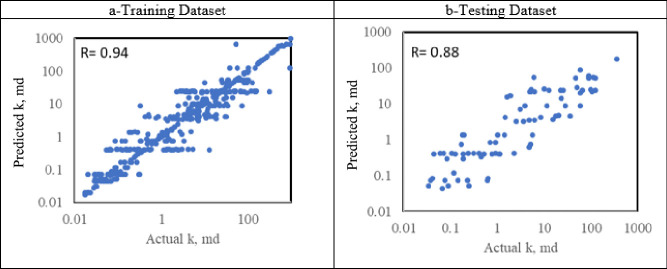
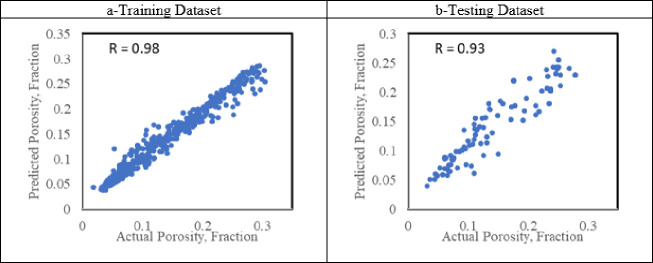
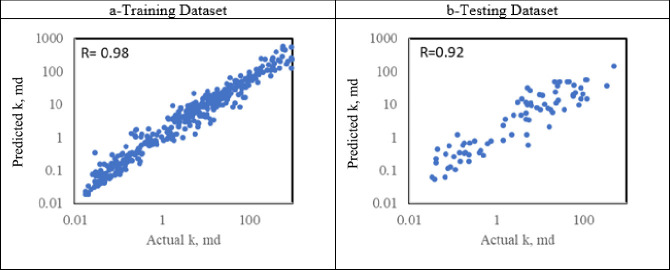
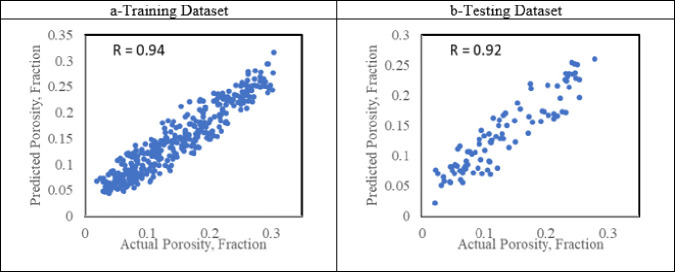
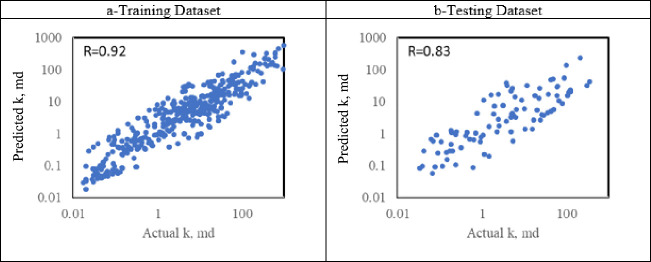
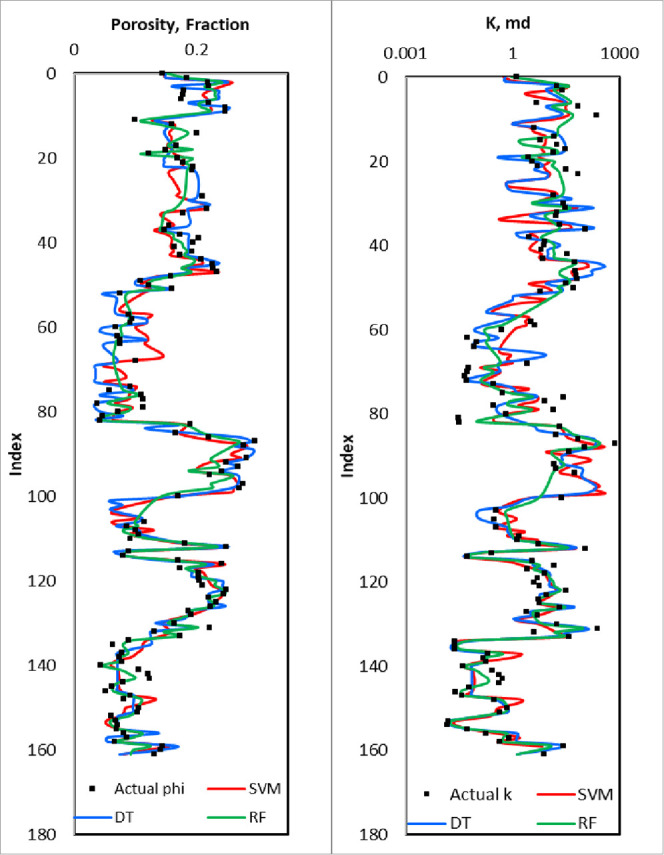
The prediction of rock porosity and permeability is crucial for assessing reservoir productivity and economic feasibility. However, traditional methods for obtaining these properties are time-consuming and expensive, making them impractical for comprehensive reservoir evaluation. This study introduces a novel approach to efficiently predict rock porosity and permeability for reservoir assessment by leveraging real-time machine learning models. Utilizing readily available drilling parameters, this approach offers a cost-effective alternative to traditional time-consuming methods to predict formation petrophysical parameters in real-time. The data set used in this study was collected from two vertical wells located in the Middle East. It encompasses drilling parameters such as the rate of penetration (ROP), gallons per minute (GPM), revolutions per minute (RPM), strokes per minute (SPP), torque, and weight on bit (WOB), along with the corresponding measurements of porosity (ϕ) and permeability () obtained through core analysis. Three machine learning models, namely, decision trees (DTs), random forest (RFs), and support vector machines (SVMs), were employed and evaluated for their effectiveness in predicting porosity and permeability. The results demonstrate promising performance across the different data sets. All three models achieved correlation coefficients () higher than 0.91 in predicting porosity. The RF model exhibited accurate predictions of permeability, achieving values surpassing 0.92 in the various data sets. While the DT model displayed slightly lower performance, with the -value decreasing to 0.88 in the testing data set, the SVM model suffered from overfitting, with values dropping to 0.83 in the testing data set. The novelty of this work lies in the successful application of machine learning models to the real-time prediction of reservoir properties, providing a practical and efficient solution for the oil and gas industry. By achieving correlation coefficients exceeding 0.91 and showcasing the models' efficacy in a dynamic testing data set, this study paves the way for improved decision-making processes and enhanced exploration and production activities. The innovative aspect lies in the utilization of drilling parameters for timely and cost-effective estimation, transforming conventional reservoir evaluation methods.
岩石孔隙度和渗透率的预测对于评估油藏产能和经济可行性至关重要。然而,获取这些属性的传统方法既耗时又昂贵,使其在全面的油藏评价中不切实际。本研究引入了一种新颖的方法,通过利用实时机器学习模型来高效预测岩石孔隙度和渗透率,以进行油藏评价。利用现成的钻井参数,这种方法为传统的耗时方法提供了一种经济高效的替代方案,能够实时预测地层岩石物理参数。本研究中使用的数据集来自中东地区的两口垂直井。它包括钻速(ROP)、每分钟加仑数(GPM)、每分钟转数(RPM)、每分钟冲程数(SPP)、扭矩和钻压(WOB)等钻井参数,以及通过岩心分析获得的相应孔隙度(ϕ)和渗透率()测量值。采用了三种机器学习模型,即决策树(DTs)、随机森林(RFs)和支持向量机(SVMs),并评估了它们在预测孔隙度和渗透率方面的有效性。结果表明,在不同数据集上都有良好的表现。所有三种模型在预测孔隙度时的相关系数()均高于0.91。RF模型对渗透率的预测较为准确,在各个数据集中的值超过0.92。虽然DT模型的表现略低,在测试数据集中的值降至0.88,但SVM模型存在过拟合问题,在测试数据集中的值降至0.83。这项工作的新颖之处在于成功地将机器学习模型应用于油藏属性的实时预测,为石油和天然气行业提供了一种实用且高效的解决方案。通过实现相关系数超过0.91,并在动态测试数据集中展示模型的有效性,本研究为改进决策过程以及加强勘探和生产活动铺平了道路。创新之处在于利用钻井参数进行及时且经济高效的估计,改变了传统的油藏评价方法。