Dunst Anna Katharina, Hesse Clemens, Ueberschär Olaf
Institute for Applied Training Science, Department of Endurance Sports, Leipzig, Germany.
German Cycling Federation, Frankfurt, Germany.
Front Physiol. 2024 Apr 5;15:1343601. doi: 10.3389/fphys.2024.1343601. eCollection 2024.
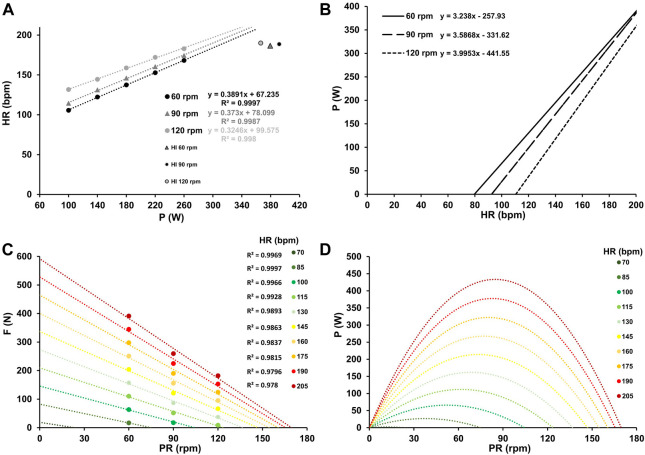
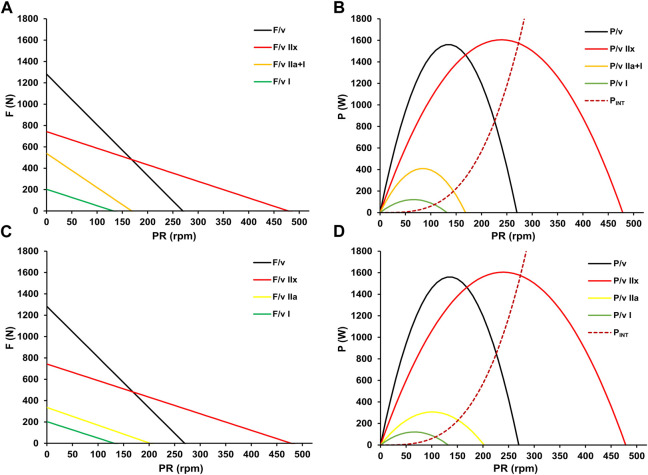
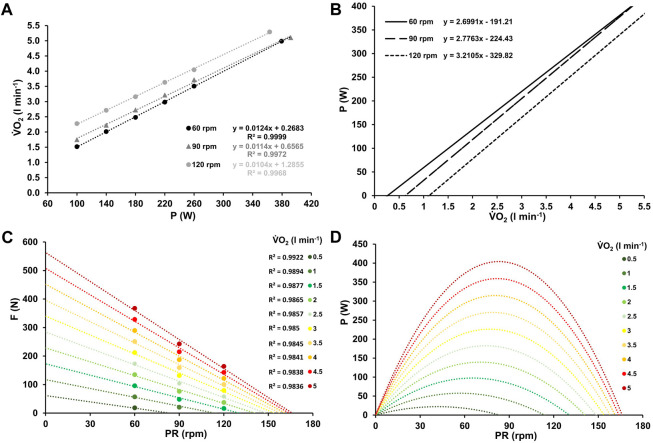
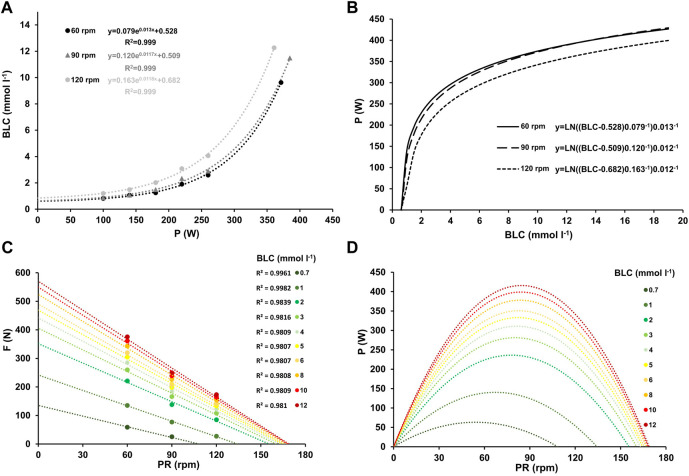
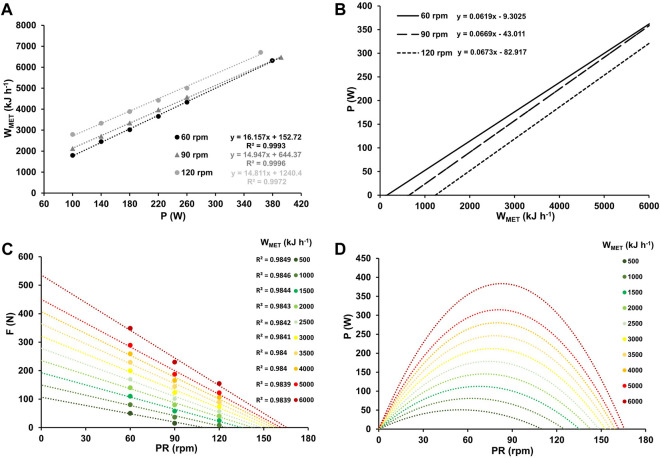
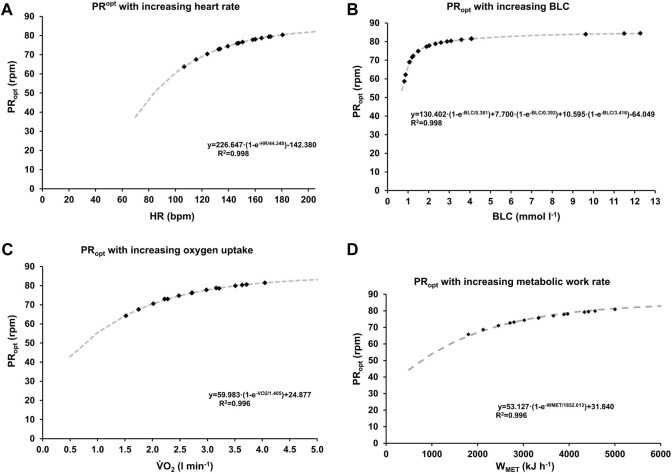
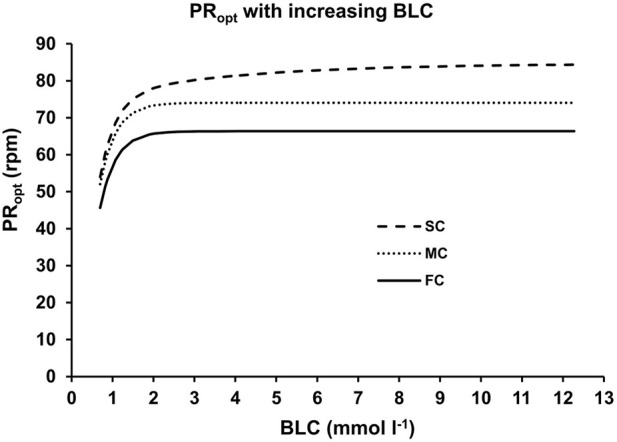
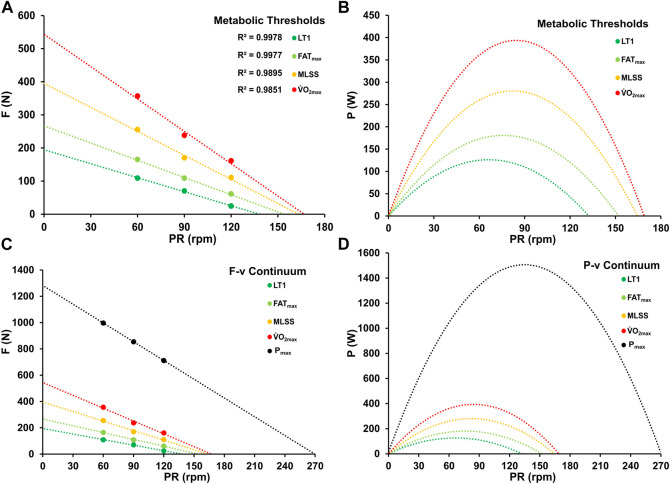
This study aimed to investigate the changes in force-velocity (F/v) and power-velocity (P/v) relationships with increasing work rate up to maximal oxygen uptake and to assess the resulting alterations in optimal cadence, particularly at characteristic metabolic states. Fourteen professional track cyclists (9 sprinters, 5 endurance athletes) performed submaximal incremental tests, high-intensity cycling trials, and maximal sprints at varied cadences (60, 90, 120 rpm) on an SRM bicycle ergometer. Linear and non-linear regression analyses were used to assess the relationship between heart rate, oxygen uptake (V.O), blood lactate concentration and power output at each pedaling rate. Work rates linked to various cardiopulmonary and metabolic states, including lactate threshold (LT1), maximal fat combustion (FAT), maximal lactate steady-state (MLSS) and maximal oxygen uptake (V.O), were determined using cadence-specific inverse functions. These data were used to calculate state-specific force-velocity (F/v) and power-velocity (P/v) profiles, from which state-specific optimal cadences were derived. Additionally, fatigue-free profiles were generated from sprint data to illustrate the entire F/v and P/v continuum. HR, V.O demonstrated linear relationships, while BLC exhibited an exponential relationship with work rate, influenced by cadence ( < 0.05, η ≥ 0.655). Optimal cadence increased sigmoidally across all parameters, ranging from 66.18 ± 3.00 rpm at LT1, 76.01 ± 3.36 rpm at FAT, 82.24 ± 2.59 rpm at MLSS, culminating at 84.49 ± 2.66 rpm at V.O ( < 0.01, η = 0.936). A fatigue-free optimal cadence of 135 ± 11 rpm was identified. Sprinters and endurance athletes showed no differences in optimal cadences, except for the fatigue-free optimum ( < 0.001, d = 2.215). Optimal cadence increases sigmoidally with exercise intensity up to maximal aerobic power, irrespective of the athlete's physical condition or discipline. Threshold-specific changes in optimal cadence suggest a shift in muscle fiber type recruitment toward faster types beyond these thresholds. Moreover, the results indicate the need to integrate movement velocity into Henneman's hierarchical size principle and the critical power curve. Consequently, intensity zones should be presented as a function of movement velocity rather than in absolute terms.
本研究旨在探究随着工作强度增加直至最大摄氧量时,力-速度(F/v)和功率-速度(P/v)关系的变化,并评估由此导致的最佳踏频变化,尤其是在特定代谢状态下。14名职业场地自行车运动员(9名短跑运动员,5名耐力运动员)在SRM自行车测力计上以不同踏频(60、90、120转/分钟)进行次最大递增测试、高强度骑行试验和最大冲刺。采用线性和非线性回归分析来评估每个踏频下心率、摄氧量(V.O)、血乳酸浓度与功率输出之间的关系。使用特定踏频的反函数确定与各种心肺和代谢状态相关的工作强度,包括乳酸阈(LT1)、最大脂肪燃烧(FAT)、最大乳酸稳态(MLSS)和最大摄氧量(V.O)。这些数据用于计算特定状态的力-速度(F/v)和功率-速度(P/v)曲线,从中得出特定状态的最佳踏频。此外,从冲刺数据生成无疲劳曲线以说明整个F/v和P/v连续体。心率、摄氧量呈线性关系,而血乳酸浓度与工作强度呈指数关系,受踏频影响(<0.05,η≥0.655)。所有参数的最佳踏频呈S形增加,从LT1时的66.18±3.00转/分钟、FAT时的76.01±3.36转/分钟、MLSS时的82.24±2.59转/分钟,最终在V.O时达到84.49±2.66转/分钟(<0.01,η=0.936)。确定无疲劳最佳踏频为135±11转/分钟。短跑运动员和耐力运动员在最佳踏频上无差异,除了无疲劳最佳踏频(<0.001,d=2.215)。最佳踏频随着运动强度呈S形增加直至最大有氧功率,与运动员的身体状况或项目无关。特定阈值下最佳踏频的变化表明,超过这些阈值后,肌肉纤维类型募集向更快类型转变。此外,结果表明需要将运动速度纳入亨内曼的分级大小原则和临界功率曲线。因此,强度区域应以运动速度的函数形式呈现,而非绝对值形式。