Al-Asmari Ahmed Ibrahim
Special Toxicological Analysis Section, Pathology and Laboratory Medicine Department, King Faisal Special Hospital and Research Center, P.O. Box 3354, Riyadh 11211, Saudi Arabia.
Saudi Pharm J. 2024 May;32(5):102065. doi: 10.1016/j.jsps.2024.102065. Epub 2024 Apr 8.
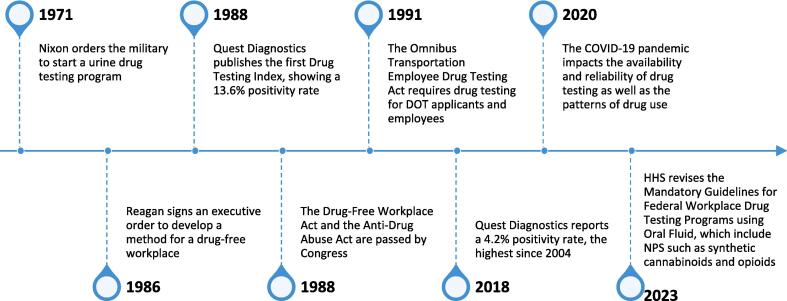
Workplace drug testing (WDT) is essential to prevent drug abuse disorders among the workforce because it can impair work performance and safety. However, WDT is limited by many challenges, such as urine adulteration, specimen selection, and new psychoactive substances (NPS). This review examined the issues related to WDT. Various scientific databases were searched for articles on WDT for drug detection published between 1986 (when WDT started) and January 2024. The review discussed the history, importance, and challenges of WDT, such as time of specimen collection/testing, specimen adulteration, interference in drug testing, and detection of NPS. It evaluated the best methods to detect NPS in forensic laboratories. Moreover, it compared different techniques that can enhance WDT, such as immunoassays, targeted mass spectrometry, and nontargeted mass spectrometry. These techniques can be used to screen for known and unknown drugs and metabolites in biological samples. This review assessed the strengths and weaknesses of such techniques, such as their validation, identification, library search, and reference standards. Furthermore, this review contrasted the benefits and drawbacks of different specimens for WDT and discussed studies that have applied these techniques for WDT. WDT remains the best approach for preventing drug abuse in the workplace, despite the challenges posed by NPS and limitations of the screening methods. Nontargeted techniques using high-resolution liquid chromatography-mass spectrometry (MS)/gas chromatography-tandem MS can improve the detection and identification of drugs during WDT and provide useful information regarding the prevalence, trends, and toxicity of both traditional and NPS drugs. Finally, this review suggested that WDT can be improved by using a combination of techniques, multiple specimens, and online library searches in case of new NPS as well as by updating the methods and databases to include new NPS and metabolites as they emerge. To the best of the author's knowledge, this is the first review to address NPS as an issue in WDT and its application and propose the best methods to detect these substances in the workplace environment.
工作场所药物检测(WDT)对于预防劳动力中的药物滥用障碍至关重要,因为它会损害工作绩效和安全。然而,WDT受到许多挑战的限制,例如尿液掺假、样本选择和新型精神活性物质(NPS)。本综述研究了与WDT相关的问题。检索了各种科学数据库,以查找1986年(WDT开始时)至2024年1月期间发表的关于用于药物检测的WDT的文章。该综述讨论了WDT的历史、重要性和挑战,如样本采集/检测时间、样本掺假、药物检测干扰以及NPS的检测。它评估了法医实验室中检测NPS的最佳方法。此外,它比较了可以增强WDT的不同技术,如免疫测定、靶向质谱和非靶向质谱。这些技术可用于筛查生物样本中的已知和未知药物及代谢物。本综述评估了这些技术的优缺点,如它们的验证、鉴定、库搜索和参考标准。此外,本综述对比了不同样本用于WDT的利弊,并讨论了将这些技术应用于WDT的研究。尽管NPS带来了挑战且筛查方法存在局限性,但WDT仍然是预防工作场所药物滥用的最佳方法。使用高分辨率液相色谱 - 质谱(MS)/气相色谱 - 串联质谱的非靶向技术可以改善WDT期间药物的检测和鉴定,并提供有关传统药物和NPS药物的流行率、趋势和毒性的有用信息。最后,本综述建议,通过结合多种技术、多个样本以及在出现新NPS时进行在线库搜索,以及更新方法和数据库以纳入新出现的NPS和代谢物,可以改进WDT。据作者所知,这是第一篇将NPS作为WDT中的一个问题及其应用进行探讨,并提出在工作场所环境中检测这些物质的最佳方法的综述。