Webster Luke J, Villa-Gomez Denys, Brown Reuben, Clarke William, Schenk Peer M
Australian Institute for Bioengineering and Nanotechnology, The University of Queensland, Brisbane, QLD, Australia.
School of Civil Engineering, The University of Queensland, Brisbane, QLD, Australia.
Front Bioeng Biotechnol. 2024 Apr 5;12:1379301. doi: 10.3389/fbioe.2024.1379301. eCollection 2024.
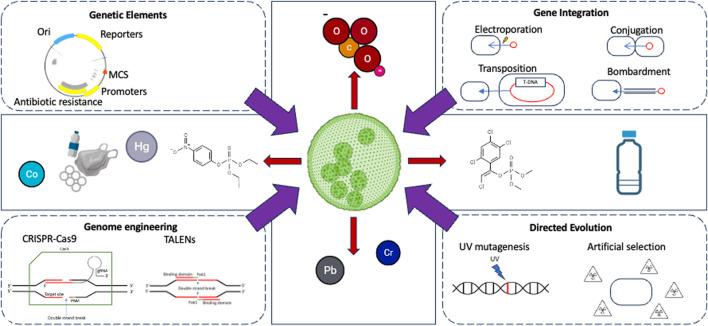
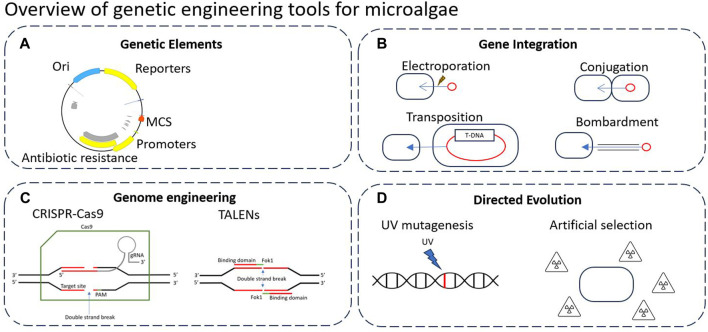
The increase in global population and industrial development has led to a significant release of organic and inorganic pollutants into water streams, threatening human health and ecosystems. Microalgae, encompassing eukaryotic protists and prokaryotic cyanobacteria, have emerged as a sustainable and cost-effective solution for removing these pollutants and mitigating carbon emissions. Various microalgae species, such as and have demonstrated their ability to eliminate heavy metals, salinity, plastics, and pesticides. Synthetic biology holds the potential to enhance microalgae-based technologies by broadening the scope of treatment targets and improving pollutant removal rates. This review provides an overview of the recent advances in the synthetic biology of microalgae, focusing on genetic engineering tools to facilitate the removal of inorganic (heavy metals and salinity) and organic (pesticides and plastics) compounds. The development of these tools is crucial for enhancing pollutant removal mechanisms through gene expression manipulation, DNA introduction into cells, and the generation of mutants with altered phenotypes. Additionally, the review discusses the principles of synthetic biology tools, emphasizing the significance of genetic engineering in targeting specific metabolic pathways and creating phenotypic changes. It also explores the use of precise engineering tools, such as CRISPR/Cas9 and TALENs, to adapt genetic engineering to various microalgae species. The review concludes that there is much potential for synthetic biology based approaches for pollutant removal using microalgae, but there is a need for expansion of the tools involved, including the development of universal cloning toolkits for the efficient and rapid assembly of mutants and transgenic expression strains, and the need for adaptation of genetic engineering tools to a wider range of microalgae species.
全球人口增长和工业发展导致大量有机和无机污染物排入水流,威胁着人类健康和生态系统。微藻包括真核原生生物和原核蓝细菌,已成为去除这些污染物和减少碳排放的可持续且经济高效的解决方案。各种微藻物种,如 和 ,已证明它们有能力去除重金属、盐分、塑料和农药。合成生物学有潜力通过拓宽处理目标范围和提高污染物去除率来增强基于微藻的技术。本综述概述了微藻合成生物学的最新进展,重点关注促进去除无机(重金属和盐分)和有机(农药和塑料)化合物的基因工程工具。这些工具的开发对于通过操纵基因表达、将DNA导入细胞以及产生具有改变表型的突变体来增强污染物去除机制至关重要。此外,综述讨论了合成生物学工具的原理,强调了基因工程在靶向特定代谢途径和产生表型变化方面的重要性。它还探讨了使用精确工程工具,如CRISPR/Cas9和TALENs,使基因工程适用于各种微藻物种。综述得出结论,基于合成生物学的微藻去除污染物方法有很大潜力,但需要扩展所涉及的工具,包括开发用于高效快速组装突变体和转基因表达菌株的通用克隆工具包,以及使基因工程工具适用于更广泛微藻物种的需求。