Wang Jiaming, Wang Peng, Liu Beibei, Kinney Patrick L, Huang Lei, Chen Kai
State Key Laboratory of Pollution Control and Resource Reuse, School of the Environment, Nanjing University, Nanjing 210023, China.
Faculty of Civil Engineering and Mechanics, Jiangsu University, Zhenjiang 212013, China.
Eco Environ Health. 2024 Jan 28;3(2):154-164. doi: 10.1016/j.eehl.2024.01.004. eCollection 2024 Jun.
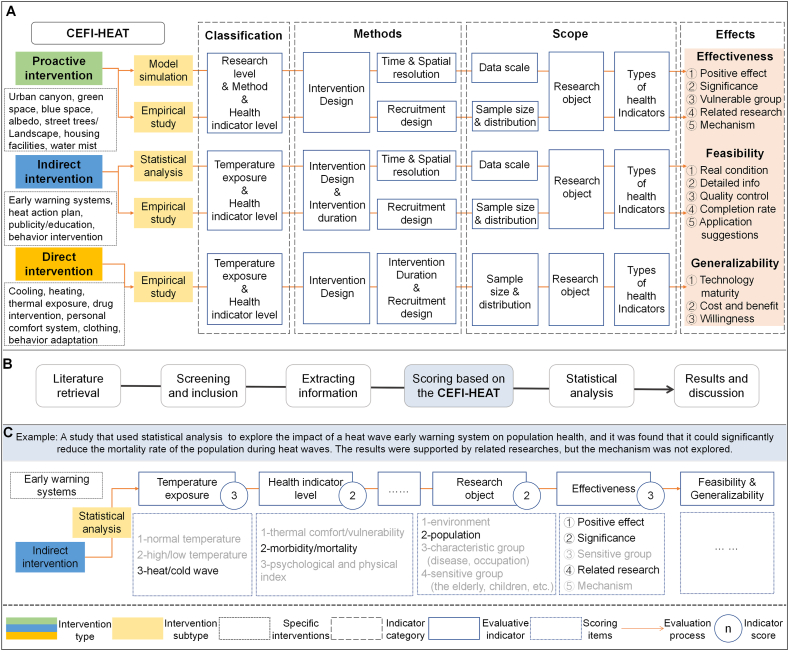
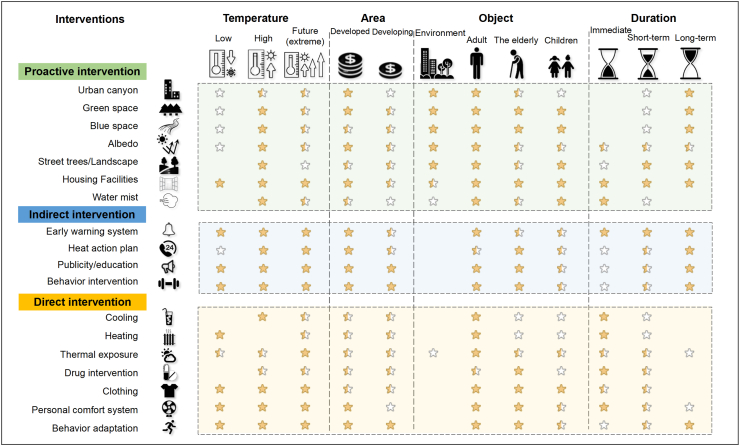
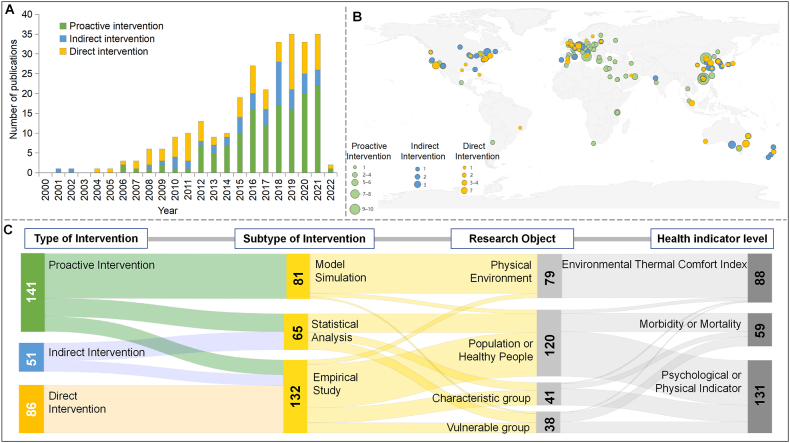
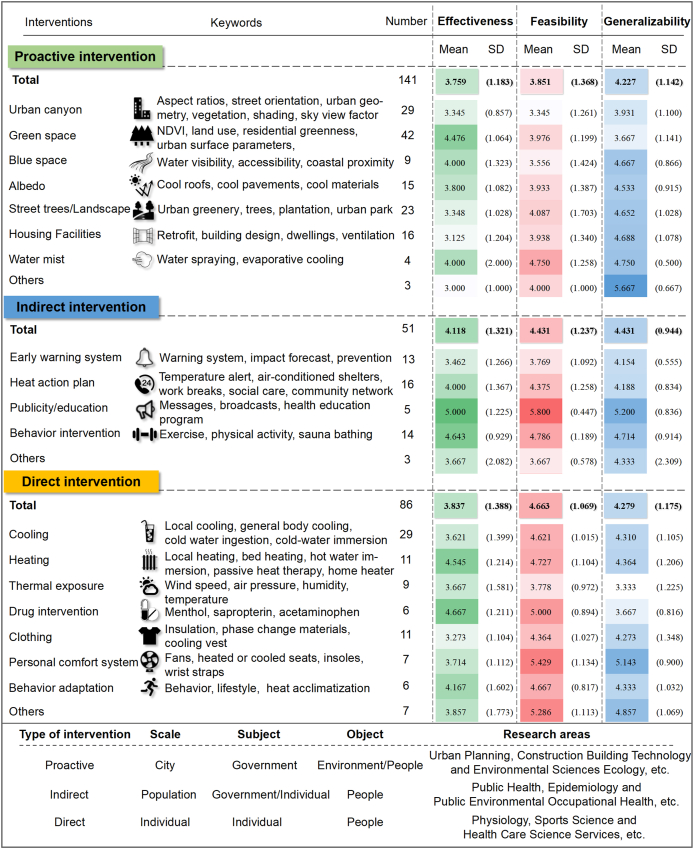
Despite the existence of many interventions to mitigate or adapt to the health effects of climate change, their effectiveness remains unclear. Here, we introduce the Comprehensive Evaluation Framework for Intervention on Health Effects of Ambient Temperature to evaluate study designs and effects of intervention studies. The framework comprises three types of interventions: proactive, indirect, and direct, and four categories of indicators: classification, methods, scope, and effects. We trialed the framework by an evaluation of existing intervention studies. The evaluation revealed that each intervention has its own applicable characteristics in terms of effectiveness, feasibility, and generalizability scores. We expanded the framework's potential by offering a list of intervention recommendations in different scenarios. Future applications are then explored to establish models of the relationship between study designs and intervention effects, facilitating effective interventions to address the health effects of ambient temperature under climate change.
尽管存在许多减轻或适应气候变化对健康影响的干预措施,但其有效性仍不明确。在此,我们引入《环境温度对健康影响的干预综合评估框架》来评估干预研究的设计和效果。该框架包括三种干预类型:主动型、间接型和直接型,以及四类指标:分类、方法、范围和效果。我们通过对现有干预研究进行评估来试用该框架。评估结果显示,每种干预措施在有效性、可行性和可推广性得分方面都有其适用特点。我们通过提供不同情景下的干预建议清单来拓展该框架的潜力。随后探讨了其未来应用,以建立研究设计与干预效果之间的关系模型,促进采取有效干预措施应对气候变化下环境温度对健康的影响。