Departamento de Medicina, Hospital General de Niños "Pedro de Elizalde", Buenos Aires, Argentina.
Department of Pediatrics and Infectious Disease, Hsinchu Municipal MacKay Children's Hospital, Hsinchu, Taiwan.
Paediatr Drugs. 2024 Jul;26(4):411-427. doi: 10.1007/s40272-024-00625-x. Epub 2024 Apr 22.
Respiratory syncytial virus (RSV) causes significant morbidity and mortality in children aged ≤ 5 years and adults aged ≥ 60 years worldwide. Despite this, RSV-specific therapeutic options are limited. Rilematovir is an investigational, orally administered inhibitor of RSV fusion protein-mediated viral entry.
To establish the antiviral activity, clinical outcomes, safety, and tolerability of rilematovir (low or high dose) in children aged ≥ 28 days and ≤ 3 years with RSV disease.
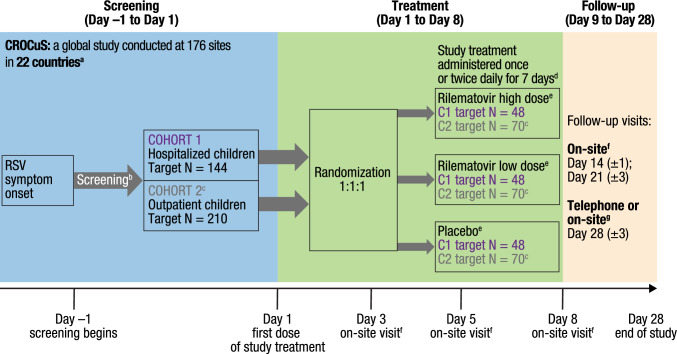
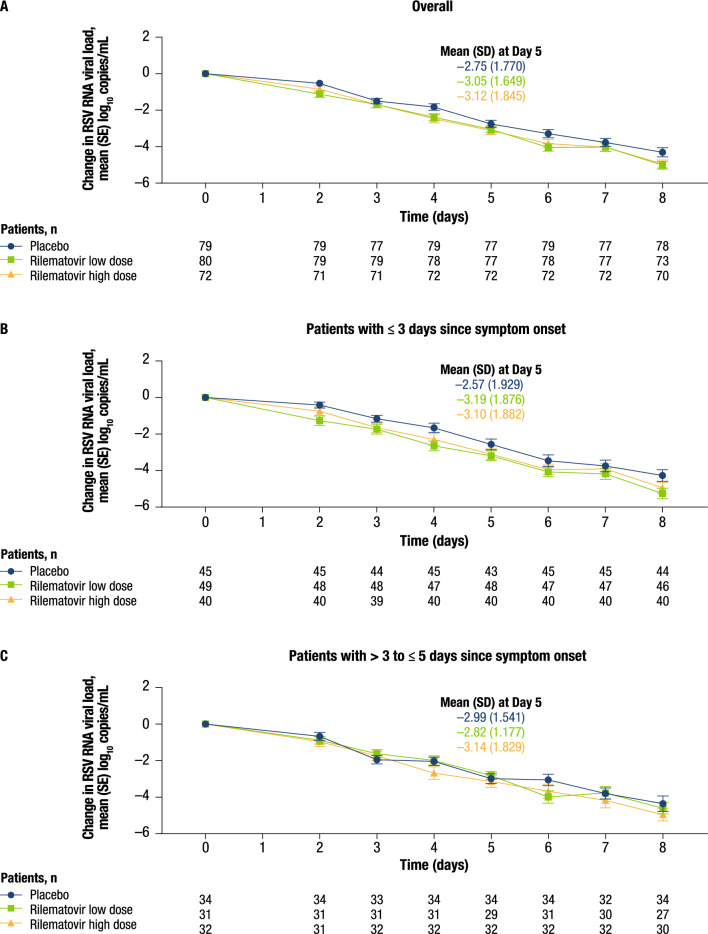
CROCuS was a multicenter, international, double-blind, placebo-controlled, randomized, adaptive phase II study, wherein children aged ≥ 28 days and ≤ 3 years with confirmed RSV infection who were either hospitalized (Cohort 1) or treated as outpatients (Cohort 2) were randomized (1:1:1) to receive rilematovir (low or high dose) or placebo. Study treatment was administered daily as an oral suspension from days 1 to 7, with dosing based on weight and age groups. The primary objective was to establish antiviral activity of rilematovir by evaluating the area under the plasma concentration-time curve of RSV viral load in nasal secretions from baseline through day 5. Severity and duration of RSV signs and symptoms and the safety and tolerability of rilematovir were also assessed through day 28 (± 3).
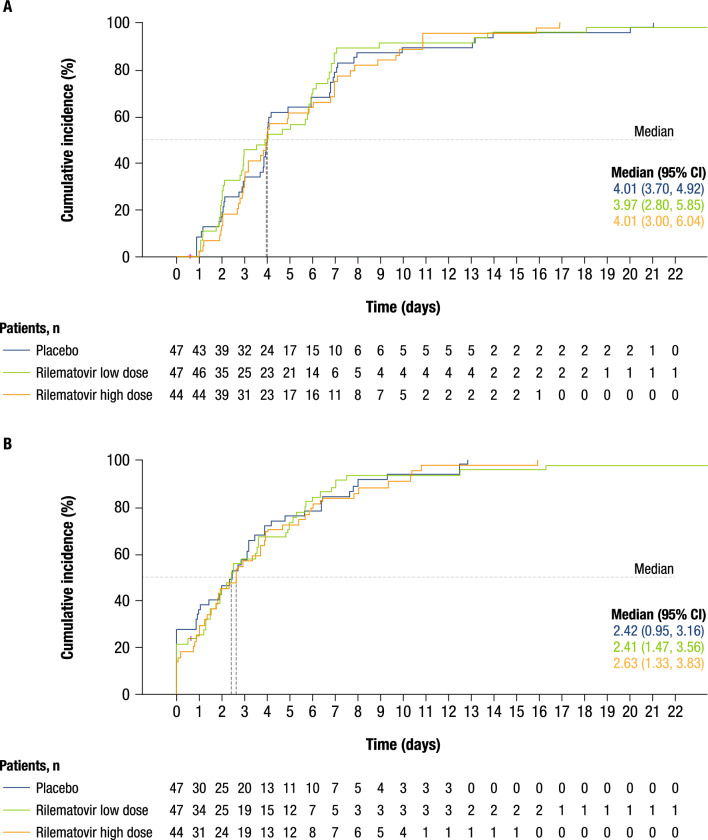
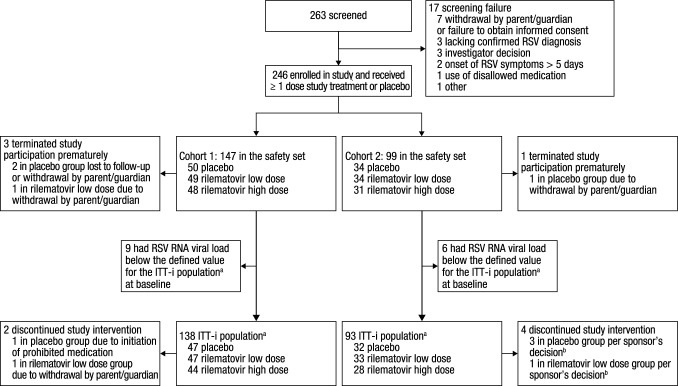
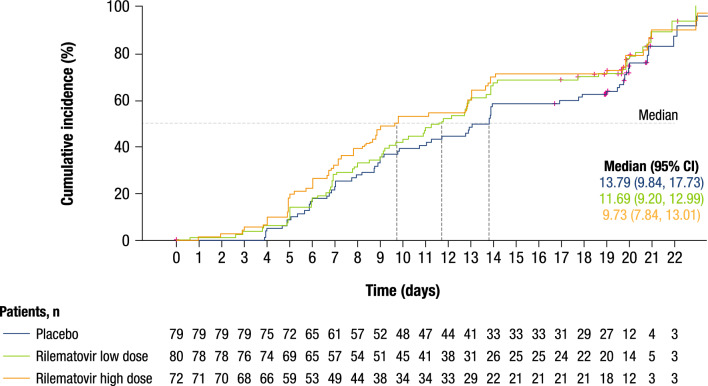
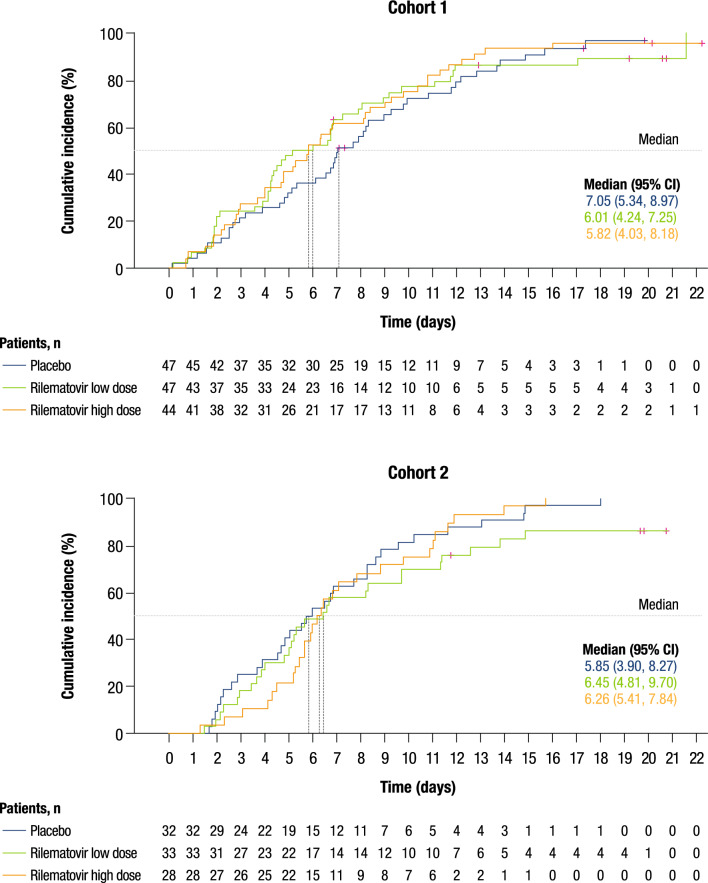
In total, 246 patients were randomized, treated, and included in the safety analysis population (Cohort 1: 147; Cohort 2: 99). Of these, 231 were included in the intent-to-treat-infected analysis population (Cohort 1: 138; Cohort 2: 93). In both cohorts, demographics were generally similar across treatment groups. In both cohorts combined, the difference (95% confidence interval) in the mean area under the plasma concentration-time curve of RSV RNA viral load through day 5 was - 1.25 (- 2.672, 0.164) and - 1.23 (- 2.679, 0.227) log copies∙days/mL for the rilematovir low-dose group and the rilematovir high-dose group, respectively, when compared with placebo. The estimated Kaplan-Meier median (95% confidence interval) time to resolution of key RSV symptoms in the rilematovir low-dose, rilematovir high-dose, and placebo groups of Cohort 1 was 6.01 (4.24, 7.25), 5.82 (4.03, 8.18), and 7.05 (5.34, 8.97) days, respectively; in Cohort 2, estimates were 6.45 (4.81, 9.70), 6.26 (5.41, 7.84), and 5.85 (3.90, 8.27) days, respectively. A similar incidence of adverse events was reported in patients treated with rilematovir and placebo in Cohort 1 (rilematovir: 61.9%; placebo: 58.0%) and Cohort 2 (rilematovir: 50.8%; placebo: 47.1%), with most reported as grade 1 or 2 and none leading to study discontinuation. The study was terminated prematurely, as the sponsor made a non-safety-related strategic decision to discontinue rilematovir development prior to full recruitment of Cohort 2.
Data from the combined cohort suggest that rilematovir has a small but favorable antiviral effect of indeterminate clinical relevance compared with placebo, as well as a favorable safety profile. Safe and effective therapeutic options for RSV in infants and young children remain an unmet need.
EudraCT Number: 2016-003642-93; ClinicalTrials.gov Identifier: NCT03656510. First posted date: 4 September, 2018.
呼吸道合胞病毒(RSV)在全球范围内导致 5 岁以下儿童和 60 岁以上成年人发病率和死亡率显著增加。尽管如此,针对 RSV 的治疗选择仍然有限。利马托韦是一种研究性、口服的 RSV 融合蛋白介导的病毒进入抑制剂。
评估利马托韦(低剂量或高剂量)在患有 RSV 疾病的 28 天至 3 岁的儿童中的抗病毒活性、临床结局、安全性和耐受性。
CROCuS 是一项多中心、国际、双盲、安慰剂对照、随机、适应性的 II 期研究,其中患有确诊 RSV 感染的 28 天至 3 岁儿童,分为住院(队列 1)或门诊治疗(队列 2),按 1:1:1 的比例随机分配接受利马托韦(低剂量或高剂量)或安慰剂治疗。研究治疗从第 1 天至第 7 天每天口服混悬液,剂量根据体重和年龄组而定。主要目的是通过评估鼻分泌物中 RSV 病毒载量的血浆浓度-时间曲线下面积(AUC)来确定利马托韦的抗病毒活性,从基线到第 5 天。通过第 28 天(±3)还评估了 RSV 体征和症状的严重程度和持续时间以及利马托韦的安全性和耐受性。
共有 246 名患者接受了随机分组、治疗并纳入了安全性分析人群(队列 1:147 名;队列 2:99 名)。其中,231 名患者纳入意向治疗感染分析人群(队列 1:138 名;队列 2:93 名)。在两个队列中,治疗组的人口统计学特征总体相似。在两个队列中,低剂量利马托韦组和高剂量利马托韦组在第 5 天的鼻分泌物中 RSV RNA 病毒载量的 AUC 差异(95%置信区间)分别为-1.25(-2.672,0.164)和-1.23(-2.679,0.227)log 拷贝/天/mL,与安慰剂相比。队列 1 中,低剂量利马托韦组、高剂量利马托韦组和安慰剂组的关键 RSV 症状缓解的估计 Kaplan-Meier 中位(95%置信区间)时间分别为 6.01(4.24,7.25)、5.82(4.03,8.18)和 7.05(5.34,8.97)天;在队列 2 中,估计值分别为 6.45(4.81,9.70)、6.26(5.41,7.84)和 5.85(3.90,8.27)天。在队列 1(利马托韦:61.9%;安慰剂:58.0%)和队列 2(利马托韦:50.8%;安慰剂:47.1%)中,接受利马托韦和安慰剂治疗的患者报告了相似的不良事件发生率,大多数为 1 级或 2 级,没有任何不良事件导致研究终止。由于赞助商在完全招募队列 2 之前做出了与安全性无关的战略决定,停止了利马托韦的开发,因此该研究提前终止。
来自联合队列的数据表明,与安慰剂相比,利马托韦具有较小但有利的抗病毒作用,其临床相关性不确定,且具有良好的安全性。安全有效的 RSV 治疗选择在婴儿和幼儿中仍然是一个未满足的需求。
EudraCT 编号:2016-003642-93;临床试验.gov 标识符:NCT03656510。首次发布日期:2018 年 9 月 4 日。