Zhong Yaqin, Guo Xiaojun, Liu Yitong, Wang Yaning, Wang Yanan, Song Yan, Lu Rujian
School of Public Health, Nantong University, Nantong, China.
School of Science, Nantong University, Nantong, China.
BMC Nurs. 2024 Apr 22;23(1):254. doi: 10.1186/s12912-024-01907-y.
The aged people who live in nursing home are predicted to keep growing in the following decades. There are both quantitative imbalance and structural imbalance in the utilization of nursing homes in China. This study aimed to analyze old people's preference for nursing homes and help the government optimize resource allocation.
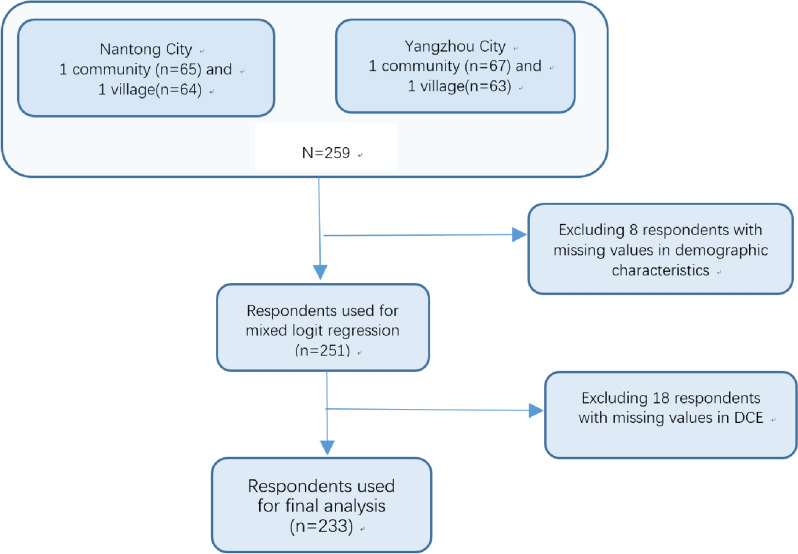
A discrete choice experiment (DCE) was conducted and six attributes of nursing homes including monthly fee, distance from home, geographical location, medical facilities, environment of nursing homes and nursing staff were determined. Respondents were recruited from Nantong and Yangzhou city, China. In each city, two communities or villages were randomly selected. In each community/village, about 65 old people were randomly selected. Analysis was conducted using mixed logit regression models to determine preferences for potential attributes.
A total of 233 old people were included in the analysis. The findings indicated that all six attributes were statistically significant factors for participants. "Professional nursing staff" was the most important characteristic to participants, followed by "Medical facilities". Compared with female, the males preferred professional nursing staff (β = 2.939 vs. β = 2.643, P < 0.001), medical facilities (β = 1.890 vs. β = 1.498, P < 0.001), and the environment (β = 0.752, P < 0.01). For different age groups, participants aged 60-69 didn't pay attention to distance and location, while those aged 80 and above only paid attention to professional nursing staff and medical facilities.
The present study provides important insights into the characteristics of nursing home that are most preferred by old people. Authorities should take into account old people's preference in the planning, design and evaluation of nursing homes.
预计在未来几十年里,居住在养老院的老年人数量将持续增长。中国养老院的利用存在数量和结构上的双重失衡。本研究旨在分析老年人对养老院的偏好,以帮助政府优化资源配置。
开展了一项离散选择实验(DCE),确定了养老院的六个属性,包括月费用、离家距离、地理位置、医疗设施、养老院环境和护理人员。研究对象来自中国南通和扬州市。在每个城市,随机选择两个社区或村庄。在每个社区/村庄,随机抽取约65名老年人。采用混合逻辑回归模型进行分析,以确定对潜在属性的偏好。
共有233名老年人纳入分析。结果表明,所有六个属性对参与者来说都是具有统计学意义的因素。“专业护理人员”是参与者最重要的特征,其次是“医疗设施”。与女性相比,男性更倾向于专业护理人员(β = 2.939对β = 2.643,P < 0.001)、医疗设施(β = 1.890对β = 1.498,P < 0.001)和环境(β = 0.752,P < 0.01)。对于不同年龄组,60 - 69岁的参与者不关注距离和位置,而80岁及以上的参与者只关注专业护理人员和医疗设施。
本研究为老年人最喜欢的养老院特征提供了重要见解。政府部门在养老院的规划、设计和评估中应考虑老年人的偏好。