Wu Jian, Feng Yifei, Zhao Yuanyuan, Guo Zhiping, Liu Rongmei, Zeng Xin, Yang Fan, Liu Bei, Gu Jianqing, Tarimo Clifford Silver, Shao Weihao, Guo Xinghong, Li Quanman, Zhao Lipei, Ma Mingze, Shen Zhanlei, Zhao Qiuping, Miao Yudong
Department of Health management, College of Public Health, Zhengzhou University, Zhengzhou, Henan, People's Republic of China.
Central China Fuwai Hospital of Zhengzhou University, Zhengzhou, Henan, People's Republic of China.
Int J Behav Nutr Phys Act. 2024 Apr 22;21(1):42. doi: 10.1186/s12966-024-01586-7.
Healthy lifestyle behaviors (LBs) have been widely recommended for the prevention and management of cardiovascular disease (CVD). Despite a large number of studies exploring the association between combined LBs and CVD, a notable gap exists in integration of relevant literatures. We conducted a systematic review and meta-analysis of prospective cohort studies to analyze the correlation between combined LBs and the occurrence of CVD, as well as to estimate the risk of various health complications in individuals already diagnosed with CVD.
Articles published up to February 10, 2023 were sourced through PubMed, EMBASE and Web of Science. Eligible prospective cohort studies that reported the relations of combined LBs with pre-determined outcomes were included. Summary relative risks (RRs) and 95% confidence intervals (CIs) were estimated using either a fixed or random-effects model. Subgroup analysis, meta-regression, publication bias, and sensitivity analysis were as well performed.
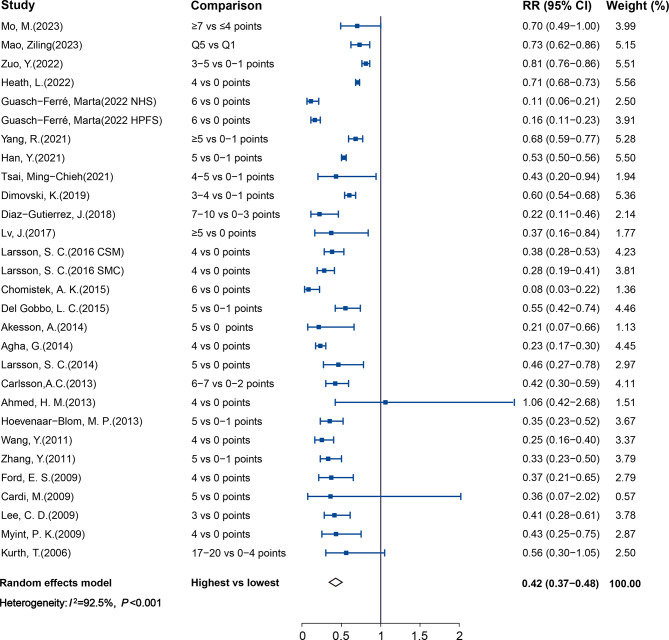
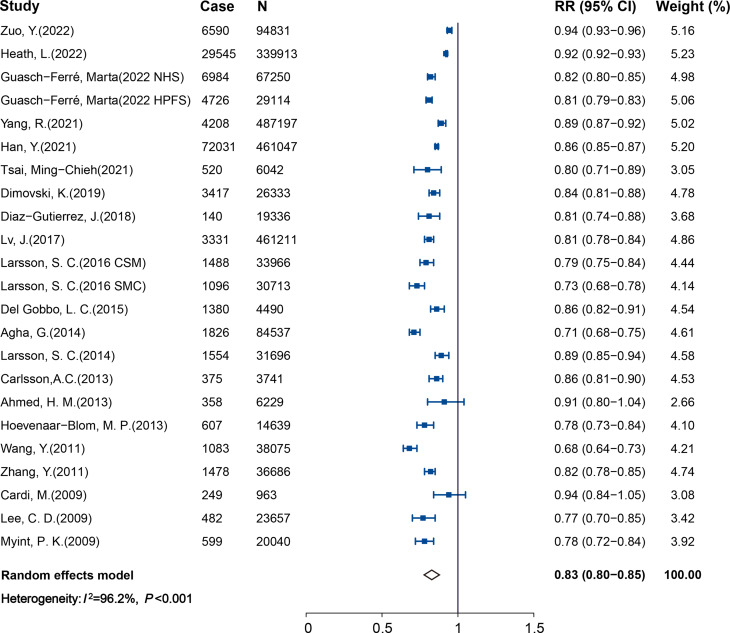
In the general population, individuals with the healthiest combination of LBs exhibited a significant risk reduction of 58% for CVD and 55% for CVD mortality. For individuals diagnosed with CVD, adherence to the healthiest combination of LBs corresponded to a significant risk reduction of 62% for CVD recurrence and 67% for all-cause mortality, when compared to those with the least-healthy combination of LBs. In the analysis of dose-response relationship, for each increment of 1 healthy LB, there was a corresponding decrease in risk of 17% for CVD and 19% for CVD mortality within the general population. Similarly, among individuals diagnosed with CVD, each additional healthy LB was associated with a risk reduction of 27% for CVD recurrence and 27% for all-cause mortality.
Adopting healthy LBs is associated with substantial risk reduction in CVD, CVD mortality, and adverse outcomes among individuals diagnosed with CVD. Rather than focusing solely on individual healthy LB, it is advisable to advocate for the adoption of multiple LBs for the prevention and management of CVD.
PROSPERO: CRD42023431731.
健康生活方式行为已被广泛推荐用于预防和管理心血管疾病(CVD)。尽管有大量研究探讨了综合生活方式行为与心血管疾病之间的关联,但相关文献的整合仍存在显著差距。我们对前瞻性队列研究进行了系统评价和荟萃分析,以分析综合生活方式行为与心血管疾病发生之间的相关性,并估计已诊断患有心血管疾病的个体出现各种健康并发症的风险。
通过PubMed、EMBASE和科学网检索截至2023年2月10日发表的文章。纳入报告综合生活方式行为与预定结局之间关系的合格前瞻性队列研究。使用固定效应模型或随机效应模型估计汇总相对风险(RR)和95%置信区间(CI)。还进行了亚组分析、meta回归、发表偏倚分析和敏感性分析。
在一般人群中,拥有最健康生活方式行为组合的个体患心血管疾病的风险显著降低58%,心血管疾病死亡率降低55%。对于已诊断患有心血管疾病的个体,与生活方式行为组合最不健康的个体相比,坚持最健康的生活方式行为组合可使心血管疾病复发风险显著降低62%,全因死亡率降低67%。在剂量反应关系分析中,在一般人群中,每增加一种健康的生活方式行为,心血管疾病风险相应降低17%,心血管疾病死亡率降低19%。同样,在已诊断患有心血管疾病的个体中,每增加一种健康的生活方式行为,心血管疾病复发风险降低27%,全因死亡率降低27%。
采用健康的生活方式行为与显著降低心血管疾病、心血管疾病死亡率以及已诊断患有心血管疾病个体的不良结局风险相关。与其仅关注单一的健康生活方式行为,建议倡导采用多种生活方式行为来预防和管理心血管疾病。
PROSPERO:CRD42023431731。