Tan Xu, Zhang Sheng, Song Wei, Liu Jia, Gao Cong, Chen Xiulai, Liu Liming, Wu Jing
School of Pharmaceutical Science, Jiangnan University, 1800 Lihu Road, Wuxi, 214122, China.
State Key Laboratory of Food Science and Technology, Jiangnan University, Wuxi, 214122, China.
Bioresour Bioprocess. 2021 May 21;8(1):41. doi: 10.1186/s40643-021-00394-2.
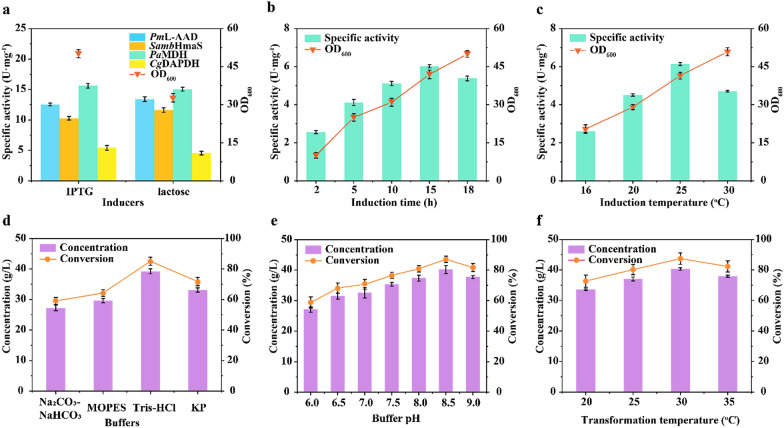
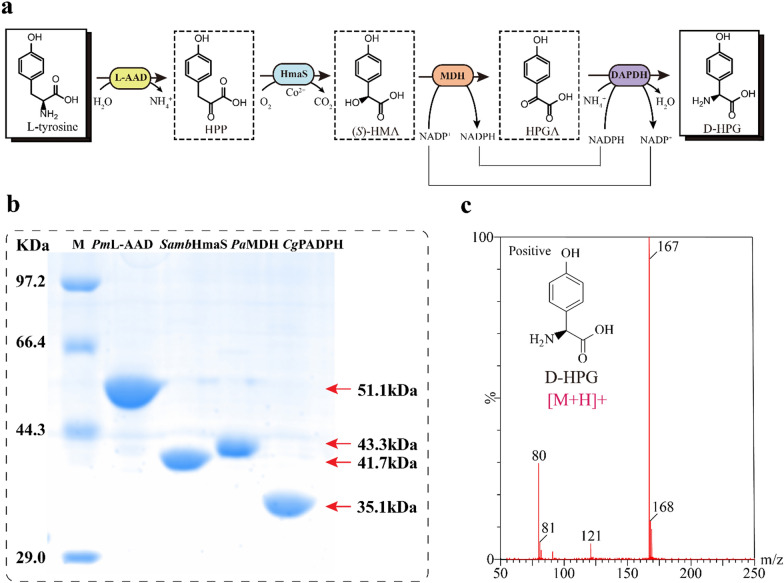
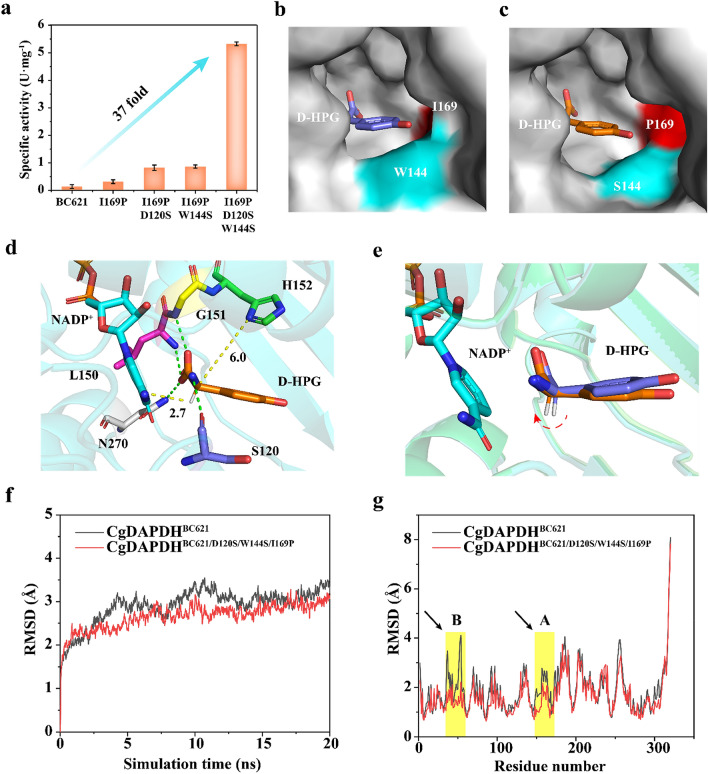
In this study, a four-enzyme cascade pathway was developed and reconstructed in vivo for the production of D-p-hydroxyphenylglycine (D-HPG), a valuable intermediate used to produce β-lactam antibiotics and in fine-chemical synthesis, from L-tyrosine. In this pathway, catalytic conversion of the intermediate 4-hydroxyphenylglyoxalate by meso-diaminopimelate dehydrogenase from Corynebacterium glutamicum (CgDAPDH) was identified as the rate-limiting step, followed by application of a mechanism-guided "conformation rotation" strategy to decrease the hydride-transfer distance d and increase CgDAPDH activity. Introduction of the best variant generated by protein engineering (CgDAPDH with 5.32 ± 0.85 U·mg specific activity) into the designed pathway resulted in a D-HPG titer of 42.69 g/L from 50-g/L L-tyrosine in 24 h, with 92.5% conversion, 71.5% isolated yield, and > 99% enantiomeric excess in a 3-L fermenter. This four-enzyme cascade provides an efficient enzymatic approach for the industrial production of D-HPG from cheap amino acids.
在本研究中,构建并在体内重建了一条四酶级联途径,用于从L-酪氨酸生产D-对羟基苯甘氨酸(D-HPG),D-HPG是用于生产β-内酰胺抗生素和精细化学合成的重要中间体。在该途径中,谷氨酸棒杆菌的中-二氨基庚二酸脱氢酶(CgDAPDH)催化中间体4-羟基苯乙二醛酸的转化被确定为限速步骤,随后应用机制引导的“构象旋转”策略来缩短氢化物转移距离d并提高CgDAPDH活性。将蛋白质工程产生的最佳变体(比活性为5.32±0.85 U·mg的CgDAPDH)引入设计的途径,在3-L发酵罐中,24小时内从50 g/L的L-酪氨酸产生了42.69 g/L的D-HPG,转化率为92.5%,分离产率为71.5%,对映体过量>99%。这种四酶级联为从廉价氨基酸工业生产D-HPG提供了一种高效的酶促方法。