
靶向克林霉素递送系统:使用生物材料预防和治疗细菌感染的有前景的选择。
Targeted Clindamycin Delivery Systems: Promising Options for Preventing and Treating Bacterial Infections Using Biomaterials.
作者信息
Słota Dagmara, Jampilek Josef, Sobczak-Kupiec Agnieszka
机构信息
Department of Materials Science, Faculty of Materials Engineering and Physics, KrakowUniversity of Technology, 37 Jana Pawła II Av., 31-864 Krakow, Poland.
Department of Analytical Chemistry, Faculty of Natural Sciences, Comenius University, Ilkovicova 6, 842 15 Bratislava, Slovakia.
出版信息
Int J Mol Sci. 2024 Apr 16;25(8):4386. doi: 10.3390/ijms25084386.
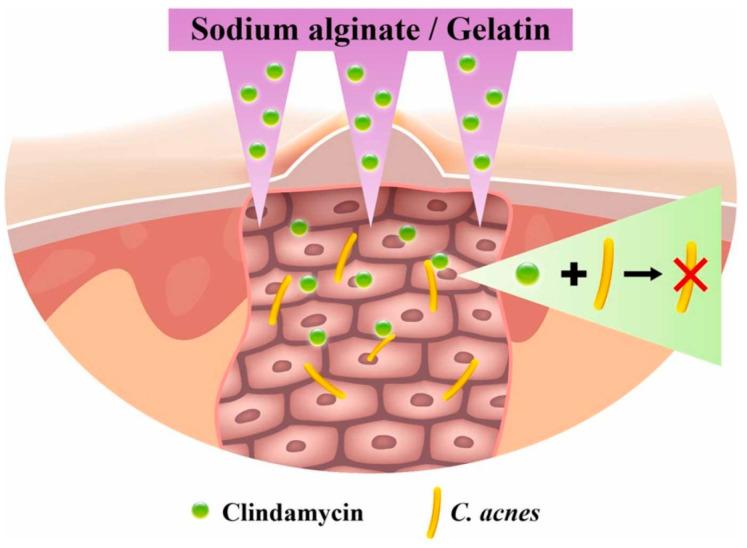
Targeted therapy represents a real opportunity to improve the health and lives of patients. Developments in this field are confirmed by the fact that the global market for drug carriers was worth nearly $40 million in 2022. For this reason, materials engineering and the development of new drug carrier compositions for targeted therapy has become a key area of research in pharmaceutical drug delivery in recent years. Ceramics, polymers, and metals, as well as composites, are of great interest, as when they are appropriately processed or combined with each other, it is possible to obtain biomaterials for hard tissues, soft tissues, and skin applications. After appropriate modification, these materials can release the drug directly at the site requiring a therapeutic effect. This brief literature review characterizes routes of drug delivery into the body and discusses biomaterials from different groups, options for their modification with clindamycin, an antibiotic used for infections caused by aerobic and anaerobic Gram-positive bacteria, and different methods for the final processing of carriers. Examples of coating materials for skin wound healing, acne therapy, and bone tissue fillers are given. Furthermore, the reasons why the use of antibiotic therapy is crucial for a smooth and successful recovery and the risks of bacterial infections are explained. It was demonstrated that there is no single proven delivery scheme, and that the drug can be successfully released from different carriers depending on the destination.
靶向治疗为改善患者的健康状况和生活带来了切实的机遇。这一领域的发展从以下事实得到印证:2022年全球药物载体市场价值近4000万美元。因此,材料工程以及用于靶向治疗的新型药物载体组合物的研发,近年来已成为药物递送领域的关键研究方向。陶瓷、聚合物、金属以及复合材料都备受关注,因为经过适当加工或相互组合后,有可能获得用于硬组织、软组织及皮肤应用的生物材料。经过适当修饰后,这些材料能够在需要治疗效果的部位直接释放药物。这篇简短的文献综述阐述了药物进入人体的递送途径,并讨论了不同类别的生物材料、用克林霉素(一种用于治疗需氧和厌氧革兰氏阳性菌引起感染的抗生素)对其进行修饰的方法以及载体最终加工的不同方式。文中给出了用于皮肤伤口愈合、痤疮治疗及骨组织填充的涂层材料示例。此外,还解释了使用抗生素治疗对于顺利且成功康复至关重要的原因以及细菌感染的风险。结果表明,不存在单一的经证实的递送方案,并且根据目标部位的不同,药物能够从不同载体中成功释放。
 Zotero 插件