Zhang Li-Na, Tan Jing-Tong, Ng Ho-Yu, Liao Yun-Shi, Zhang Rui-Qi, Chan Kwok-Hung, Hung Ivan Fan-Ngai, Lam Tommy Tsan-Yuk, Cheung Ka-Shing
Department of Medicine, School of Clinical Medicine, The University of Hong Kong, Queen Mary Hospital, Hong Kong.
School of Clinical Medicine, The University of Hong Kong, Hong Kong.
Vaccines (Basel). 2024 Mar 27;12(4):365. doi: 10.3390/vaccines12040365.
Neutralizing antibody level wanes with time after COVID-19 vaccination. We aimed to study the relationship between baseline gut microbiota and immunogenicity after three doses of CoronaVac.
This was a prospective cohort study recruiting three-dose CoronaVac recipients from two centers in Hong Kong. Blood samples were collected at baseline and one year post-first dose for virus microneutralization (vMN) assays to determine neutralization titers. The primary outcome was high immune response (defined as with vMN titer ≥ 40). Shotgun DNA metagenomic sequencing of baseline fecal samples identified potential bacterial species and metabolic pathways using Linear Discriminant Analysis Effect Size (LEfSe) analysis. Univariate and multivariable logistic regression models were used to identify high response predictors.
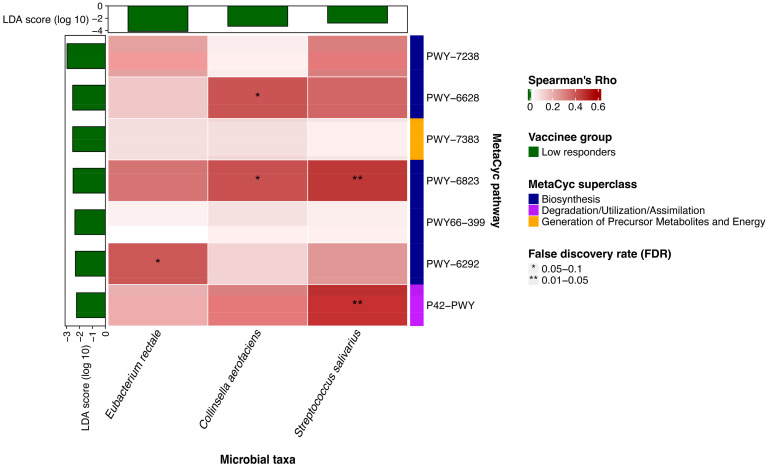
In total, 36 subjects were recruited (median age: 52.7 years [IQR: 47.9-56.4]; male: 14 [38.9%]), and 18 had low immune response at one year post-first dose vaccination. (logLDA score = 4.15, = 0.001; relative abundance of 1.4% vs. 0, = 0.002), (logLDA score = 3.31, = 0.037; 0.39% vs. 0.18%, = 0.038), and (logLDA score = 2.79, = 0.021; 0.05% vs. 0.02%, = 0.022) were enriched in low responders. The aOR of high immune response with , and was 0.03 (95% CI: 9.56 × 10-0.32), 0.03 (95% CI: 4.47 × 10-0.59), and 10.19 (95% CI: 0.81-323.88), respectively. had a positive correlation with pathways enriched in high responders like incomplete reductive TCA cycle (logLDA score = 2.23). similarly correlated with amino acid biosynthesis-related pathways. These pathways all showed anti-inflammation functions.
, and correlated with poorer long-term immunogenicity following three doses of CoronaVac.
新型冠状病毒肺炎疫苗接种后,中和抗体水平会随时间下降。我们旨在研究三剂科兴疫苗接种后基线肠道微生物群与免疫原性之间的关系。
这是一项前瞻性队列研究,从香港的两个中心招募接种三剂科兴疫苗的受试者。在基线和首次接种后一年采集血样进行病毒微量中和(vMN)试验,以确定中和滴度。主要结局为高免疫反应(定义为vMN滴度≥40)。使用线性判别分析效应大小(LEfSe)分析对基线粪便样本进行鸟枪法DNA宏基因组测序,以确定潜在的细菌种类和代谢途径。采用单变量和多变量逻辑回归模型确定高反应预测因素。
共招募36名受试者(中位年龄:52.7岁[四分位间距:47.9 - 56.4];男性:14名[38.9%]),18名在首次接种疫苗后一年免疫反应较低。低反应者中富集了(对数线性判别分析得分 = 4.15,P = 0.001;相对丰度1.4%对0,P = 0.002)、(对数线性判别分析得分 = 3.31,P = 0.037;0.39%对0.18%,P = 0.038)和(对数线性判别分析得分 = 2.79,P = 0.021;0.05%对0.02%,P = 0.022)。、和高免疫反应的调整后比值比分别为0.03(95%置信区间:9.56×10⁻⁰.³²)、0.03(95%置信区间:4.47×10⁻⁰.⁵⁹)和10.19(95%置信区间:0.81 - 323.88)。与高反应者中富集的途径如不完全还原性三羧酸循环(对数线性判别分析得分 = 2.23)呈正相关。同样与氨基酸生物合成相关途径相关。这些途径均显示出抗炎功能。
、和与三剂科兴疫苗接种后的长期免疫原性较差相关。