Department of Hepatobiliary Surgery, Mianyang Central Hospital, School of Medicine, University of Electronic Science and Technology of China, Mianyang, China.
National Health Commission (NHC) Key Laboratory of Nuclear Technology Medical Transformation, Mianyang Central Hospital, School of Medicine, University of Electronic Science and Technology of China, Mianyang, China.
Front Immunol. 2024 Apr 15;15:1373371. doi: 10.3389/fimmu.2024.1373371. eCollection 2024.
Serum creatinine (Cr) and albumin (Alb) are important predictors of mortality in individuals with various diseases, including acute pancreatitis (AP). However, most previous studies have only examined the relationship between single Cr or Alb levels and the prognosis of patients with AP. To our knowledge, the association between short- and long-term all-cause mortality in patients with AP and the blood creatinine to albumin ratio (CAR) has not been investigated. Therefore, this study aimed to evaluate the short- and long-term relationships between CAR and all-cause mortality in patients with AP.
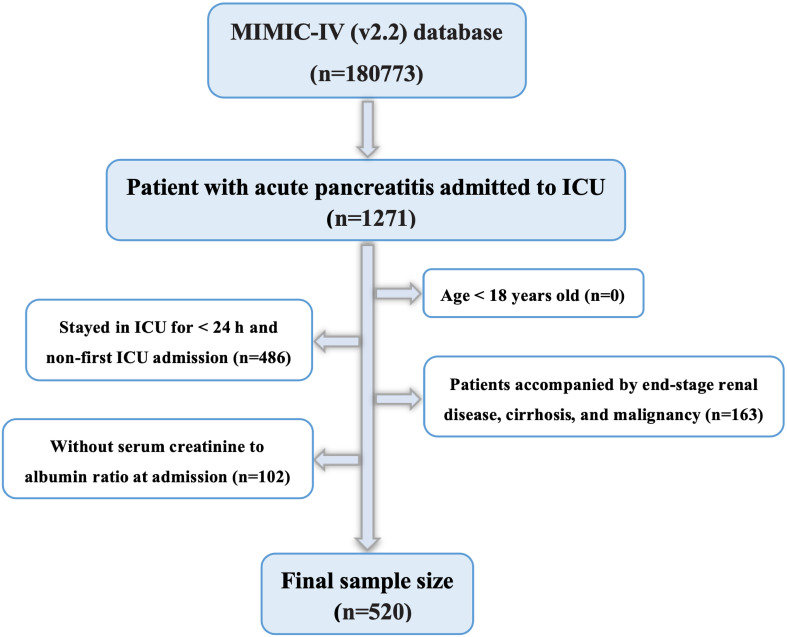
We conducted a retrospective study utilizing data from the Medical Information Market for Intensive Care (MIMIC-IV) database. The study involved analyzing various mortality variables and obtaining CAR values at the time of admission. The X-tile software was used to determine the optimal threshold for the CAR. Kaplan-Meier (K-M) survival curves and multivariate Cox proportional hazards regression models were used to assess the relationship between CAR and both short- and long-term all-cause mortality. The predictive power, sensitivity, specificity, and area under the curve (AUC) of CAR for short- and long-term mortality in patients with AP after hospital admission were investigated using Receiver Operating Characteristic analysis. Additionally, subgroup analyses were conducted.
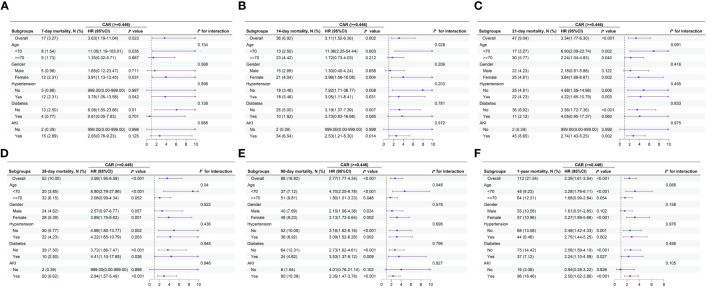
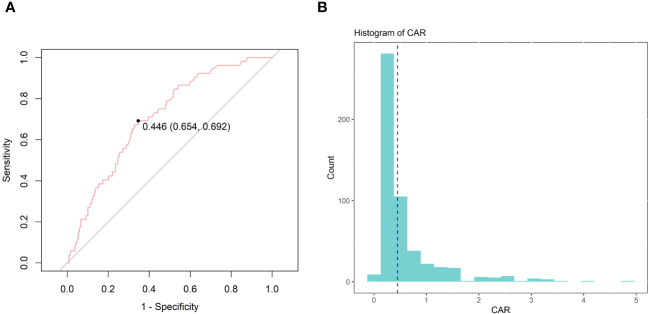
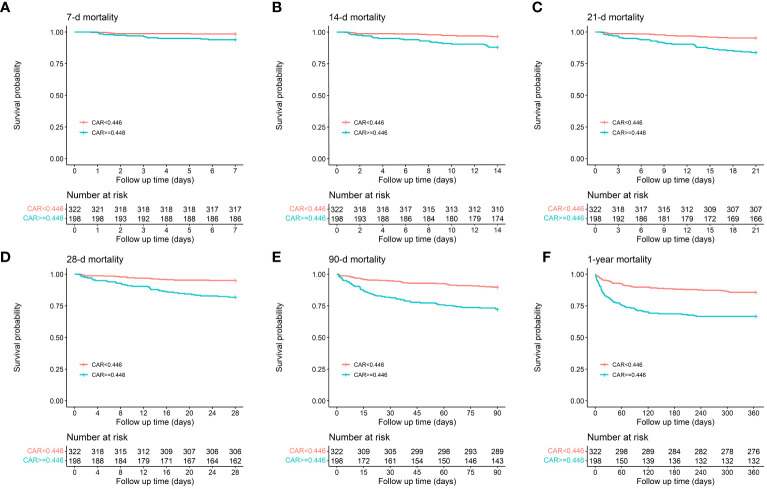
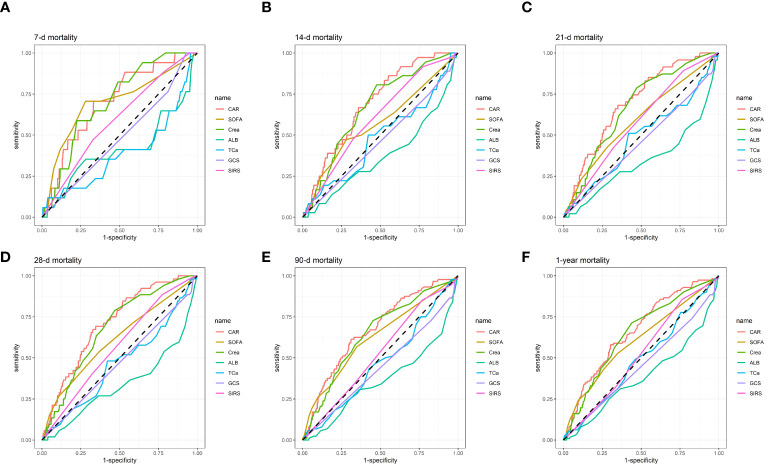
A total of 520 participants were included in this study. The CAR ideal threshold, determined by X-tile software, was 0.446. The Cox proportional hazards model revealed an independent association between CAR≥0.446 and all-cause mortality at 7-day (d), 14-d, 21-d, 28-d, 90-d, and 1-year (y) before and after adjustment for confounders. K-M survival curves showed that patients with CAR≥0.446 had lower survival rates at 7-d, 14-d, 21-d, 28-d, 90-d, and 1-y. Additionally, CAR demonstrated superior performance, with higher AUC values than Cr, Alb, serum total calcium, Glasgow Coma Scale, Systemic Inflammatory Response Syndrome score, and Sepsis-related Organ Failure Assessment score at 7-d, 14-d, 21-d, 28-d, 90-d, and 1-y intervals. Subgroup analyses showed that CAR did not interact with a majority of subgroups.
The CAR can serve as an independent predictor for short- and long-term all-cause mortality in patients with AP. This study enhances our understanding of the association between serum-based biomarkers and the prognosis of patients with AP.
血清肌酐(Cr)和白蛋白(Alb)是各种疾病包括急性胰腺炎(AP)患者死亡率的重要预测指标。然而,大多数先前的研究仅检查了单个 Cr 或 Alb 水平与 AP 患者预后之间的关系。据我们所知,AP 患者的短期和长期全因死亡率与血肌酐白蛋白比值(CAR)之间的关系尚未得到研究。因此,本研究旨在评估 CAR 与 AP 患者全因死亡率之间的短期和长期关系。
我们进行了一项回顾性研究,利用医疗信息市场重症监护(MIMIC-IV)数据库中的数据。该研究分析了各种死亡率变量,并在入院时获得了 CAR 值。使用 X-tile 软件确定 CAR 的最佳阈值。使用 Kaplan-Meier(K-M)生存曲线和多变量 Cox 比例风险回归模型评估 CAR 与 AP 患者短期和长期全因死亡率之间的关系。使用Receiver Operating Characteristic 分析评估 CAR 对 AP 患者住院后短期和长期死亡率的预测能力、敏感性、特异性和曲线下面积(AUC)。此外,还进行了亚组分析。
共有 520 名参与者纳入本研究。X-tile 软件确定的 CAR 理想阈值为 0.446。Cox 比例风险模型显示,在调整混杂因素后,CAR≥0.446 与 7 天(d)、14 天(d)、21 天(d)、28 天(d)、90 天(d)和 1 年(y)前和后全因死亡率之间存在独立关联。K-M 生存曲线显示,CAR≥0.446 的患者在 7-d、14-d、21-d、28-d、90-d 和 1-y 的生存率较低。此外,CAR 在 7-d、14-d、21-d、28-d、90-d 和 1-y 时,与 Cr、Alb、血清总钙、格拉斯哥昏迷量表、全身炎症反应综合征评分和脓毒症相关器官衰竭评估评分相比,AUC 值更高,表现出更好的性能。亚组分析表明,CAR 与大多数亚组之间没有交互作用。
CAR 可作为 AP 患者短期和长期全因死亡率的独立预测指标。本研究加深了我们对基于血清生物标志物与 AP 患者预后之间关系的理解。