Department of Cell and Molecular Biology, Faculty of Biological Science, Kharazmi University, Tehran, Iran.
Department of Medical Biotechnology, National Institute of Genetic Engineering and Biotechnology, Shahrak-e Pajoohesh, km 15, P.O. Box 14965/161, Tehran, Tehran - Karaj Highway, Iran.
BMC Med Genomics. 2024 Apr 30;17(1):117. doi: 10.1186/s12920-024-01893-9.
Colorectal cancer (CRC) is one of the significant global health concerns with an increase in cases. Regular screening tests are crucial for early detection as it is often asymptomatic in the initial stages. Liquid biopsies, a non-invasive approach that examines biomarkers in biofluids, offer a promising future in diagnosing and screening cancer. Circulating-tumour DNA (ctDNA) is the genetic material in biofluids released into the circulatory system by cells. ctDNA is a promising marker for monitoring patients since cancer cells display distinct DNA methylation patterns compared to normal cells. The potential of our research to contribute to early detection and improved patient outcomes is significant.
The primary objective of this research project was to explore the HAND1 methylation levels in plasma ctDNA as a potential biomarker for diagnosing CRC and evaluate the methylation level of the well-established gene SPET9 to compare it with the methylation level of HAND1.
Plasma samples were collected from 30 CRC patients and 15 healthy individuals, with CRC samples obtained pre-treatment. ctDNA was extracted and treated with bisulfite for methylation status assessment. Quantitative methylation-specific PCR (qMS-PCR) was performed for HAND1 and SEPT9, using β-actin (ACTB gene) as a reference. The study aims to evaluate the potential of these genes as diagnostic biomarkers for CRC, contributing to early detection and improved patient outcomes.
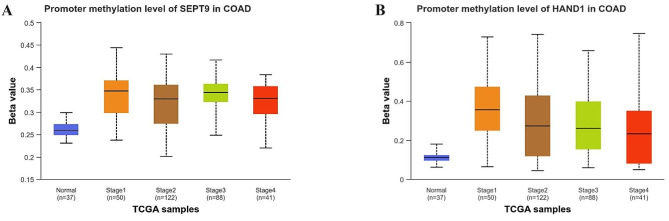
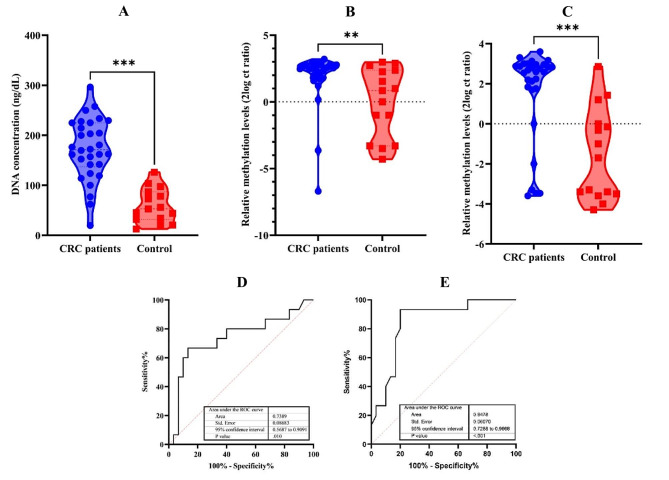
Our study yielded significant results: 90% of CRC patients (27 out of 30) had hypermethylation in the SEPT9 gene, and 83% (25 out of 30) exhibited hypermethylation in the HAND1 gene. The methylation levels of both genes were significantly higher in CRC patients than in healthy donors. These findings underscore the potential of SEPT9 and HAND1 methylation as promising biomarkers for diagnosing CRC, potentially leading to early detection and improved patient outcomes.
These findings highlight the potential of SEPT9 and HAND1 methylation as promising biomarkers for diagnosing CRC. However, further research and validation studies are needed to confirm these findings and to explore their clinical utility in CRC diagnosis and management.
结直肠癌(CRC)是全球关注的重大健康问题之一,其发病率呈上升趋势。定期进行筛查测试对于早期检测至关重要,因为在早期阶段,CRC 通常没有明显症状。液体活检是一种非侵入性的方法,通过检查生物流体中的生物标志物来提供癌症诊断和筛查的前景。循环肿瘤 DNA(ctDNA)是细胞释放到循环系统中的生物流体中的遗传物质。ctDNA 是监测患者的有前途的标志物,因为与正常细胞相比,癌细胞显示出独特的 DNA 甲基化模式。我们的研究对早期检测和改善患者预后的潜在贡献是重大的。
本研究项目的主要目的是探索 HAND1 甲基化水平在血浆 ctDNA 中作为诊断 CRC 的潜在生物标志物,并评估已建立的 SPET9 基因的甲基化水平,以将其与 HAND1 的甲基化水平进行比较。
收集了 30 例 CRC 患者和 15 例健康个体的血浆样本,CRC 样本在治疗前获得。提取 ctDNA 并进行亚硫酸氢盐处理以评估甲基化状态。使用β-肌动蛋白(ACTB 基因)作为参考,通过定量甲基化特异性 PCR(qMS-PCR)对 HAND1 和 SEPT9 进行检测。本研究旨在评估这些基因作为 CRC 诊断生物标志物的潜力,有助于早期检测和改善患者预后。
我们的研究产生了显著的结果:90%的 CRC 患者(30 例中的 27 例)在 SEPT9 基因中出现过度甲基化,83%(30 例中的 25 例)在 HAND1 基因中出现过度甲基化。CRC 患者中这两个基因的甲基化水平均显著高于健康供体。这些发现强调了 SEPT9 和 HAND1 甲基化作为诊断 CRC 的有前途的生物标志物的潜力,可能导致早期检测和改善患者预后。
这些发现强调了 SEPT9 和 HAND1 甲基化作为诊断 CRC 的有前途的生物标志物的潜力。然而,需要进一步的研究和验证研究来确认这些发现,并探讨它们在 CRC 诊断和管理中的临床应用。