Mastalerz Andrzej, Johne Monika, Mróz Anna, Bojarczuk Aleksandra, Stastny Petr, Petr Miroslav, Kolinger Dominik, Pisz Anna, Vostatkova Pavlina, Maculewicz Ewelina
Faculty of Physical Education, Jozef Pilsudski University of Physical Education in Warsaw, Warsaw, Poland.
Faculty of Physical Education, Gdansk University of Physical Education and Sport, Gdansk, Poland.
J Hum Kinet. 2024 Apr 15;91(Spec Issue):165-174. doi: 10.5114/jhk/186074. eCollection 2024 Mar.
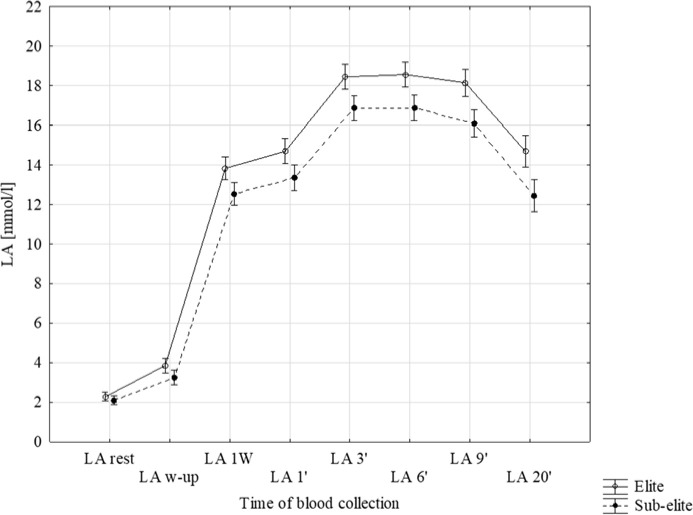
400-m races are based on anaerobic energy metabolism, they induce significant muscle fatigue, muscle fiber damage, and high blood lactate (LA) concentration. Despite extensive research on sprint training, our understanding of the training process that leads to world-class sprint performance is rather limited. This study aimed to determine differences in LA concentration and anaerobic power using jumping tests after an intense glycolytic effort in a group of elite and sub-elite 400-m runners. One hundred thirty male runners were divided into two groups: elite (n = 66, body mass = 73.4 ± 7.8 kg, body height = 182.1 ± 6.2 cm, age = 20.8 ± 4.0 y) running the 400-m dash below 50 s and sub-elite (n = 64, body mass = 72.0 ± 7.1 kg, body height = 182.1 ± 5.2 cm, age = 20.8 ± 4.0 y) with a 400-m personal best above 50 s. The power of the countermovement and the sequential squat jumps was measured in two sets after a warm-up, followed by two intermittent 30-s Wingate tests. LA concentration was measured eight times. It was observed that elite athletes achieved significantly higher power in both types of jumps. The maximum post-exercise LA concentration was significantly lower in the sub-elite group after the 3, the 6, the 9, and the 20 min after the cessation of two Wingate tests (p < 0.001). The rate of LA accumulation after exercise and the rate of LA utilization did not differ between the groups. It can be concluded that elite and non-elite runners differ in higher LA production but not in LA utilization. Anaerobic power and LA concentration seem to differentiate between 400 elite and sub-elite performance.
400米跑基于无氧能量代谢,会引发明显的肌肉疲劳、肌纤维损伤以及高血乳酸(LA)浓度。尽管对短跑训练进行了广泛研究,但我们对造就世界级短跑成绩的训练过程的了解仍相当有限。本研究旨在通过对一组精英和次精英400米跑运动员进行高强度糖酵解运动后的跳跃测试,来确定血乳酸浓度和无氧功率的差异。130名男性跑步运动员被分为两组:精英组(n = 66,体重 = 73.4 ± 7.8千克,身高 = 182.1 ± 6.2厘米,年龄 = 20.8 ± 4.0岁),400米短跑成绩低于50秒;次精英组(n = 64,体重 = 72.0 ± 7.1千克,身高 = 182.1 ± 5.2厘米,年龄 = 20.8 ± 4.0岁),400米个人最好成绩高于50秒。在热身之后,进行两组反向运动和连续深蹲跳的功率测量,随后进行两次间歇30秒的温盖特测试。血乳酸浓度测量八次。结果发现,精英运动员在两种跳跃测试中均获得显著更高的功率。在两次温盖特测试结束后的3分钟、6分钟、9分钟和20分钟,次精英组运动后的最高血乳酸浓度显著更低(p < 0.001)。两组之间运动后血乳酸积累速率和血乳酸利用速率没有差异。可以得出结论,精英和非精英跑步运动员在更高的血乳酸产生方面存在差异,但在血乳酸利用方面没有差异。无氧功率和血乳酸浓度似乎可以区分400米精英和次精英成绩。