National Taiwan Normal University, Physical Education and Sport Sciences, Taipei, Taiwan.
National Taiwan University of Sport, Department of Sport Performance, Taichung, Taiwan.
J Int Soc Sports Nutr. 2024 Dec;21(1):2414871. doi: 10.1080/15502783.2024.2414871. Epub 2024 Oct 10.
This study investigated the effects of caffeinated chewing gum on fatigue index and 400-meter performance in trained sprinters.
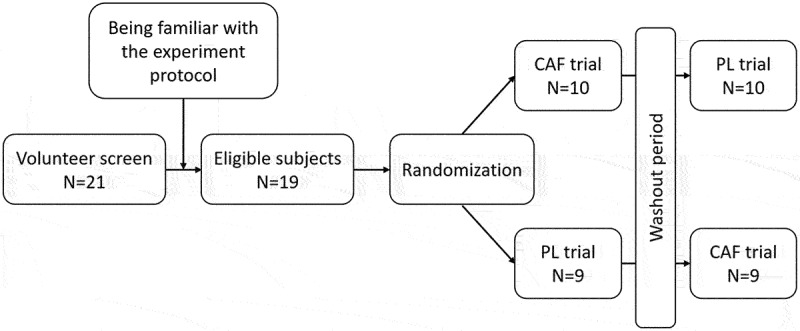
Nineteen participants (age: 20.9 ± 1.0 years; height: 175.6 ± 4.9 cm; mass: 66.5 ± 5.6 kg; training age: 7.9 ± 1.0 years) were randomly assigned to either a caffeine trial (CAF) or a placebo trial (PL) using a double-blind, randomized crossover design. The participants in the CAF trial chewed a gum containing 3 mg/kg of caffeine for a period of 10 minutes, while those in the PL trial chewed a gum containing a placebo with no caffeine. Following a 15-minute period of rest, the fatigue index was tested by six maximal 35-meter sprints with a 10-second rest between efforts. After this, at least 30 minutes of rest was permitted, during which time the participants engaged in brief warm-up activities prior to the commencement of the 400-meter sprint test. Saliva samples were collected before chewing gum, before the fatigue test and before 400-meters sprinting.
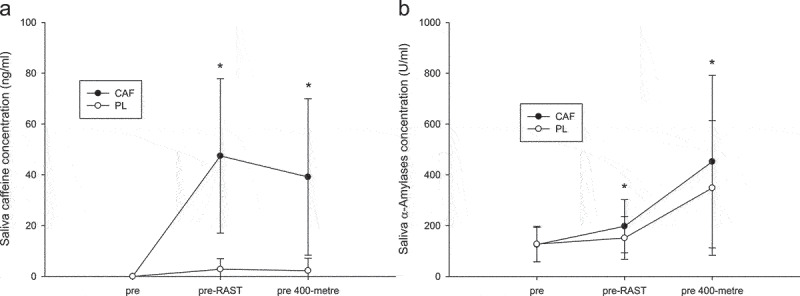
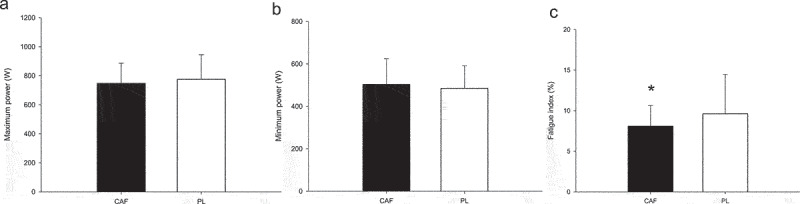
The fatigue index was significantly lower in the CAF trial compared to the PL trial (CAF: 8.1 ± 2.5%; PL: 9.6 ± 4.8%; = 0.046, Cohen's d = 039). The CAF trial demonstrated significantly lower sprint time for the 300-400 meter segment (CAF: 14.73 ± 1.35 seconds; PL: 15.23 ± 1.30 seconds; = 0.019, Cohen's d = 0.37) and total sprint time compared to the PL trial (CAF: 53.87 ± 2.88 seconds; PL: 54.68 ± 3.37 seconds; = 0.003, Cohen's d = 0.27). Saliva caffeine and α-amylase concentration were significantly higher in the CAF trial compared to the PL trial ( < 0.05).
The present study demonstrated that caffeine gum supplementation prior to exercise significantly reduced the fatigue index and increased the capacity to maintain speed, particularly in the final 300 to 400 meters, as well as enhancing 400-meter sprint performance.
本研究旨在探讨含咖啡因口香糖对训练有素短跑运动员的疲劳指数和 400 米成绩的影响。
采用双盲、随机交叉设计,将 19 名参与者(年龄:20.9±1.0 岁;身高:175.6±4.9cm;体重:66.5±5.6kg;训练年限:7.9±1.0 年)随机分为咖啡因试验(CAF)组和安慰剂试验(PL)组。CAF 组咀嚼含有 3mg/kg 咖啡因的口香糖 10 分钟,PL 组咀嚼不含咖啡因的安慰剂口香糖。休息 15 分钟后,通过 6 次最大 35 米冲刺测试疲劳指数,每次冲刺之间休息 10 秒。之后,至少休息 30 分钟,在此期间,参与者在进行 400 米冲刺测试前进行短暂的热身活动。在咀嚼口香糖前、疲劳测试前和 400 米冲刺前采集唾液样本。
CAF 组的疲劳指数明显低于 PL 组(CAF:8.1±2.5%;PL:9.6±4.8%; = 0.046,Cohen's d = 039)。CAF 组 300-400 米段的冲刺时间明显更短(CAF:14.73±1.35 秒;PL:15.23±1.30 秒; = 0.019,Cohen's d = 0.37),总冲刺时间也明显短于 PL 组(CAF:53.87±2.88 秒;PL:54.68±3.37 秒; = 0.003,Cohen's d = 0.27)。与 PL 组相比,CAF 组的唾液咖啡因和 α-淀粉酶浓度明显更高( < 0.05)。
本研究表明,运动前补充咖啡因口香糖可显著降低疲劳指数,提高维持速度的能力,尤其是在最后 300 至 400 米,同时提高 400 米冲刺成绩。