Department for Diagnostic Laboratory Medicine, Institute for Clinical Chemistry and Pathobiochemistry, University Hospital Tübingen, Tübingen, Germany.
Metabolomics and Proteomics Core Helmholtz Center Munich, German Research Center for Environmental Health, Neuherberg, Germany.
Am J Physiol Cell Physiol. 2024 May 1;326(5):C1462-C1481. doi: 10.1152/ajpcell.00654.2023. Epub 2024 Mar 4.
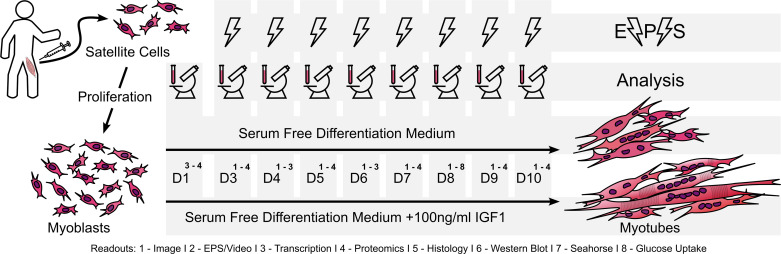
Skeletal muscle mediates the beneficial effects of exercise, thereby improving insulin sensitivity and reducing the risk for type 2 diabetes. Current human skeletal muscle models in vitro are incapable of fully recapitulating its physiological functions especially muscle contractility. By supplementation of insulin-like growth factor 1 (IGF1), a growth factor secreted by myofibers in vivo, we aimed to overcome these limitations. We monitored the differentiation process starting from primary human CD56-positive myoblasts in the presence/absence of IGF1 in serum-free medium in daily collected samples for 10 days. IGF1-supported differentiation formed thicker multinucleated myotubes showing physiological contraction upon electrical pulse stimulation (EPS) following . Myotubes without IGF1 were almost incapable of contraction. IGF1 treatment shifted the proteome toward skeletal muscle-specific proteins that contribute to myofibril and sarcomere assembly, striated muscle contraction, and ATP production. Elevated PPARGC1A, MYH7, and reduced MYH1/2 suggest a more oxidative phenotype further demonstrated by higher abundance of proteins of the respiratory chain and elevated mitochondrial respiration. IGF1-treatment also upregulated glucose transporter (GLUT)4 and increased insulin-dependent glucose uptake compared with myotubes differentiated without IGF1. To conclude, addition of IGF1 to serum-free medium significantly improves the differentiation of human myotubes that showed enhanced myofibril formation, response to electrical pulse stimulation, oxidative respiratory capacity, and glucose metabolism overcoming limitations of previous standards. This novel protocol enables investigation of muscular exercise on a molecular level. Human skeletal muscle models are highly valuable to study how exercise prevents type 2 diabetes without invasive biopsies. Current models did not fully recapitulate the function of skeletal muscle especially during exercise. By supplementing insulin-like growth factor 1 (IGF1), the authors developed a functional human skeletal muscle model characterized by inducible contractility and increased oxidative and insulin-sensitive metabolism. The novel protocol overcomes the limitations of previous standards and enables investigation of exercise on a molecular level.
骨骼肌介导运动的有益作用,从而提高胰岛素敏感性并降低 2 型糖尿病的风险。目前的体外人类骨骼肌模型无法完全再现其生理功能,尤其是肌肉收缩力。通过补充胰岛素样生长因子 1(IGF1),一种体内肌纤维分泌的生长因子,我们旨在克服这些限制。我们在无血清培养基中从原代人 CD56 阳性成肌细胞开始,每天收集样本并监测 10 天的分化过程,有无 IGF1。IGF1 支持的分化形成了更厚的多核肌管,在电脉冲刺激(EPS)后表现出生理收缩,而没有 IGF1 的肌管几乎无法收缩。IGF1 处理将蛋白质组转移到与肌原纤维和肌节组装、横纹肌收缩和 ATP 产生相关的骨骼肌特异性蛋白。升高的 PPARGC1A、MYH7 和降低的 MYH1/2 表明更具氧化表型,这进一步通过呼吸链和升高的线粒体呼吸的蛋白质丰度的增加来证明。IGF1 处理还上调了葡萄糖转运蛋白(GLUT)4 并增加了胰岛素依赖性葡萄糖摄取,与没有 IGF1 分化的肌管相比。总之,在无血清培养基中添加 IGF1 可显著改善肌管的分化,肌管表现出增强的肌原纤维形成、对电脉冲刺激的反应、氧化呼吸能力和葡萄糖代谢,克服了以前标准的限制。该新型方案可实现对肌肉运动的分子水平研究。人类骨骼肌模型对于研究运动如何在无需侵入性活检的情况下预防 2 型糖尿病非常有价值。目前的模型并未完全再现骨骼肌的功能,特别是在运动期间。通过补充胰岛素样生长因子 1(IGF1),作者开发了一种功能强大的人类骨骼肌模型,其特点是可诱导收缩性和增加的氧化和胰岛素敏感代谢。该新型方案克服了以前标准的限制,并可实现对运动的分子水平研究。