Université de Montréal, École de Santé Publique, Montreal, H3N 1X9, Canada.
Centre de Recherche en Santé Publique, Montreal, H3N 1X9, Canada.
Sci Rep. 2024 May 1;14(1):10003. doi: 10.1038/s41598-024-59976-7.
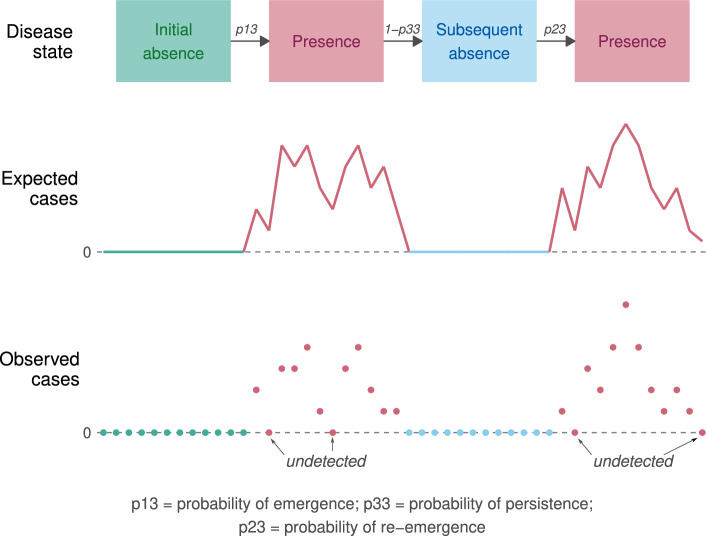
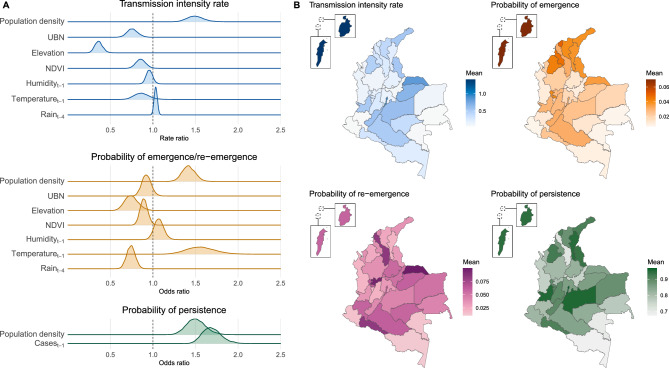
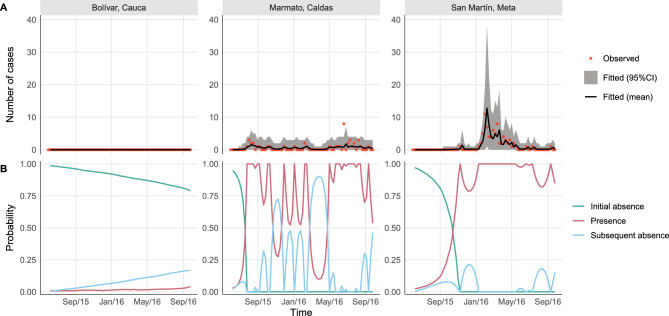
Zika, a viral disease transmitted to humans by Aedes mosquitoes, emerged in the Americas in 2015, causing large-scale epidemics. Colombia alone reported over 72,000 Zika cases between 2015 and 2016. Using national surveillance data from 1121 municipalities over 70 weeks, we identified sociodemographic and environmental factors associated with Zika's emergence, re-emergence, persistence, and transmission intensity in Colombia. We fitted a zero-state Markov-switching model under the Bayesian framework, assuming Zika switched between periods of presence and absence according to spatially and temporally varying probabilities of emergence/re-emergence (from absence to presence) and persistence (from presence to presence). These probabilities were assumed to follow a series of mixed multiple logistic regressions. When Zika was present, assuming that the cases follow a negative binomial distribution, we estimated the transmission intensity rate. Our results indicate that Zika emerged/re-emerged sooner and that transmission was intensified in municipalities that were more densely populated, at lower altitudes and/or with less vegetation cover. Warmer temperatures and less weekly-accumulated rain were also associated with Zika emergence. Zika cases persisted for longer in more densely populated areas with more cases reported in the previous week. Overall, population density, elevation, and temperature were identified as the main contributors to the first Zika epidemic in Colombia. We also estimated the probability of Zika presence by municipality and week, and the results suggest that the disease circulated undetected by the surveillance system on many occasions. Our results offer insights into priority areas for public health interventions against emerging and re-emerging Aedes-borne diseases.
寨卡病毒是一种由埃及伊蚊传播给人类的病毒性疾病,于 2015 年在美洲出现,并引发了大规模的疫情。仅哥伦比亚在 2015 年至 2016 年期间就报告了超过 72000 例寨卡病例。利用来自 1121 个城市的 70 周的国家监测数据,我们确定了与寨卡病毒在哥伦比亚出现、再次出现、持续存在和传播强度相关的社会人口和环境因素。我们在贝叶斯框架下拟合了零状态马尔可夫开关模型,假设寨卡病毒根据出现/再次出现(从无到有)和持续存在(从有到有)的时空变化概率在存在和不存在之间切换。这些概率被假设遵循一系列混合多项逻辑回归。当寨卡病毒存在时,假设病例遵循负二项分布,我们估计了传播强度率。研究结果表明,在人口密度更高、海拔更低和/或植被覆盖更少的城市,寨卡病毒更快地出现/再次出现,且传播强度更大。温度升高和每周降雨量减少也与寨卡病毒的出现有关。在人口密度更高、前一周报告的病例更多的地区,寨卡病毒持续时间更长。总体而言,人口密度、海拔和温度被确定为哥伦比亚首次寨卡病毒流行的主要因素。我们还按城市和周估算了寨卡病毒存在的概率,结果表明该疾病在许多情况下都未被监测系统检测到。我们的研究结果为针对新发和再发埃及伊蚊传播疾病的公共卫生干预措施提供了重要信息。