Department of Applied and Computational Mathematics and Statistics, University of Notre Dame, Notre Dame, Indiana, United States of America.
Department of Biology, Stanford University, Stanford, California, United States of America.
PLoS Negl Trop Dis. 2018 May 10;12(5):e0006451. doi: 10.1371/journal.pntd.0006451. eCollection 2018 May.
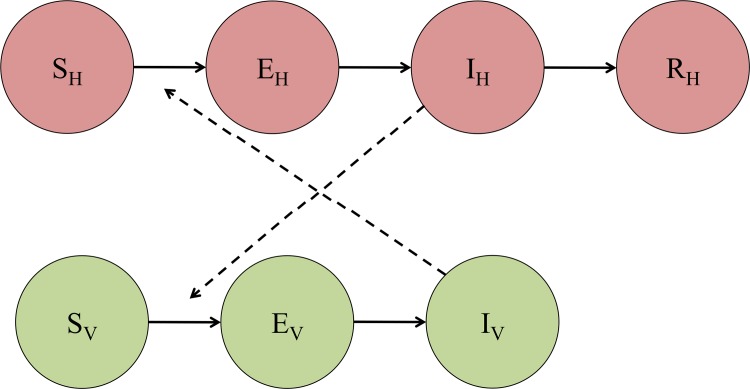
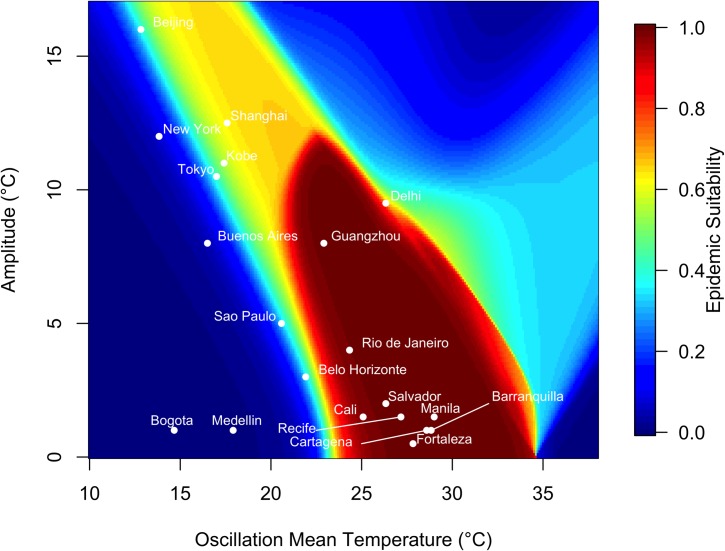
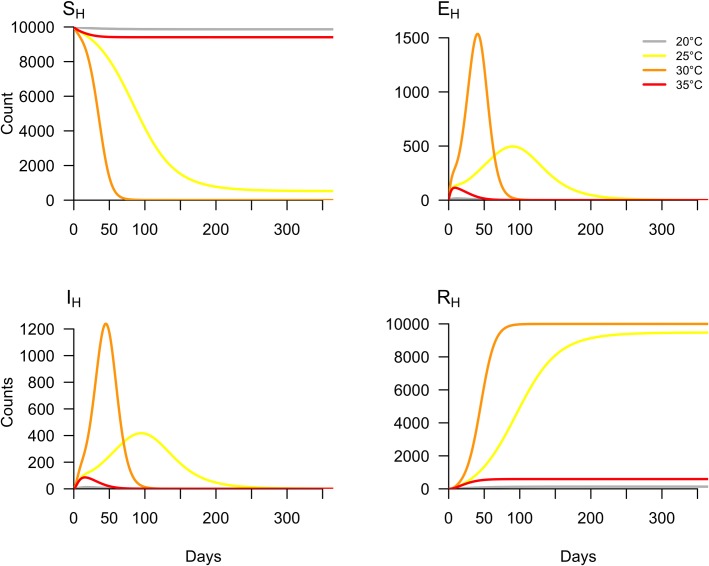
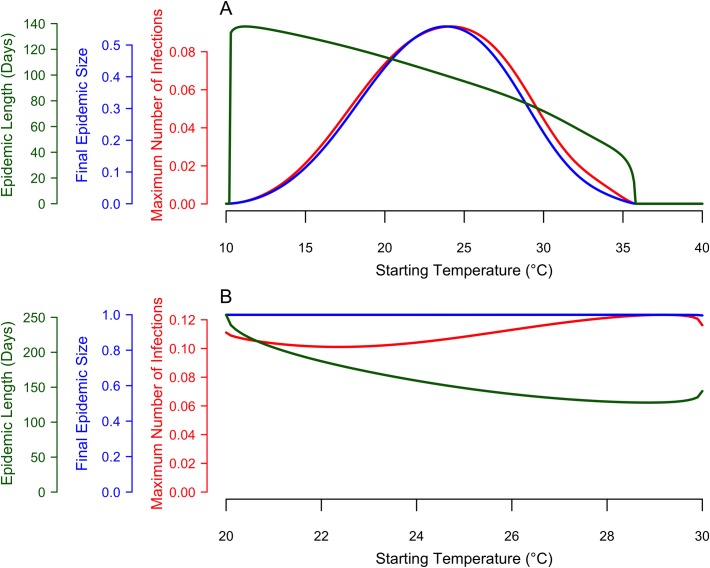
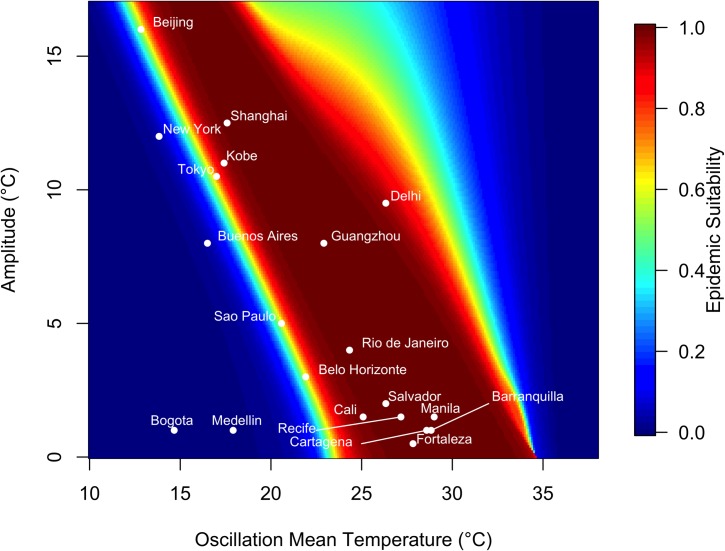
Dengue, chikungunya, and Zika virus epidemics transmitted by Aedes aegypti mosquitoes have recently (re)emerged and spread throughout the Americas, Southeast Asia, the Pacific Islands, and elsewhere. Understanding how environmental conditions affect epidemic dynamics is critical for predicting and responding to the geographic and seasonal spread of disease. Specifically, we lack a mechanistic understanding of how seasonal variation in temperature affects epidemic magnitude and duration. Here, we develop a dynamic disease transmission model for dengue virus and Aedes aegypti mosquitoes that integrates mechanistic, empirically parameterized, and independently validated mosquito and virus trait thermal responses under seasonally varying temperatures. We examine the influence of seasonal temperature mean, variation, and temperature at the start of the epidemic on disease dynamics. We find that at both constant and seasonally varying temperatures, warmer temperatures at the start of epidemics promote more rapid epidemics due to faster burnout of the susceptible population. By contrast, intermediate temperatures (24-25°C) at epidemic onset produced the largest epidemics in both constant and seasonally varying temperature regimes. When seasonal temperature variation was low, 25-35°C annual average temperatures produced the largest epidemics, but this range shifted to cooler temperatures as seasonal temperature variation increased (analogous to previous results for diurnal temperature variation). Tropical and sub-tropical cities such as Rio de Janeiro, Fortaleza, and Salvador, Brazil; Cali, Cartagena, and Barranquilla, Colombia; Delhi, India; Guangzhou, China; and Manila, Philippines have mean annual temperatures and seasonal temperature ranges that produced the largest epidemics. However, more temperate cities like Shanghai, China had high epidemic suitability because large seasonal variation offset moderate annual average temperatures. By accounting for seasonal variation in temperature, the model provides a baseline for mechanistically understanding environmental suitability for virus transmission by Aedes aegypti. Overlaying the impact of human activities and socioeconomic factors onto this mechanistic temperature-dependent framework is critical for understanding likelihood and magnitude of outbreaks.
登革热、基孔肯雅热和寨卡病毒通过埃及伊蚊传播的疫情最近(重新)出现并在美洲、东南亚、太平洋岛屿和其他地区传播。了解环境条件如何影响疫情动态对于预测和应对疾病的地理和季节性传播至关重要。具体来说,我们缺乏对季节性温度变化如何影响疫情规模和持续时间的机制理解。在这里,我们为登革热病毒和埃及伊蚊开发了一个动态疾病传播模型,该模型整合了季节性变化温度下蚊子和病毒特性的机制、经验参数化和独立验证的热响应。我们研究了季节性温度平均值、变化和疫情开始时的温度对疾病动态的影响。我们发现,在恒定和季节性变化的温度下,疫情开始时较暖的温度由于易感人群更快地耗尽,会促进疫情更快地爆发。相比之下,在恒定和季节性变化的温度条件下,疫情开始时的中等温度(24-25°C)会导致最大的疫情。当季节性温度变化较小时,25-35°C 的年平均温度会产生最大的疫情,但随着季节性温度变化的增加,这个范围会转移到较冷的温度(类似于之前对昼夜温度变化的结果)。里约热内卢、福塔莱萨和萨尔瓦多等巴西的热带和亚热带城市;卡利、卡塔赫纳和巴兰基亚等哥伦比亚城市;德里、广州和马尼拉等印度和中国城市;以及菲律宾的马尼拉等城市的年平均温度和季节性温度范围产生了最大的疫情。然而,像中国上海这样的温带城市由于较大的季节性变化抵消了适中的年平均温度,因此具有较高的疫情适宜性。通过考虑温度的季节性变化,该模型为从机制上理解埃及伊蚊传播病毒的环境适宜性提供了一个基准。将人类活动和社会经济因素的影响叠加到这个机制性的温度依赖框架上,对于理解疫情爆发的可能性和规模至关重要。