Division of Endocrinology and Metabolism, Department of Medicine, Samsung Medical Center, Sungkyunkwan University School of Medicine, 81, Irwon-Ro, Gangnam-Gu, Seoul, 06351, Republic of Korea.
Department of Clinical Research Design and Evaluation, Samsung Advanced Institute for Health Sciences and Technology, Sungkyunkwan University, Seoul, 06355, Republic of Korea.
BMC Med. 2024 May 1;22(1):185. doi: 10.1186/s12916-024-03408-w.
We investigated the effects of a physical activity encouragement intervention based on a smartphone personal health record (PHR) application (app) on step count increases, glycemic control, and body weight in patients with type 2 diabetes (T2D).
In this 12-week, single-center, randomized controlled, 12-week extension study, patients with T2D who were overweight or obese were randomized using ratio 1:2 to a group using a smartphone PHR app (control group) or group using the app and received individualized motivational text messages (intervention group) for 12 weeks. During the extension period, the sending of the encouraging text messages to the intervention group was discontinued. The primary outcome was a change in daily step count after 12 weeks and analyzed by independent t-test. The secondary outcomes included HbA1c, fasting glucose, and body weight analyzed by paired or independent t-test.
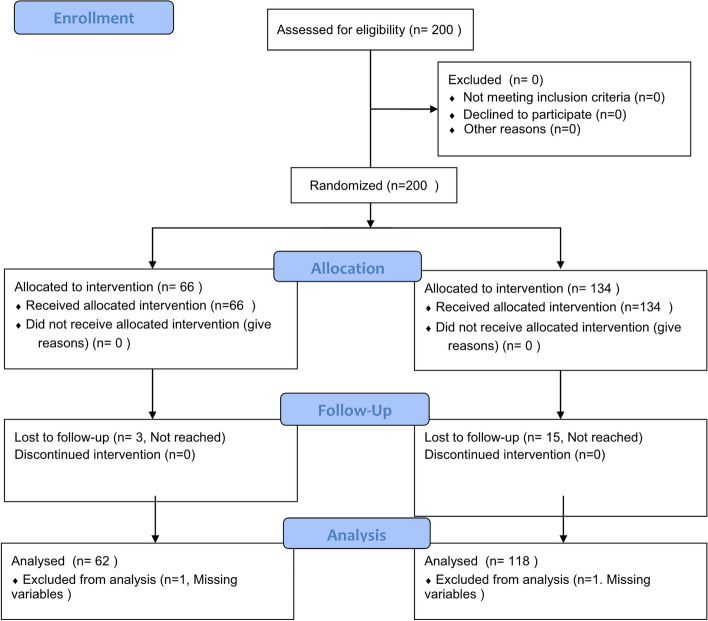
Of 200 participants, 62 (93.9%) and 118 (88.1%) in the control and intervention group, respectively, completed the 12-week main study. The change in daily step count from baseline to week 12 was not significantly different between the two groups (P = 0.365). Among participants with baseline step counts < 7,500 steps per day, the change in the mean daily step count at week 12 in the intervention group (1,319 ± 3,020) was significantly larger than that in control group (-139 ± 2,309) (P = 0.009). At week 12, HbA1c in the intervention group (6.7 ± 0.5%) was significantly lower than that in control group (6.9 ± 0.6%, P = 0.041) and at week 24, changes in HbA1c from baseline were significant in both groups but, comparable between groups. Decrease in HbA1c from baseline to week 12 of intervention group was greater in participants with baseline HbA1c ≥ 7.5% (-0.81 ± 0.84%) compared with those with baseline HbA1c < 7.5% (-0.22 ± 0.39%) (P for interaction = 0.014). A significant reduction in body weight from baseline to week 24 was observed in both groups without significant between-group differences (P = 0.370).
App-based individualized motivational intervention for physical activity did not increase daily step count from baseline to week 12, and the changes in HbA1c levels from baseline to week 12 were comparable.
ClinicalTrials.gov (NCT03407222).
我们研究了基于智能手机个人健康记录(PHR)应用程序(app)的体力活动鼓励干预对 2 型糖尿病(T2D)患者的步数增加、血糖控制和体重的影响。
在这项为期 12 周、单中心、随机对照、12 周扩展研究中,超重或肥胖的 T2D 患者按比例 1:2 随机分为使用智能手机 PHR app(对照组)或使用 app 并接受个性化激励短信(干预组)的两组,干预组持续 12 周。在扩展期,停止向干预组发送鼓励短信。主要结局是 12 周后每日步数的变化,采用独立 t 检验分析。次要结局包括 HbA1c、空腹血糖和体重,采用配对或独立 t 检验分析。
在 200 名参与者中,对照组和干预组分别有 62 名(93.9%)和 118 名(88.1%)完成了 12 周的主要研究。两组从基线到第 12 周的每日步数变化无显著差异(P=0.365)。在基线每日步数<7500 步的参与者中,干预组第 12 周的平均每日步数变化(1319±3020)明显大于对照组(-139±2309)(P=0.009)。第 12 周时,干预组的 HbA1c(6.7±0.5%)明显低于对照组(6.9±0.6%,P=0.041),第 24 周时,两组的 HbA1c 变化均有显著差异,但组间无差异。从基线到第 12 周,干预组的 HbA1c 下降幅度大于基线 HbA1c≥7.5%的参与者(-0.81±0.84%),而基线 HbA1c<7.5%的参与者(-0.22±0.39%)(P 交互=0.014)。两组均观察到体重从基线到第 24 周的显著下降,但组间无显著差异(P=0.370)。
基于应用程序的个体化体力活动激励干预并未增加从基线到第 12 周的每日步数,并且从基线到第 12 周的 HbA1c 水平变化无差异。
ClinicalTrials.gov(NCT03407222)。