Department of Urology, Tongji Hospital, Tongji Medical College, Huazhong University of Science and Technology, Wuhan, China.
Front Immunol. 2024 Apr 17;15:1395047. doi: 10.3389/fimmu.2024.1395047. eCollection 2024.
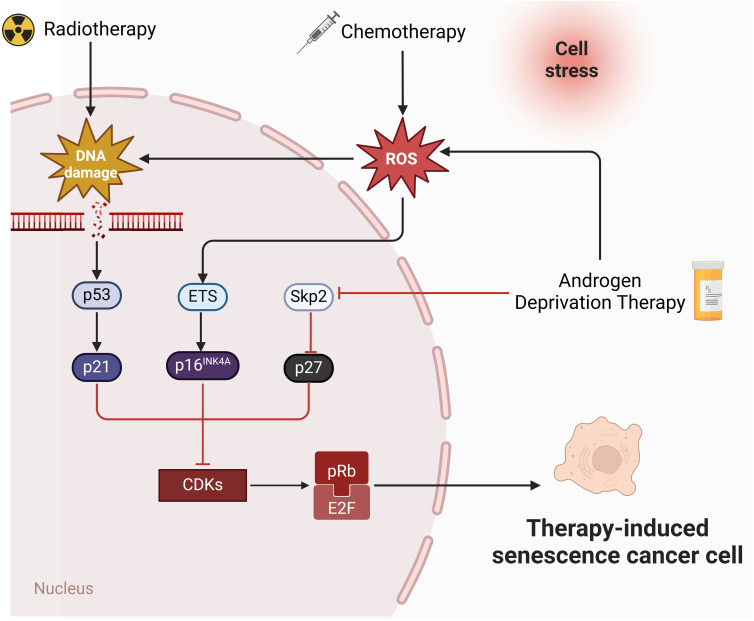
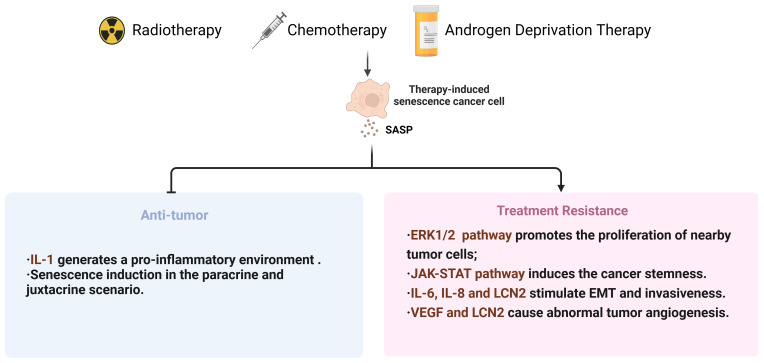
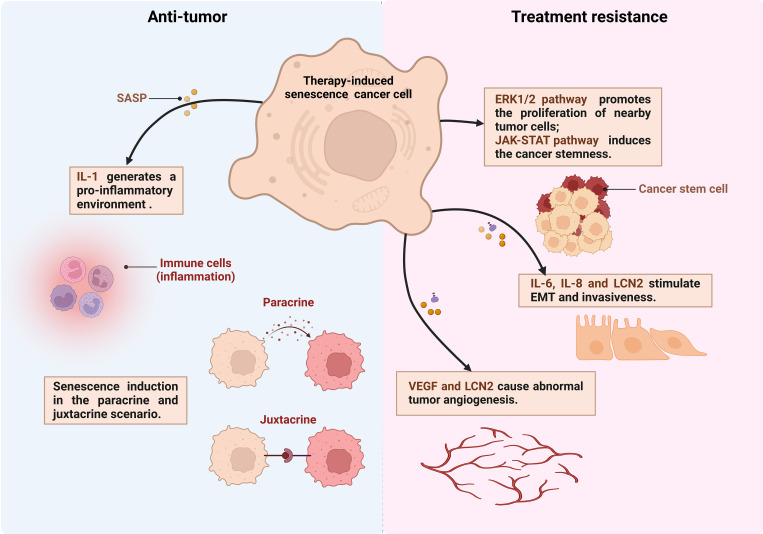
The emergence of resistance to prostate cancer (PCa) treatment, particularly to androgen deprivation therapy (ADT), has posed a significant challenge in the field of PCa management. Among the therapeutic options for PCa, radiotherapy, chemotherapy, and hormone therapy are commonly used modalities. However, these therapeutic approaches, while inducing apoptosis in tumor cells, may also trigger stress-induced premature senescence (SIPS). Cellular senescence, an entropy-driven transition from an ordered to a disordered state, ultimately leading to cell growth arrest, exhibits a dual role in PCa treatment. On one hand, senescent tumor cells may withdraw from the cell cycle, thereby reducing tumor growth rate and exerting a positive effect on treatment. On the other hand, senescent tumor cells may secrete a plethora of cytokines, growth factors and proteases that can affect neighboring tumor cells, thereby exerting a negative impact on treatment. This review explores how radiotherapy, chemotherapy, and hormone therapy trigger SIPS and the nuanced impact of senescent tumor cells on PCa treatment. Additionally, we aim to identify novel therapeutic strategies to overcome resistance in PCa treatment, thereby enhancing patient outcomes.
前列腺癌 (PCa) 治疗耐药性的出现,特别是对雄激素剥夺治疗 (ADT) 的耐药性,给 PCa 管理领域带来了重大挑战。在 PCa 的治疗选择中,放疗、化疗和激素治疗是常用的方法。然而,这些治疗方法在诱导肿瘤细胞凋亡的同时,也可能引发应激诱导的过早衰老 (SIPS)。细胞衰老,即从有序状态向无序状态的熵驱动转变,最终导致细胞生长停滞,在 PCa 治疗中具有双重作用。一方面,衰老的肿瘤细胞可能退出细胞周期,从而降低肿瘤生长速度,并对治疗产生积极影响。另一方面,衰老的肿瘤细胞可能会分泌大量细胞因子、生长因子和蛋白酶,从而影响邻近的肿瘤细胞,对治疗产生负面影响。本综述探讨了放疗、化疗和激素治疗如何引发 SIPS 以及衰老肿瘤细胞对 PCa 治疗的细微影响。此外,我们旨在确定克服 PCa 治疗耐药性的新治疗策略,从而提高患者的治疗效果。