Department of Medicine, University of California, San Francisco, San Francisco, CA.
Division of Hospital Medicine, Department of Medicine, University of California, San Francisco, San Francisco, CA.
Crit Care Explor. 2024 Apr 26;6(5):e1082. doi: 10.1097/CCE.0000000000001082. eCollection 2024 May.
To evaluate the relationship between early IV fluid volume and hospital outcomes, including death in-hospital or discharge to hospice, in septic patients with and without heart failure (HF).
A retrospective cohort study using logistic regression with restricted cubic splines to assess for nonlinear relationships between fluid volume and outcomes, stratified by HF status and adjusted for propensity to receive a given fluid volume in the first 6 hours. An ICU subgroup analysis was performed. Secondary outcomes of vasopressor use, mechanical ventilation, and length of stay in survivors were assessed.
An urban university-based hospital.
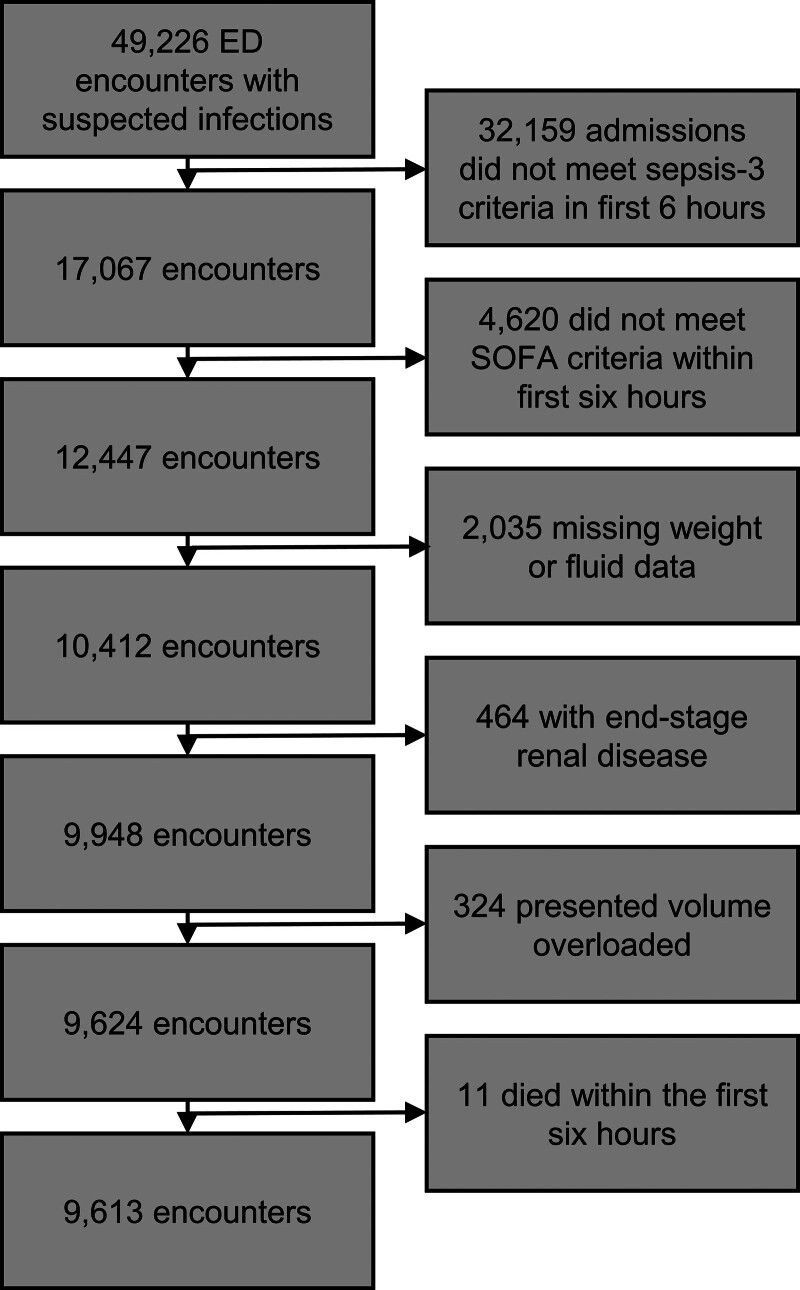
A total of 9613 adult patients were admitted from the emergency department from 2012 to 2021 that met electronic health record-based Sepsis-3 criteria. Preexisting HF diagnosis was identified by the codes.
None.
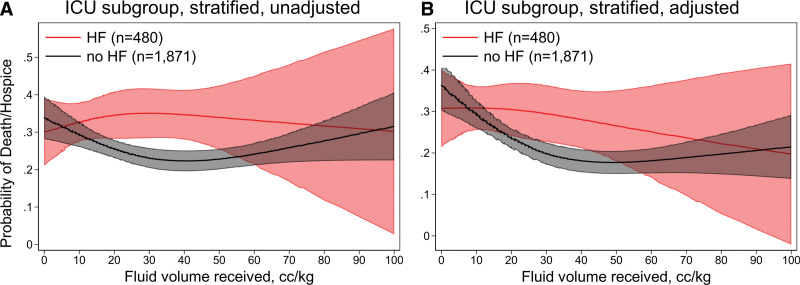
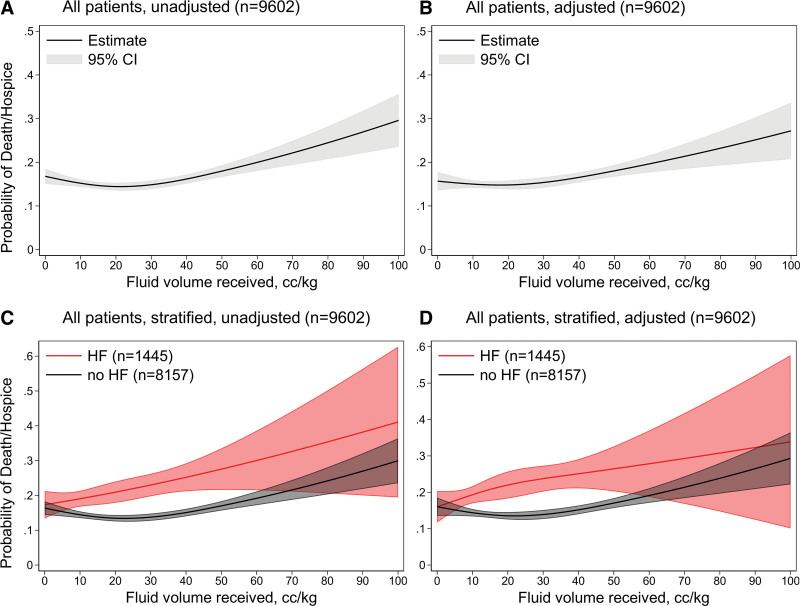
There were 1449 admissions from patients with HF. The relationship between fluid volume and death or discharge to hospice was nonlinear in patients without HF, and approximately linear in patients with HF. Receiving 0-15 mL/kg in the first 6 hours was associated with lower likelihood of death or discharge to hospice compared with 30-45 mL/kg (odds ratio = 0.61; 95% CI, 0.41-0.90; = 0.01) in HF patients, but no significant difference for non-HF patients. A similar pattern was identified in ICU admissions and some secondary outcomes. Volumes larger than 15-30 mL/kg for non-HF patients and 30-45 mL/kg for ICU-admitted non-HF patients were not associated with improved outcomes.
Early fluid resuscitation showed distinct patterns of potential harm and benefit between patients with and without HF who met Sepsis-3 criteria. Restricted cubic splines analysis highlighted the importance of considering nonlinear fluid outcomes relationships and identified potential points of diminishing returns (15-30 mL/kg across all patients without HF and 30-45 mL/kg when admitted to the ICU). Receiving less than 15 mL/kg was associated with better outcomes in HF patients, suggesting small volumes may be appropriate in select patients. Future studies may benefit from investigating nonlinear fluid-outcome associations and a focus on other conditions like HF.
评估有和没有心力衰竭(HF)的败血症患者早期静脉输液量与住院结局(包括院内死亡或临终关怀出院)之间的关系。
一项回顾性队列研究,使用逻辑回归和限制立方样条评估液体量与结局之间的非线性关系,按 HF 状态分层,并根据前 6 小时内接受特定液体量的倾向进行调整。进行了 ICU 亚组分析。评估存活者的血管加压药使用、机械通气和住院时间等次要结局。
一所城市大学附属医院。
共有 9613 名成年患者从 2012 年至 2021 年从急诊科入院,符合电子病历为基础的 Sepsis-3 标准。预先存在的 HF 诊断通过 代码确定。
无。
HF 患者中有 1449 例住院。无 HF 患者的液体量与死亡或临终关怀出院之间的关系是非线性的,而 HF 患者的关系则是近似线性的。与 30-45 mL/kg 相比,前 6 小时内接受 0-15 mL/kg 输液与 HF 患者的死亡或临终关怀出院的可能性较低相关(比值比=0.61;95%CI,0.41-0.90; = 0.01),而非 HF 患者则无显著差异。在 ICU 入院和一些次要结局中也发现了类似的模式。对于非 HF 患者,体积大于 15-30 mL/kg,对于 ICU 入院的非 HF 患者,体积大于 30-45 mL/kg,与改善结局无关。
符合 Sepsis-3 标准的有和没有 HF 的败血症患者早期液体复苏表现出明显的潜在危害和获益模式。限制立方样条分析强调了考虑非线性液体结局关系的重要性,并确定了潜在的收益递减点(所有非 HF 患者为 15-30 mL/kg,当 ICU 入院时为 30-45 mL/kg)。HF 患者接受少于 15 mL/kg 与更好的结局相关,这表明在某些选择的患者中,小体积可能是合适的。未来的研究可能受益于调查非线性液体-结局关联,并关注其他疾病如 HF。