Department of Biosystems Science and Engineering, ETH Zürich, Basel, Switzerland.
Swiss Tropical and Public Health Institute, Allschwil, Switzerland.
PLoS Pathog. 2024 May 2;20(5):e1011675. doi: 10.1371/journal.ppat.1011675. eCollection 2024 May.
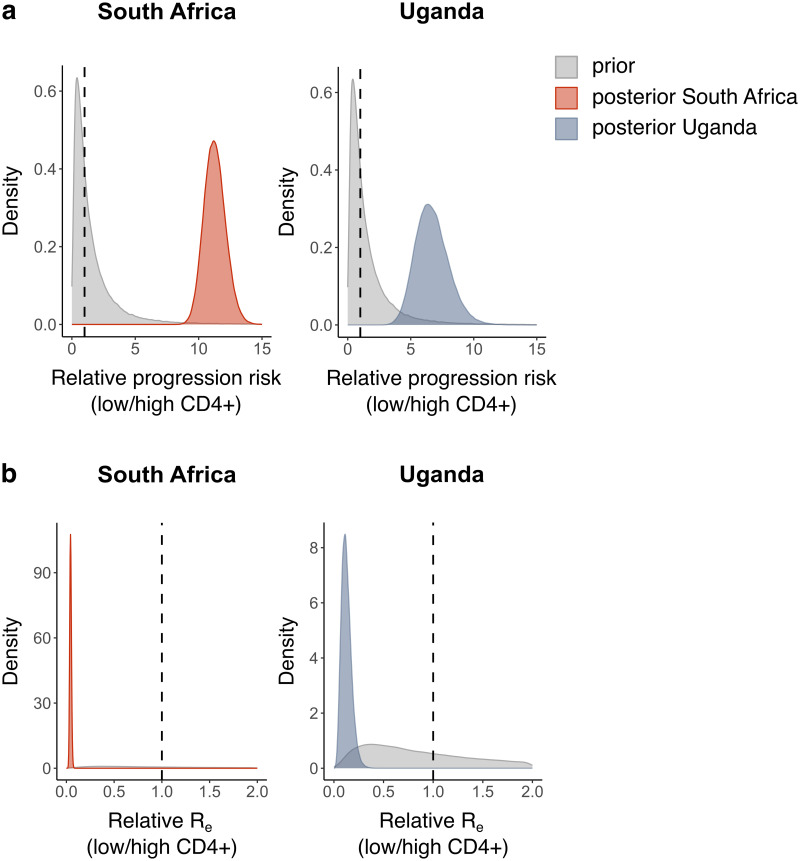
Persons living with HIV are known to be at increased risk of developing tuberculosis (TB) disease upon infection with Mycobacterium tuberculosis (Mtb). However, it has remained unclear how HIV co-infection affects subsequent Mtb transmission from these patients. Here, we customized a Bayesian phylodynamic framework to estimate the effects of HIV co-infection on the Mtb transmission dynamics from sequence data. We applied our model to four Mtb genomic datasets collected in sub-Saharan African countries with a generalized HIV epidemic. Our results confirm that HIV co-infection is a strong risk factor for developing active TB. Additionally, we demonstrate that HIV co-infection is associated with a reduced effective reproductive number for TB. Stratifying the population by CD4+ T-cell count yielded similar results, suggesting that, in this context, CD4+ T-cell count is not a better predictor of Mtb transmissibility than HIV infection status alone. Together, our genome-based analyses complement observational household contact studies, and more firmly establish the negative association between HIV co-infection and Mtb transmissibility.
已知 HIV 感染者在感染结核分枝杆菌(Mtb)后,患结核病(TB)的风险增加。然而,HIV 合并感染如何影响这些患者随后的 Mtb 传播仍不清楚。在这里,我们定制了一个贝叶斯系统发育动力学框架来估计 HIV 合并感染对 Mtb 从序列数据传播动力学的影响。我们将我们的模型应用于在 HIV 广泛流行的撒哈拉以南非洲国家收集的四个 Mtb 基因组数据集。我们的结果证实,HIV 合并感染是发生活动性结核病的一个强烈危险因素。此外,我们证明 HIV 合并感染与 TB 的有效繁殖数减少有关。根据 CD4+ T 细胞计数对人群进行分层得到了类似的结果,这表明在这种情况下,CD4+ T 细胞计数并不能比 HIV 感染状态本身更好地预测 Mtb 的传播能力。总的来说,我们基于基因组的分析补充了观察性家庭接触研究,并更有力地确立了 HIV 合并感染与 Mtb 传播能力之间的负相关关系。