Vaccines and Immunity Theme, Medical Research Council Unit The Gambia at the London School of Hygiene & Tropical Medicine, Banjul, The Gambia.
Division of Viral Diseases, National Center for Immunization and Respiratory Diseases, Centers for Disease Control and Prevention, Atlanta, GA, USA.
Lancet. 2024 May 11;403(10439):1879-1892. doi: 10.1016/S0140-6736(24)00532-4. Epub 2024 Apr 29.
Microneedle patches (MNPs) have been ranked as the highest global priority innovation for overcoming immunisation barriers in low-income and middle-income countries. This trial aimed to provide the first data on the tolerability, safety, and immunogenicity of a measles and rubella vaccine (MRV)-MNP in children.
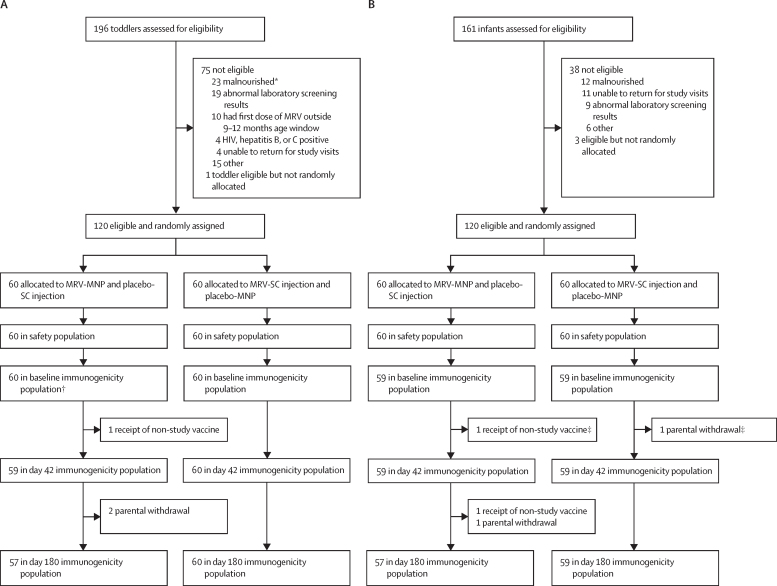
This single-centre, phase 1/2, double-blind, double-dummy, randomised, active-controlled, age de-escalation trial was conducted in The Gambia. To be eligible, all participants had to be healthy according to prespecified criteria, aged 18-40 years for the adult cohort, 15-18 months for toddlers, or 9-10 months for infants, and to be available for visits throughout the follow-up period. The three age cohorts were randomly assigned in a 2:1 ratio (adults) or 1:1 ratio (toddlers and infants) to receive either an MRV-MNP (Micron Biomedical, Atlanta, GA, USA) and a placebo (0·9% sodium chloride) subcutaneous injection, or a placebo-MNP and an MRV subcutaneous injection (MRV-SC; Serum Institute of India, Pune, India). Unmasked staff ransomly assigned the participants using an online application, and they prepared visually identical preparations of the MRV-MNP or placebo-MNP and MRV-SC or placebo-SC, but were not involved in collecting endpoint data. Staff administering the study interventions, participants, parents, and study staff assessing trial endpoints were masked to treatment allocation. The safety population consists of all vaccinated participants, and analysis was conducted according to route of MRV administration, irrespective of subsequent protocol deviations. The immunogenicity population consisted of all vaccinated participants who had a baseline and day 42 visit result available, and who had no protocol deviations considered to substantially affect the immunogenicity endpoints. Solicited local and systemic adverse events were collected for 14 days following vaccination. Unsolicited adverse events were collected to day 180. Age de-escalation between cohorts was based on the review of the safety data to day 14 by an independent data monitoring committee. Serum neutralising antibodies to measles and rubella were measured at baseline, day 42, and day 180. Analysis was descriptive and included safety events, seroprotection and seroconversion rates, and geometric mean antibody concentrations. The trial was registered with the Pan African Clinical Trials Registry PACTR202008836432905, and is complete.
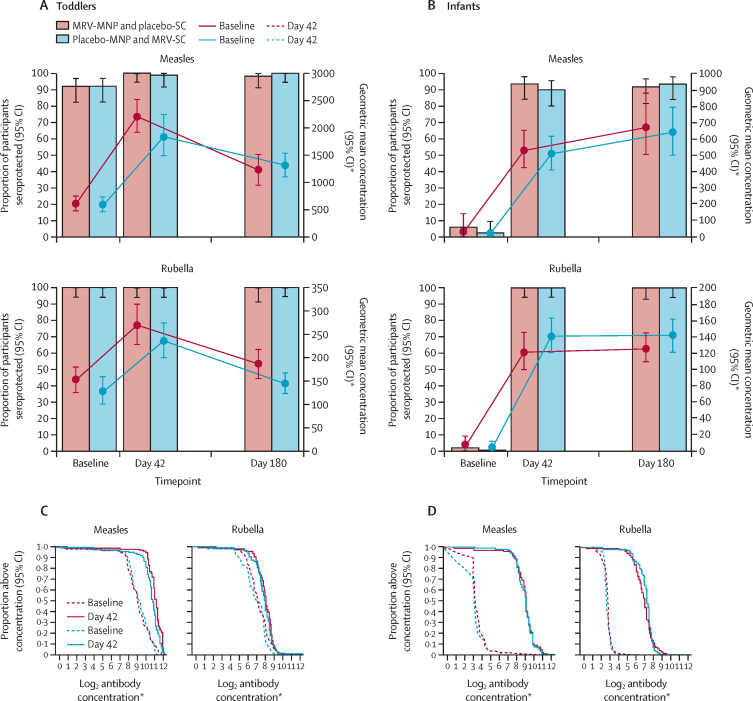
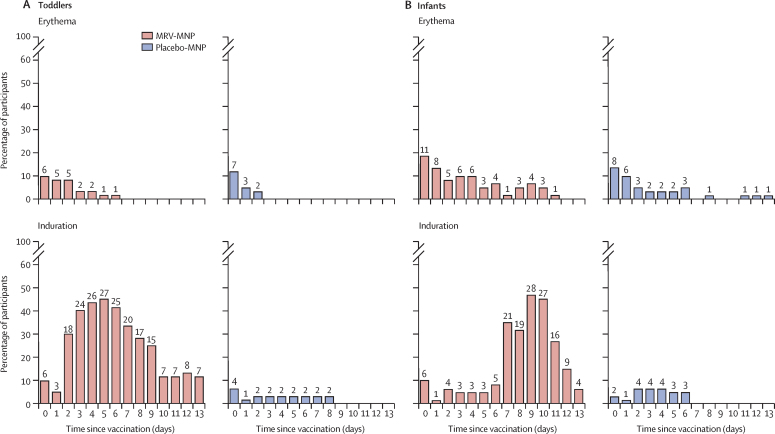
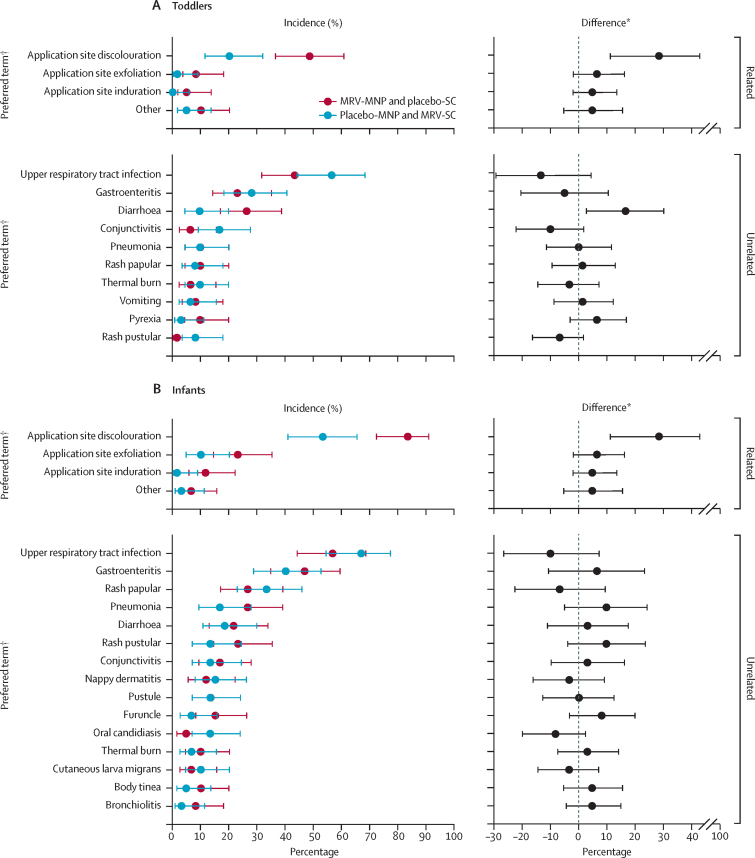
Recruitment took place between May 18, 2021, and May 27, 2022. 45 adults, 120 toddlers, and 120 infants were randomly allocated and vaccinated. There were no safety concerns in the first 14 days following vaccination in either adults or toddlers, and age de-escalation proceeded accordingly. In infants, 93% (52/56; 95% CI 83·0-97·2) seroconverted to measles and 100% (58/58; 93·8-100) seroconverted to rubella following MRV-MNP administration, while 90% (52/58; 79·2-95·2) and 100% (59/59; 93·9-100) seroconverted to measles and rubella respectively, following MRV-SC. Induration at the MRV-MNP application site was the most frequent local reaction occurring in 46 (77%) of 60 toddlers and 39 (65%) of 60 infants. Related unsolicited adverse events, most commonly discolouration at the application site, were reported in 35 (58%) of 60 toddlers and 57 (95%) of 60 infants that had received the MRV-MNP. All local reactions were mild. There were no related severe or serious adverse events.
The safety and immunogenicity data support the accelerated development of the MRV-MNP.
Bill & Melinda Gates Foundation.
微针贴片(MNPs)被评为克服低收入和中等收入国家免疫障碍的最高全球优先创新。本试验旨在提供麻疹和风疹疫苗(MRV)-MNP 在儿童中的耐受性、安全性和免疫原性的首批数据。
这是一项在冈比亚进行的单中心、1/2 期、双盲、双模拟、随机、对照、年龄递减的试验。符合条件的所有参与者都必须根据预先规定的标准健康,成人组年龄为 18-40 岁,幼儿组为 15-18 个月,婴儿组为 9-10 个月,并且在随访期间可随时进行访问。三个年龄组以 2:1 或 1:1 的比例随机分配(成人)或(幼儿和婴儿)接受 MRV-MNP(美敦力生物医学,亚特兰大,佐治亚州,美国)和安慰剂(0.9%氯化钠)皮下注射,或安慰剂-MNP 和 MRV 皮下注射(MRV-SC;印度血清研究所,浦那,印度)。未蒙面的工作人员使用在线应用程序随机分配参与者,他们准备了视觉上相同的 MRV-MNP 或安慰剂-MNP 和 MRV-SC 或安慰剂-SC,但不参与收集终点数据。管理研究干预措施的工作人员、参与者、父母和评估试验终点的研究工作人员对治疗分配进行了掩蔽。安全性人群包括所有接种疫苗的参与者,分析根据 MRV 给药途径进行,无论随后的方案偏差如何。免疫原性人群包括所有接种疫苗且基线和第 42 天就诊结果均可用的参与者,且无方案偏差被认为会对免疫原性终点产生实质性影响。接种疫苗后 14 天内收集了自发的局部和全身不良事件。接种疫苗后 180 天内收集了非自愿不良事件。队列之间的年龄递减是基于独立数据监测委员会在第 14 天对安全性数据的审查。在第 0、42 和 180 天测量了血清中和抗体对麻疹和风疹的滴度。分析为描述性分析,包括安全性事件、血清保护率和血清转化率以及几何平均抗体浓度。该试验在非洲临床试验注册中心 PACTR202008836432905 进行了注册,现已完成。
招募工作于 2021 年 5 月 18 日至 2022 年 5 月 27 日进行。45 名成年人、120 名幼儿和 120 名婴儿被随机分配并接种疫苗。在接种疫苗后的前 14 天内,成年人和幼儿均未出现安全性问题,并且相应地进行了年龄递减。在婴儿中,接种 MRV-MNP 后,麻疹血清转化率为 93%(52/56;95%CI 83.0-97.2),风疹血清转化率为 100%(58/58;93.8-100),而接种 MRV-SC 后,麻疹血清转化率为 90%(52/58;79.2-95.2)和 100%(59/59;93.9-100),风疹血清转化率为 100%。在 60 名幼儿中有 46 名(77%)和 60 名婴儿中有 39 名(65%)出现 MRV-MNP 应用部位硬结,是最常见的局部反应。报告了 35 名(58%)幼儿和 57 名(95%)婴儿的与疫苗接种相关的非自愿不良事件,最常见的是应用部位变色,这些婴儿接种了 MRV-MNP。所有局部反应均为轻度。没有相关的严重或严重不良事件。
安全性和免疫原性数据支持 MRV-MNP 的加速开发。
比尔和梅琳达·盖茨基金会。