Department of Environmental Health, Harvard T.H. Chan School of Public Health, Boston, Massachusetts.
Department of Environmental Health, Harvard T.H. Chan School of Public Health, Boston, Massachusetts; Channing Division of Network Medicine, Department of Medicine, Brigham and Women's Hospital and Harvard Medical School, Boston, Massachusetts.
Fertil Steril. 2024 Sep;122(3):494-503. doi: 10.1016/j.fertnstert.2024.04.032. Epub 2024 May 1.
To evaluate the association between the urinary benzophenone-3 concentrations and measures of ovarian reserve (OR) among women in the Environment and Reproductive Health study seeking fertility treatment at Massachusetts General Hospital (MGH) in Boston, Massachusetts.
Prospective cohort study.
MGH infertility clinic in Boston, Massachusetts.
PATIENT(S): Women in the Environment and Reproductive Health cohort seeking fertility treatment.
INTERVENTION(S): Women contributed spot urine samples prior to assessment of OR outcomes that were analyzed for benzophenone-3 concentrations.
MAIN OUTCOME MEASURE(S): Antral follicle count (AFC) and day 3 follicle-stimulating hormone (FSH) levels were evaluated as part of standard infertility workups during unstimulated menstrual cycles. Quasi-Poisson and linear regression models were used to evaluate the association of the specific gravity-adjusted urinary benzophenone-3 concentrations with AFC and FSH, with adjustment for age and physical activity. In the secondary analyses, models were stratified by age.
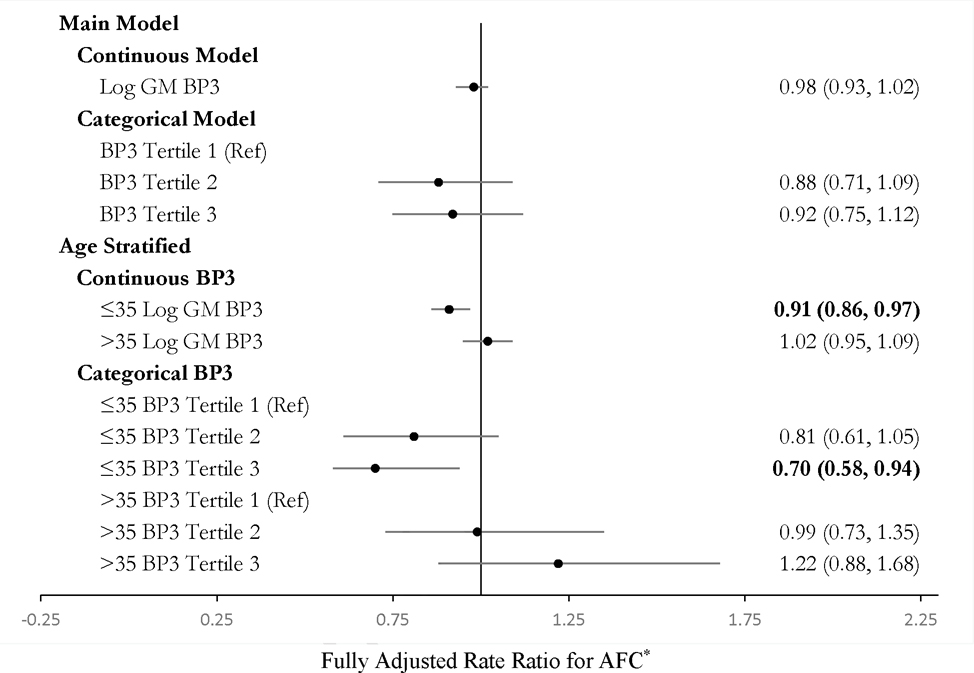
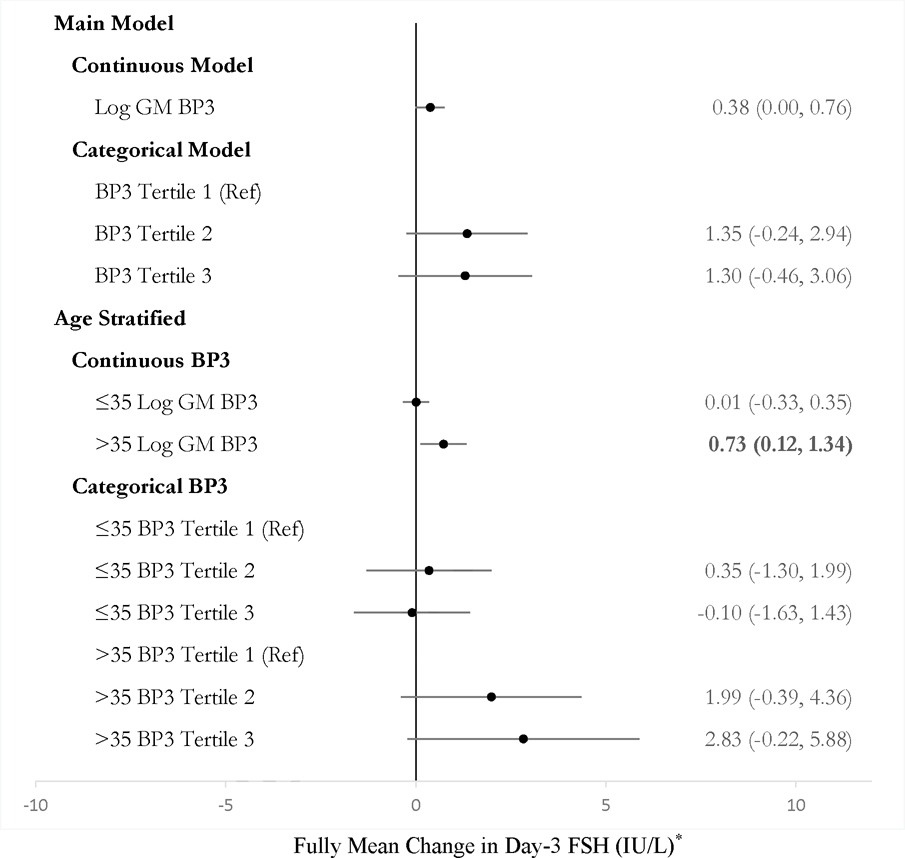
RESULT(S): This study included 142 women (mean age ± standard deviation, 36.1 ± 4.6 years; range, 22-45 years) enrolled between 2009 and 2017 with both urinary benzophenone-3 and AFC measurements and 57 women with benzophenone-3 and FSH measurements. Most women were White (78%) and highly educated (49% with a graduate degree). Women contributed a mean of 2.7 urine samples (range, 1-10), with 37% contributing ≥2 samples. Benzophenone-3 was detected in 98% of samples. The geometric mean specific gravity-corrected urinary benzophenone-3 concentration was 85.9 μg/L (geometric standard deviation, 6.2). There were no associations of benzophenone-3 with AFC and day 3 FSH in the full cohort. In stratified models, a 1-unit increase in the log geometric mean benzophenone-3 concentration was associated with a 0.91 (95% confidence interval, 0.86-0.97) times lower AFC among women aged ≤35 years and an increase in the FSH concentration of 0.73 (95% confidence interval, 0.12-1.34) IU/L among women aged >35 years.
CONCLUSION(S): In the main models, urinary benzophenone-3 was not associated with OR. However, younger patients may be vulnerable to the potential effects of benzophenone-3 on AFC. Further research is warranted.
评估马萨诸塞州总医院(MGH)波士顿生育诊所寻求生育治疗的女性尿液中苯并三唑浓度与卵巢储备(OR)测量值之间的关联。
前瞻性队列研究。
马萨诸塞州波士顿 MGH 不孕诊所。
参加环境与生殖健康队列并寻求生育治疗的女性。
在未刺激的月经周期中,女性在进行 OR 结果评估之前,提供了点尿样,对这些尿液样进行了苯并三唑浓度分析。
窦卵泡计数(AFC)和第 3 天卵泡刺激素(FSH)水平作为标准不孕检查的一部分进行评估。使用准泊松和线性回归模型评估特定比重校正后的尿液苯并三唑浓度与 AFC 和 FSH 的关联,调整了年龄和体力活动。在二次分析中,根据年龄对模型进行分层。
这项研究包括 142 名女性(平均年龄±标准差,36.1±4.6 岁;范围,22-45 岁),她们于 2009 年至 2017 年间入组,均进行了尿液苯并三唑和 AFC 测量,57 名女性进行了苯并三唑和 FSH 测量。大多数女性为白人(78%),教育程度较高(49%具有研究生学位)。女性平均提供了 2.7 份尿液样本(范围,1-10 份),其中 37%提供了≥2 份样本。98%的样本中检测到了苯并三唑。几何平均比重校正尿液苯并三唑浓度为 85.9μg/L(几何标准差,6.2)。在整个队列中,苯并三唑与 AFC 和第 3 天 FSH 均无关联。在分层模型中,苯并三唑浓度的对数几何平均值每增加 1 个单位,年龄≤35 岁的女性 AFC 降低 0.91(95%置信区间,0.86-0.97)倍,年龄>35 岁的女性 FSH 浓度增加 0.73(95%置信区间,0.12-1.34)IU/L。
在主要模型中,尿液苯并三唑与 OR 无关。然而,年轻患者可能更容易受到苯并三唑对 AFC 潜在影响的影响。需要进一步的研究。