Kim Sang Hun, Hong Cho Hui, Shin Myung-Jun, Kim Ki Uk, Park Tae Sung, Park Jun Yong, Shin Yong Beom
Department of Rehabilitation Medicine, Biomedical Research Institute, Pusan National University Hospital and Pusan National University School of Medicine, Busan, Republic of Korea.
Biomedical Research Institute, Pusan National University Hospital, Busan, Republic of Korea.
BMC Pulm Med. 2024 May 2;24(1):219. doi: 10.1186/s12890-024-03034-5.
The relationship between sarcopenia and chronic obstructive pulmonary disease (COPD) has been increasingly reported, and there is some overlap regarding their clinical features and pulmonary rehabilitation (PR) strategies. No Korean study has reported the actual prevalence of sarcopenia in patients with stable COPD who are recommended for pulmonary rehabilitation. This study evaluated the prevalence and clinical features of sarcopenia in older adult outpatients with stable COPD and the changes after 6 months.
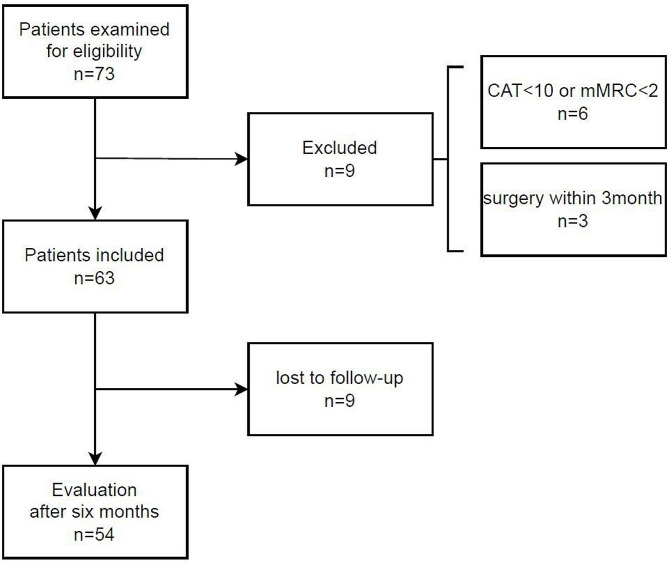
In this cross-sectional and 6-month follow-up study, we recruited 63 males aged ≥ 65 diagnosed with stable COPD. Sarcopenia was diagnosed using the AWGS 2019 criteria, which included hand grip strength testing, bioelectrical impedance analysis, Short Physical Performance Battery administration, and Strength, Assistance with walking, Rising from a chair, Climbing stairs, and Falling screening tool administration. A 6-minute walk test (6 MWT) was conducted, forced vital capacity (FVC), forced expiratory volume in 1 s (FEV), maximal inspiratory and expiratory pressures (MIP and MEP, respectively) and peak expiratory flow (PEF) were assessed, and patient-reported questionnaires were administered.
At baseline, 14 (22%) patients were diagnosed with possible sarcopenia, and eight (12.6%) were diagnosed with sarcopenia. There were significant differences in the age; body mass index; Body mass index, airflow Obstruction, Dyspnea, and Exercise index; modified Medical Research Council dyspnea scores; and International Physical Activity Questionnaire scores between the normal and sarcopenia groups. Whole-body phase angle, MIP, MEP, PEF, and 6-minute walk distance (6 MWD) also showed significant differences. Over 6 months, the proportion of patients with a reduced FEV increased; however, the proportion of patients with sarcopenia did not increase.
A relatively low prevalence of sarcopenia was observed in older adult outpatients with stable COPD. No significant change in the prevalence of sarcopenia was found during the 6-month follow-up period.
The study was registered with the Clinical Research Information Service (KCT0006720). Registration date: 30/07/2021.
肌肉减少症与慢性阻塞性肺疾病(COPD)之间的关系已有越来越多的报道,它们在临床特征和肺康复(PR)策略方面存在一些重叠。尚无韩国研究报道推荐进行肺康复的稳定期COPD患者中肌肉减少症的实际患病率。本研究评估了老年稳定期COPD门诊患者中肌肉减少症的患病率和临床特征以及6个月后的变化。
在这项横断面和6个月随访研究中,我们招募了63名年龄≥65岁、诊断为稳定期COPD的男性。采用2019年亚洲肌肉减少症工作组(AWGS)标准诊断肌肉减少症,该标准包括握力测试、生物电阻抗分析、简短体能状况量表测试,以及力量、行走辅助、从椅子上站起、爬楼梯和跌倒筛查工具测试。进行6分钟步行试验(6MWT),评估用力肺活量(FVC)、第1秒用力呼气容积(FEV)、最大吸气和呼气压力(分别为MIP和MEP)以及呼气峰值流速(PEF),并发放患者报告问卷。
基线时,14名(22%)患者被诊断为可能患有肌肉减少症,8名(12.6%)被诊断为肌肉减少症。正常组和肌肉减少症组在年龄、体重指数、体重指数、气流阻塞、呼吸困难和运动指数、改良医学研究委员会呼吸困难评分以及国际体力活动问卷评分方面存在显著差异。全身相位角、MIP、MEP、PEF和6分钟步行距离(6MWD)也显示出显著差异。在6个月期间,FEV降低的患者比例增加;然而,肌肉减少症患者的比例没有增加。
在老年稳定期COPD门诊患者中观察到肌肉减少症的患病率相对较低。在6个月的随访期内,肌肉减少症的患病率没有显著变化。
该研究已在临床研究信息服务中心注册(KCT0006720)。注册日期:2021年7月30日。