Mohamad Zani Radhiyatul Akma, Ahmad Yusof Hazwani, Azizan Nurul 'Ain, Hyder Ali Irfhan Ali, Ismail Suhaila, Mohd Shariff Noorsuzana
Department of Community Health, Advanced Medical and Dental Institute, Universiti Sains Malaysia, Kepala Batas, Penang, 13200, Malaysia.
School of Biosciences, University of Nottingham Malaysia, Malaysia Campus, Jalan Broga, Semenyih, Selangor Darul Ehsan, 43500, Malaysia.
BMC Public Health. 2025 Apr 28;25(1):1572. doi: 10.1186/s12889-025-22819-9.
Chronic respiratory diseases like asthma, chronic obstructive pulmonary disease (COPD), and tuberculosis (TB) are increasing globally, leading to systemic symptoms like skeletal muscle dysfunction. Ageing and physical inactivity exacerbate sarcopenia, reducing functional capacity, disability, and quality of life. However, limited research exists on the prevalence of sarcopenia among chronic respiratory diseases in low-middle-income countries like Malaysia. Hence, this study aims to investigate the prevalence of sarcopenia and its associated risk factors among adults with asthma, COPD, and TB in Penang, Malaysia.
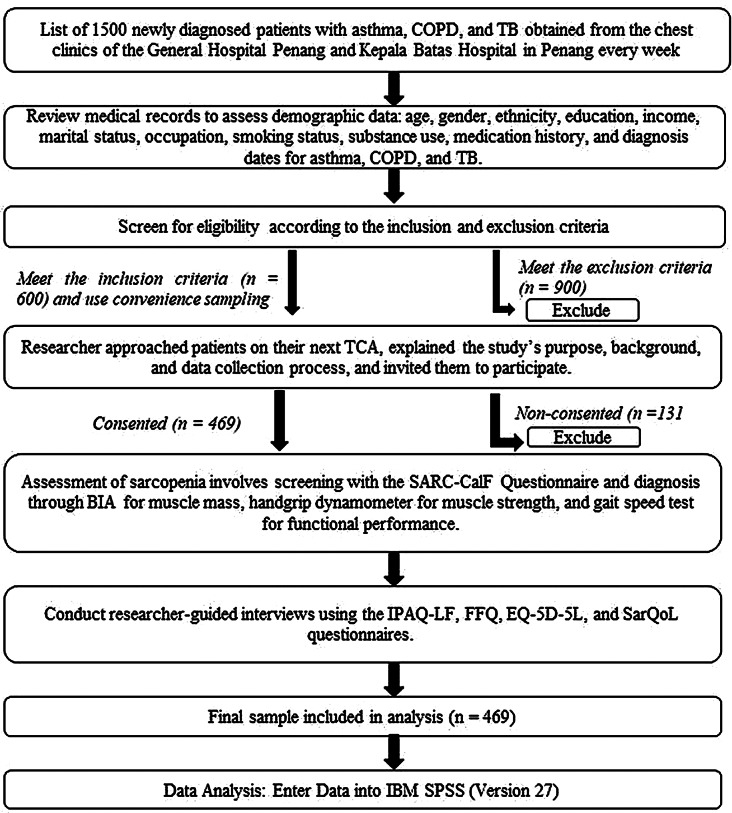
A cross-sectional study was conducted from June 2023 to March 2024. This study included 469 patients (mean age: 52.62 ± 16.61 years) diagnosed with asthma (n = 180), COPD (n = 186), or TB (n = 103) receiving treatment in chest clinics of two governmental hospitals in Penang. The SARC-F and SARC-CalF questionnaires were used to assess the participants' risk of sarcopenia. Sarcopenia was identified using the 2019 criteria of the Asian Working Group for Sarcopenia (AWGS). The risk factors for sarcopenia in asthma, COPD, and TB patients were investigated using multivariable logistic regression.
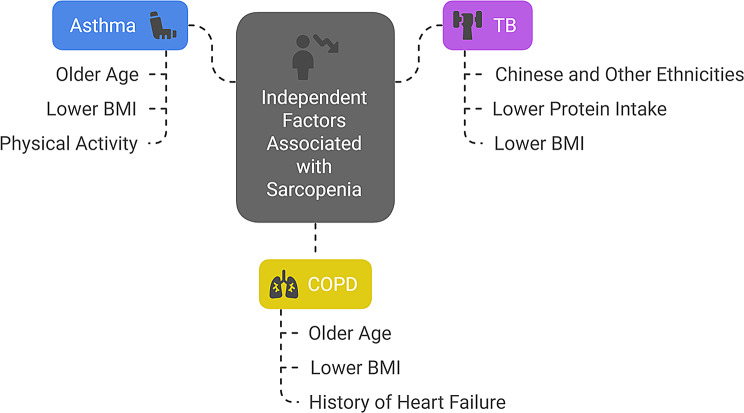
The prevalence of sarcopenia was 18.9% (95% CI 13.5-25.4) in patients with asthma, 33.9% (95% CI 27.1-41.2) in those with TB, and 35.9% (95% CI 26.7-46.0) in those with COPD, according to AWGS 2019 criteria. The SARC-CalF screening tool showed that 27.3% of participants had a positive risk of having sarcopenia. The independent risk factors associated with sarcopenia in asthma patients were age, physical activity and body mass index (BMI). For TB patients, significant risk factors included Chinese and other ethnicities, foreigners, lower daily protein intake, and BMI. In COPD patients, independent risk factors included age, moderate physical activity, BMI and history of heart failure.
This study highlighted a significant burden of sarcopenia among patients with asthma, COPD and TB. Non-clinical interventions such as lifestyle modification and nutritional support to the patients are crucial to maintain muscle strength and delay the onset of sarcopenia, particularly in people with chronic respiratory diseases.
哮喘、慢性阻塞性肺疾病(COPD)和结核病(TB)等慢性呼吸道疾病在全球范围内呈上升趋势,导致骨骼肌功能障碍等全身症状。衰老和身体活动不足会加剧肌肉减少症,降低功能能力、增加残疾率并影响生活质量。然而,在马来西亚等中低收入国家,关于慢性呼吸道疾病患者中肌肉减少症患病率的研究有限。因此,本研究旨在调查马来西亚槟城哮喘、COPD和TB成年患者中肌肉减少症的患病率及其相关危险因素。
于2023年6月至2024年3月进行了一项横断面研究。本研究纳入了469例患者(平均年龄:52.62±16.61岁),这些患者在槟城两家政府医院的胸科诊所接受治疗,其中诊断为哮喘的患者有180例,COPD患者有186例,TB患者有103例。使用SARC - F和SARC - CalF问卷评估参与者患肌肉减少症的风险。根据亚洲肌肉减少症工作组(AWGS)2019年的标准确定肌肉减少症。使用多变量逻辑回归研究哮喘、COPD和TB患者肌肉减少症的危险因素。
根据AWGS 2019年标准,哮喘患者中肌肉减少症的患病率为18.9%(95%可信区间13.5 - 25.4),TB患者为33.9%(95%可信区间27.1 - 41.2),COPD患者为35.9%(95%可信区间26.7 - 46.0)。SARC - CalF筛查工具显示,27.3%的参与者有患肌肉减少症的阳性风险。与哮喘患者肌肉减少症相关的独立危险因素是年龄、身体活动和体重指数(BMI)。对于TB患者,显著的危险因素包括华裔和其他种族、外国人、每日蛋白质摄入量较低以及BMI。在COPD患者中,独立危险因素包括年龄、适度身体活动、BMI和心力衰竭病史。
本研究强调了哮喘、COPD和TB患者中肌肉减少症的重大负担。对患者进行生活方式改变和营养支持等非临床干预对于维持肌肉力量和延缓肌肉减少症的发生至关重要,特别是对于慢性呼吸道疾病患者。