Kishk Ali, Pires Pacheco Maria, Heurtaux Tony, Sauter Thomas
Department of Life Sciences and Medicine, University of Luxembourg, L-4367 Belvaux, Luxembourg.
Luxembourg Centre of Neuropathology, L-3555 Dudelange, Luxembourg.
Brief Bioinform. 2024 Mar 27;25(3). doi: 10.1093/bib/bbae199.
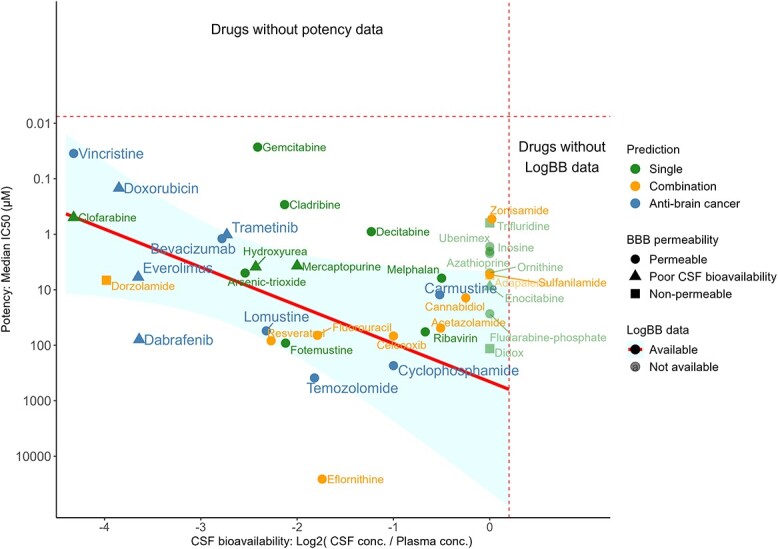
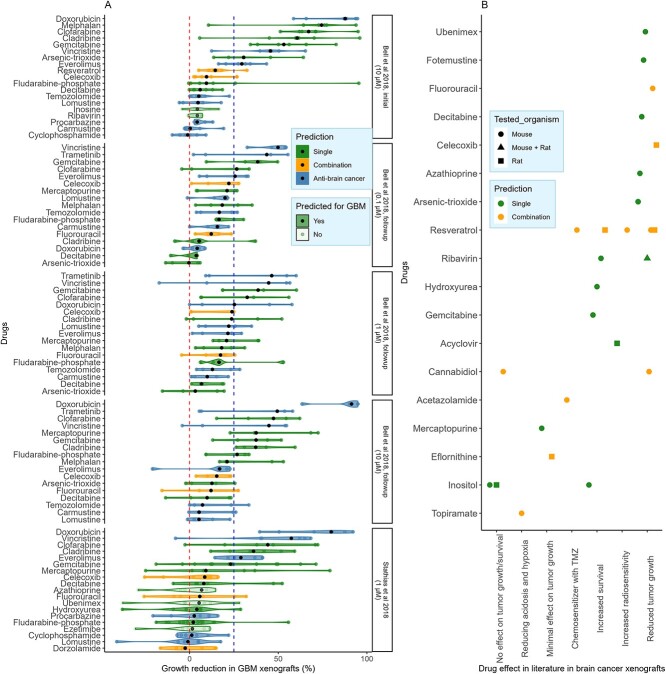
Gliomas are the most common type of malignant brain tumors, with glioblastoma multiforme (GBM) having a median survival of 15 months due to drug resistance and relapse. The treatment of gliomas relies on surgery, radiotherapy and chemotherapy. Only 12 anti-brain tumor chemotherapies (AntiBCs), mostly alkylating agents, have been approved so far. Glioma subtype-specific metabolic models were reconstructed to simulate metabolite exchanges, in silico knockouts and the prediction of drug and drug combinations for all three subtypes. The simulations were confronted with literature, high-throughput screenings (HTSs), xenograft and clinical trial data to validate the workflow and further prioritize the drug candidates. The three subtype models accurately displayed different degrees of dependencies toward glutamine and glutamate. Furthermore, 33 single drugs, mainly antimetabolites and TXNRD1-inhibitors, as well as 17 drug combinations were predicted as potential candidates for gliomas. Half of these drug candidates have been previously tested in HTSs. Half of the tested drug candidates reduce proliferation in cell lines and two-thirds in xenografts. Most combinations were predicted to be efficient for all three glioma types. However, eflornithine/rifamycin and cannabidiol/adapalene were predicted specifically for GBM and low-grade glioma, respectively. Most drug candidates had comparable efficiency in preclinical tests, cerebrospinal fluid bioavailability and mode-of-action to AntiBCs. However, fotemustine and valganciclovir alone and eflornithine and celecoxib in combination with AntiBCs improved the survival compared to AntiBCs in two-arms, phase I/II and higher glioma clinical trials. Our work highlights the potential of metabolic modeling in advancing glioma drug discovery, which accurately predicted metabolic vulnerabilities, repurposable drugs and combinations for the glioma subtypes.
神经胶质瘤是最常见的恶性脑肿瘤类型,由于耐药性和复发,多形性胶质母细胞瘤(GBM)的中位生存期为15个月。神经胶质瘤的治疗依赖于手术、放疗和化疗。到目前为止,仅有12种抗脑肿瘤化疗药物(AntiBCs)被批准,其中大多数是烷化剂。重建了神经胶质瘤亚型特异性代谢模型,以模拟代谢物交换、计算机基因敲除以及预测所有三种亚型的药物和药物组合。将模拟结果与文献、高通量筛选(HTS)、异种移植和临床试验数据进行对比,以验证工作流程并进一步对候选药物进行优先级排序。这三种亚型模型准确显示了对谷氨酰胺和谷氨酸的不同程度的依赖性。此外,预测了33种单一药物(主要是抗代谢物和TXNRD1抑制剂)以及17种药物组合作为神经胶质瘤的潜在候选药物。这些候选药物中有一半此前已在高通量筛选中进行过测试。经测试的候选药物中有一半可降低细胞系中的增殖,三分之二可降低异种移植中的增殖。大多数组合预计对所有三种神经胶质瘤类型均有效。然而,依氟鸟氨酸/利福霉素和大麻二酚/阿达帕林分别被预测对GBM和低级别神经胶质瘤具有特异性疗效。大多数候选药物在临床前测试、脑脊液生物利用度和作用方式方面与抗脑肿瘤化疗药物具有相当的疗效。然而,在双臂、I/II期及更高级别的神经胶质瘤临床试验中,与抗脑肿瘤化疗药物相比,福莫司汀和缬更昔洛韦单药以及依氟鸟氨酸和塞来昔布与抗脑肿瘤化疗药物联合使用可提高生存率。我们的工作突出了代谢建模在推进神经胶质瘤药物发现方面的潜力,该方法准确预测了神经胶质瘤亚型的代谢脆弱性、可重新利用的药物和药物组合。