Lee Rami, Kim Ji-Hun, Kim Won-Woo, Hwang Sung-Hee, Choi Sun-Hye, Kim Jong-Hoon, Cho Ik-Hyun, Kim Manho, Nah Seung-Yeol
Ginsentology Research Laboratory and Department of Physiology, College of Veterinary Medicine, Konkuk University, Seoul, Republic of Korea.
Department of Pharmaceutical Engineering, College of Health Sciences, Sangji University, Wonju, Republic of Korea.
J Ginseng Res. 2024 May;48(3):245-252. doi: 10.1016/j.jgr.2024.02.002. Epub 2024 Feb 17.
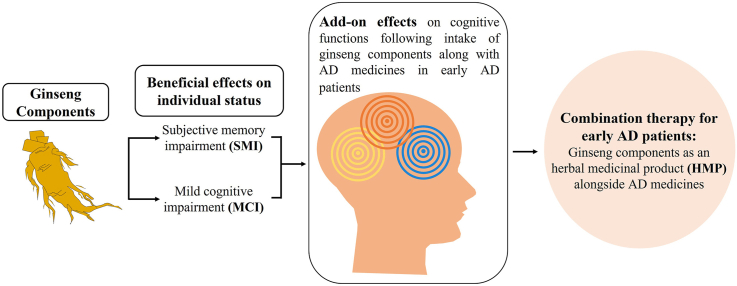
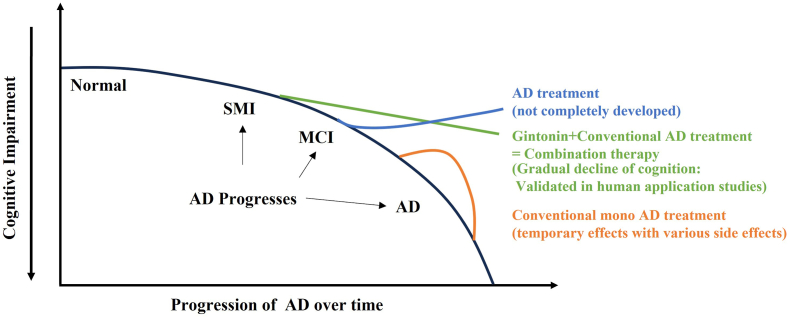
Ginseng is a traditional herbal medicine used for prevention and treatment of various diseases as a tonic. Recent scientific cohort studies on life prolongation with ginseng consumption support this record, as those who consumed ginseng for more than 5 years had reduced mortality and cognitive decline compared to those who did not. Clinical studies have also shown that acute or long-term intake of ginseng total extract improves acute working memory performance or cognitive function in healthy individuals and those with subjective memory impairment (SMI), mild cognitive impairment (MCI), or early Alzheimer's disease (AD) dementia who are taking AD medication(s). Ginseng contains various components ranging from classical ginsenosides and polysaccharides to more recently described gintonin. However, it is unclear which ginseng component(s) might be the main candidate that contribute to memory or cognitive improvements or prevent cognitive decline in older individuals. This review describes recent clinical contributors to ginseng components in clinical tests and introduces emerging evidence that ginseng components could be novel candidates for cognitive improvement in older individuals, as ginseng components improve SMI cognition and exhibits add-on effects when co-administered with early AD dementia drugs. The mechanism behind the beneficial effects of ginseng components and how it improves cognition are presented. Additionally, this review shows how ginseng components can contribute to SMI, MCI, or early AD dementia when used as a supplementary food and/or medicine, and proposes a novel combination therapy of current AD medicines with ginseng component(s).
人参是一种传统草药,作为滋补品用于预防和治疗各种疾病。最近关于食用人参延长寿命的科学队列研究支持了这一记载,因为与未食用人参的人相比,食用人参超过5年的人死亡率降低且认知能力下降减缓。临床研究还表明,急性或长期摄入人参总提取物可改善健康个体以及正在服用抗老年痴呆症药物的主观记忆障碍(SMI)、轻度认知障碍(MCI)或早期阿尔茨海默病(AD)痴呆患者的急性工作记忆表现或认知功能。人参含有从经典人参皂苷和多糖到最近发现的人参蛋白等多种成分。然而,尚不清楚哪种人参成分可能是有助于改善老年人记忆或认知或预防认知能力下降的主要候选成分。这篇综述描述了人参成分在临床试验中的最新临床贡献,并介绍了新出现的证据,即人参成分可能是改善老年人认知的新候选物,因为人参成分可改善SMI认知,并且与早期AD痴呆药物联合使用时具有附加效应。文中介绍了人参成分有益作用背后的机制及其改善认知的方式。此外,这篇综述展示了人参成分作为补充食品和/或药物时如何有助于改善SMI、MCI或早期AD痴呆,并提出了当前抗老年痴呆症药物与人参成分的新型联合疗法。