Panyakaew Pattamon, Phuenpathom Warongporn, Bhidayasiri Roongroj, Hallett Mark
Chulalongkorn Centre of Excellence for Parkinson's Disease and Related Disorders, Department of Medicine, Faculty of Medicine, Chulalongkorn University and King Chulalongkorn Memorial Hospital, Thai Red Cross Society, Bangkok 10330, Thailand.
Division of Neurology, Department of Medicine, Faculty of Medicine, Chulalongkorn University, Bangkok 10330, Thailand.
Asian Biomed (Res Rev News). 2024 Apr 30;18(2):37-52. doi: 10.2478/abm-2024-0008. eCollection 2024 Apr.
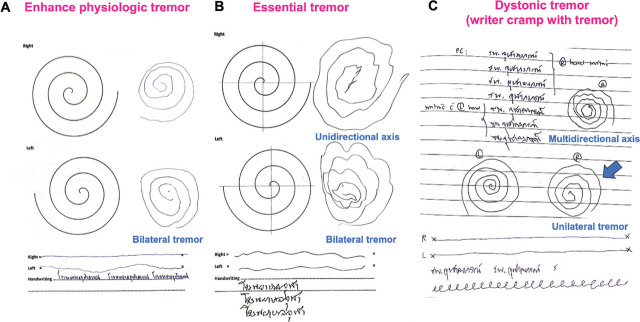
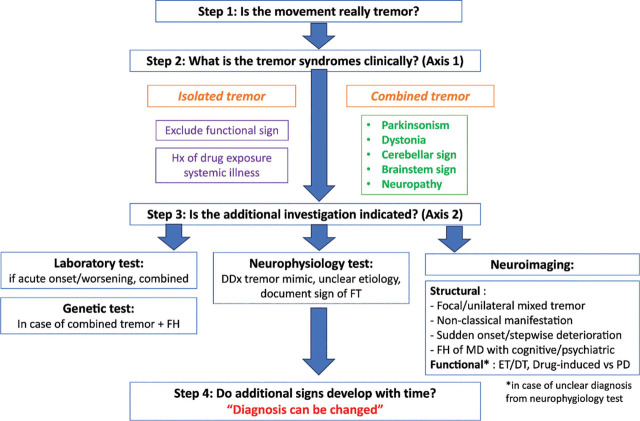
The diagnostic approach for patients with tremor is challenging due to the complex and overlapping phenotypes among tremor syndromes. The first step in the evaluation of tremor is to identify the tremulous movement and exclude the tremor mimics. The second step is to classify the tremor syndrome based on the characteristics of tremor from historical clues and focused examination (Axis 1). Comprehensive tremor examinations involve the assessment of tremor in different conditions (rest, action or mixed, position or task-specific), distribution of tremor (upper limb, lower limb, head, jaw), positive signs for functional tremor (FT) if suspected (distractibility, entrainment, co-contraction), and associated neurological signs including parkinsonism, dystonic posture, cerebellar/brainstem signs, neuropathy, and cognitive impairment. A pivotal feature in this step is to determine any distinct feature of a specific isolated or combined tremor syndrome. In this review, we propose an algorithm to assess upper limb tremors. Ancillary testing should be performed if clinical evaluation is unclear. The choice of investigation depends on the types of tremors considered to narrow down the spectrum of etiology (Axis 2). Laboratory blood tests are considered for acute onset and acute worsening of tremors, while structural neuroimaging is indicated in unilateral tremors with acute onset, nonclassical presentations, and a combination of neurological symptoms. Neurophysiological study is an important tool that aids in distinguishing between tremor and myoclonus, etiology of tremor and document specific signs of FT. Treatment is mainly symptomatic based depending on the etiology of the tremor and the patient's disabilities.
由于震颤综合征之间存在复杂且重叠的表型,震颤患者的诊断方法具有挑战性。评估震颤的第一步是识别震颤运动并排除震颤模拟症状。第二步是根据病史线索和重点检查中震颤的特征对震颤综合征进行分类(轴1)。全面的震颤检查包括评估不同状态下(静止、动作或混合、姿势或特定任务)的震颤、震颤的分布(上肢、下肢、头部、下颌)、若怀疑功能性震颤(FT)的阳性体征(可分散性、诱发性、共同收缩)以及相关的神经体征,包括帕金森综合征、肌张力障碍姿势、小脑/脑干体征、神经病变和认知障碍。这一步的关键特征是确定特定孤立或合并震颤综合征的任何独特特征。在本综述中,我们提出了一种评估上肢震颤的算法。如果临床评估不明确,应进行辅助检查。检查的选择取决于为缩小病因范围(轴2)而考虑的震颤类型。对于震颤急性发作和急性加重的情况,考虑进行实验室血液检查,而对于急性发作的单侧震颤、非典型表现以及伴有神经症状的情况,则需进行结构神经影像学检查。神经生理学研究是一种重要工具,有助于区分震颤和肌阵挛、震颤的病因并记录FT的特定体征。治疗主要根据震颤的病因和患者的残疾情况进行对症治疗。